Episode Number
108
Episode Show Notes / Description
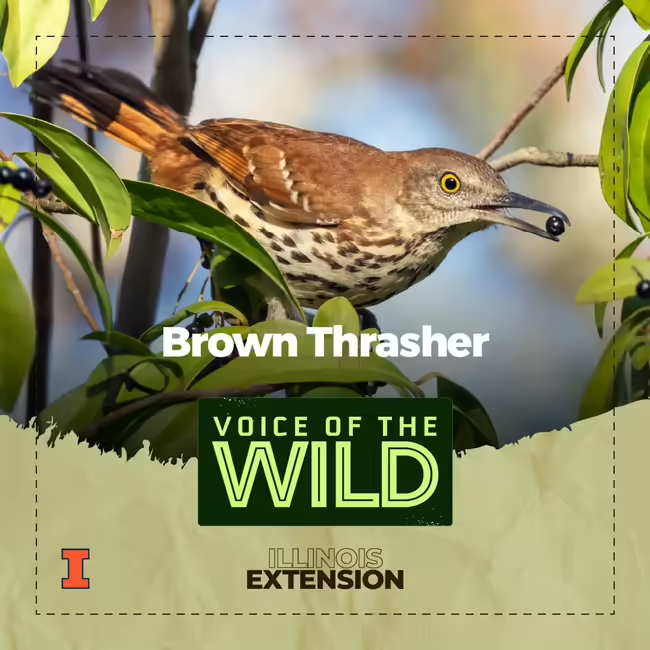
Brown thrasher (Toxostoma rufum).
The mimic that sings in doubles.
Voice of the Wild is a podcast about wildlife and the wild sounds they make.
The following Cornell Lab | Macaulay Library recordings were used in this episode:
- Brown Thrasher song by Wil Hershberger (ML508776)
- Brown Thrasher chack by Wil Hershberger (ML508779)
- Brown Thrasher whistle by Wil Hershberger (ML508780)
- Brown Thrasher hiss by James L. Gulledge (ML508785)
- Gray Catbird song by Wil Hershberger (ML508750)
- Northern Mockingbird song by Wil Hershberger (ML508824)
Sources and more:
- Cornell’s All About Birds
- Audubon
- Field guide to Hotspots and Birds in Illinois by Colin Dobson
- Audubon Videoguide to 505 birds of North America
- Peterson Field Guide to the Birds (Fourth edition)
- Peterson’s Birding by Ear
- Sibley Birds East
Transcript
This is Brodie with Illinois Extension and I’m here with a new “voice of the wild”
A song of borrowed phrases hollered out from the tallest tree in the valley. Once satisfied with their proclamations, the long-tailed singer will retreat deep into the brush, where their thrushlike brown plumage blends them in with last year’s fallen leaves. While most commonly seen foraging in a tangled understory during the growing season a scattered few will also stick around for winter. This is the Brown Thrasher.
Of the three mimids in the Midwest, the thrasher is the most musical. It has neither the harshness of the mockingbird’s song nor the whining character of the catbird. Another way to tell these cousins apart is by count: the catbird sings in singles, the thrasher usually in doubles, and the mockingbird in triples or more. In our next playthrough, also note the thrasher’s harsh “chack” call, which I’ll play first.
Thank you to the Macaulay library at the Cornell lab for today’s sound. Learn more about voice of the wild at go.illinois.edu/VOW
A song of borrowed phrases hollered out from the tallest tree in the valley. Once satisfied with their proclamations, the long-tailed singer will retreat deep into the brush, where their thrushlike brown plumage blends them in with last year’s fallen leaves. While most commonly seen foraging in a tangled understory during the growing season a scattered few will also stick around for winter. This is the Brown Thrasher.
Of the three mimids in the Midwest, the thrasher is the most musical. It has neither the harshness of the mockingbird’s song nor the whining character of the catbird. Another way to tell these cousins apart is by count: the catbird sings in singles, the thrasher usually in doubles, and the mockingbird in triples or more. In our next playthrough, also note the thrasher’s harsh “chack” call, which I’ll play first.
Thank you to the Macaulay library at the Cornell lab for today’s sound. Learn more about voice of the wild at go.illinois.edu/VOW