Episode Number
111
Episode Show Notes / Description
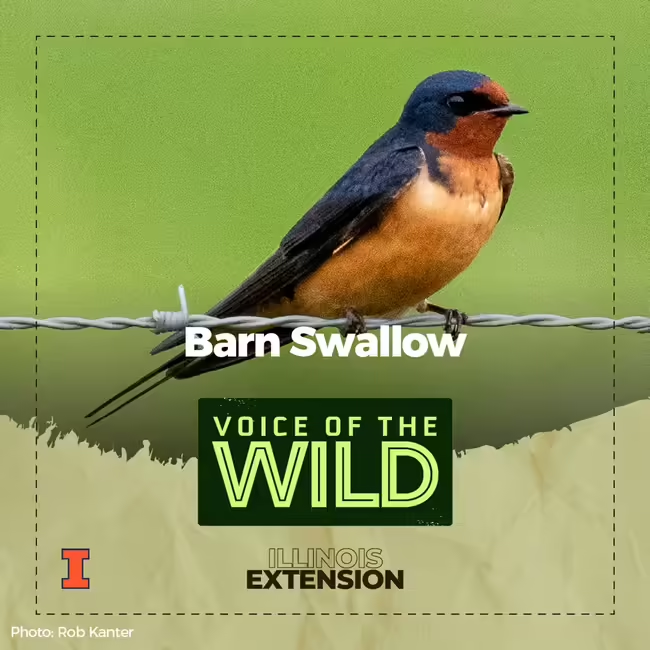
Barn swallow (Hirundo rustica).
The swallow with the true swallow-tail.
Voice of the Wild is a podcast about wildlife and the wild sounds they make.
The following Cornell Lab | Macaulay Library recordings were used in this episode:
- Barn Swallow (American) song 1 by William W. H. Gunn (ML508109)
- Barn Swallow (American) call by Randolph Little and Warren Y. Brockelman (ML508110)
- Barn Swallow (American) song 2 by Geoffrey A. Keller (ML508105)
Sources and more:
- Cornell’s All About Birds
- Audubon
- Field guide to hotspots and birds in Illinois by Colin Dobson
- Audubon videoguide to 505 birds of North America
- Peterson field guide to the birds (Fourth edition)
- Sibley Birds East
Transcript
This is Brodie with Illinois Extension and I’m here with a new “voice of the wild”
You might find this low-flying acrobat hunting over a pond, or taking advantage of all the insects kicked up in the wake of a field implement passing through a field or pasture. Though they were probably never rare in North America, they’ve greatly benefited from the proliferation of our rural infrastructure. Nowadays, no bridge or barn is complete without a few of their little mud nests. This is the barn swallow.
No other swallow in North America has a tail that’s as deeply forked as the barn swallow’s. Despite this, the swallows can be tricky to ID by sight. They fly fast, low, and seemingly always with the sun right behind them. Sound can give you a good hint; and the barn swallow is fairly vocal, seeming almost conversational with themselves and their airborne compatriots. to me their back and forth oscillations, often interspersed with clicking, sound almost like the opening and closing of a good pair of scissors. Here’s the barn swallow again.
Thank you to the Macaulay library at the Cornell lab for today’s sound. Learn more about voice of the wild at go.illinois.edu/VOW
You might find this low-flying acrobat hunting over a pond, or taking advantage of all the insects kicked up in the wake of a field implement passing through a field or pasture. Though they were probably never rare in North America, they’ve greatly benefited from the proliferation of our rural infrastructure. Nowadays, no bridge or barn is complete without a few of their little mud nests. This is the barn swallow.
No other swallow in North America has a tail that’s as deeply forked as the barn swallow’s. Despite this, the swallows can be tricky to ID by sight. They fly fast, low, and seemingly always with the sun right behind them. Sound can give you a good hint; and the barn swallow is fairly vocal, seeming almost conversational with themselves and their airborne compatriots. to me their back and forth oscillations, often interspersed with clicking, sound almost like the opening and closing of a good pair of scissors. Here’s the barn swallow again.
Thank you to the Macaulay library at the Cornell lab for today’s sound. Learn more about voice of the wild at go.illinois.edu/VOW