Episode Number
114
Episode Show Notes / Description
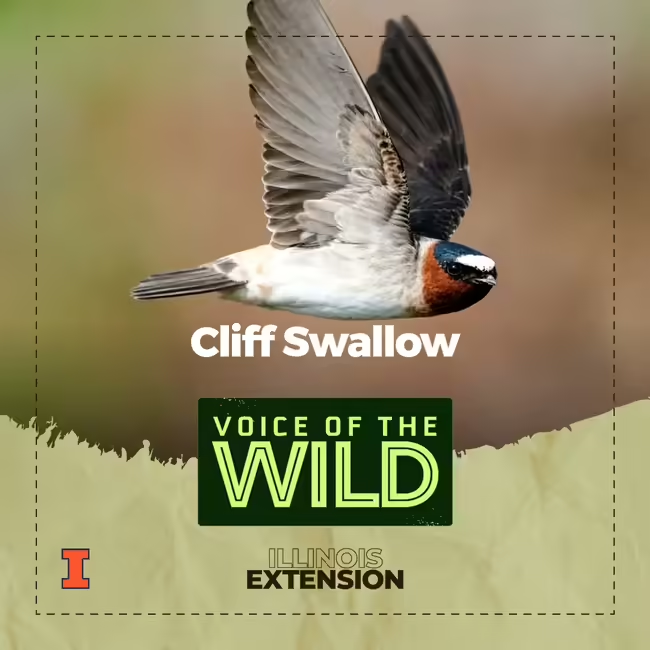
Cliff swallow (Petrochelidon pyrrhonota).
The swallow with a white dot on the head.
Voice of the Wild is a podcast about wildlife and the wild sounds they make.
The following Cornell Lab | Macaulay Library recordings were used in this episode:
- Cliff Swallow call by Thomas G. Sander (ML508112)
- Cliff Swallow call by Thomas G. Sander (ML508115)
Sources and more:
- Cornell’s All About Birds
- Audubon
- Field guide to hotspots and birds in Illinois by Colin Dobson
- Peterson field guide to the birds (Fourth edition)
- Sibley Birds East
Transcript
This is Brodie with Illinois Extension and I’m here with a new “voice of the wild”
A noisy colony of blue-colored swallows swirling to life as you approach the little bridge under which they’ve chosen to live. At first glance they might be mistaken for barn swallows, but their squared tail and white dot on the forehead reveals that they are something else. In the distant past, their range was largely restricted to the west where they could build their gourd-shaped mud nests on the rocky faces of cliffs. This is the cliff swallow.
Though their range has expanded over the decades, the cliff swallow is still relatively rare in Illinois. I’ve found that the best place to find a colony of these lovely acrobats is to drive around seldom-used country roads looking for small bridges that run over field drainage channels. These seem to be magnets for cliff swallow colonies. When you find one, you can try listening for the harsh jumble of creaks and groans they sometimes give, but you’re far more likely to hear them giving their soft “churr” calls, usually as a group. Here’s the cliff swallow again.
Thank you to the Macaulay library at the Cornell lab for today’s sound. Learn more about voice of the wild at go.illinois.edu/VOW
A noisy colony of blue-colored swallows swirling to life as you approach the little bridge under which they’ve chosen to live. At first glance they might be mistaken for barn swallows, but their squared tail and white dot on the forehead reveals that they are something else. In the distant past, their range was largely restricted to the west where they could build their gourd-shaped mud nests on the rocky faces of cliffs. This is the cliff swallow.
Though their range has expanded over the decades, the cliff swallow is still relatively rare in Illinois. I’ve found that the best place to find a colony of these lovely acrobats is to drive around seldom-used country roads looking for small bridges that run over field drainage channels. These seem to be magnets for cliff swallow colonies. When you find one, you can try listening for the harsh jumble of creaks and groans they sometimes give, but you’re far more likely to hear them giving their soft “churr” calls, usually as a group. Here’s the cliff swallow again.
Thank you to the Macaulay library at the Cornell lab for today’s sound. Learn more about voice of the wild at go.illinois.edu/VOW