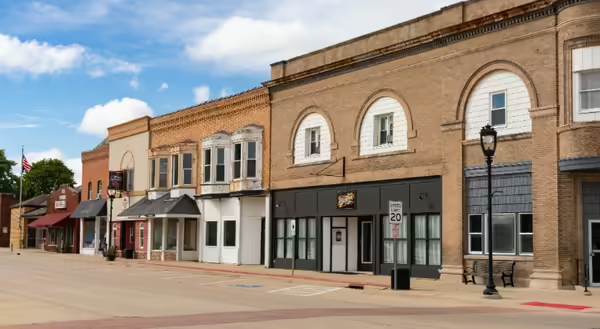
In Henry County, tourism doesn’t belong to a single town. It is something communities are building together.
As part of the Governor’s Rural Affairs Council tourism listening tour, I spent time in and around Cambridge, Galva, and Bishop Hill, three places with distinct identities but a shared approach to thinking about visitors, residents, and regional connection.
What stood out wasn’t a single attraction, event, or project.
It was the way people were working across community lines to build something bigger than any one town could do alone.
Start with identity, not imitation
Each of these communities brings something different to the table.
Bishop Hill is rooted in a deep and preserved cultural history. Cambridge and Galva reflect working communities with evolving downtowns, local institutions, and civic pride. Rather than competing with one another, there is a growing effort to connect those identities through regional storytelling, shared promotion, and partnerships such as Crossroads Cultural Connections.
What is emerging is not a generic destination.
Together, these communities give visitors a reason to slow down, move between towns, and understand the region as more than a stop on the map.
That distinction matters. Rural communities do not gain an advantage by trying to replicate what works somewhere else. They gain it by leaning more fully into what is already theirs.
If it works for residents, it works for visitors
One of the clearest themes across these communities is that tourism is not built solely for visitors. It is built with residents in mind.
Local events, downtown improvements, and community spaces are shaped first around the people who live there. You can see it in horticulture students taking ownership of downtown beautification, in community concert series that feel locally owned rather than simply attended, and in local leaders who seem open to new faces, new ideas, and the question, “Yes, and how can we help make that happen?”
That kind of local ownership changes the visitor experience, too. When a place is cared for by residents and people are invited into the work instead of kept at the edges, visitors can feel the difference.
It feels lived-in, not staged.
It also builds local buy-in. That matters because tourism strategies are more likely to last when residents can see how the work supports the place they already call home.
This same resident-first approach is at the center of Illinois Extension’s Home First tourism curriculum. The idea is simple: if a tourism strategy does not work for the people who live in a place, it is unlikely to work well for visitors in the long term.
Collaboration is infrastructure
In many rural areas, limited capacity can be a constraint. In Henry County, collaboration is how that constraint is addressed.
Local leaders, organizations, and community partners are sharing ideas, coordinating events, cross-promoting experiences, and maintaining ongoing conversations about what is working and what is not.
Some of this coordination is formal. Much of it is informal, built on relationships and trust.
In rural communities, relationships are infrastructure. They are often what make the rest of the work possible. Without them, even strong individual assets can struggle to gain traction. With them, smaller efforts start to compound.
Growth brings real tradeoffs
This work is not without tension.
Like many rural communities across Illinois and the country, leaders are navigating the balance between tourism growth and local needs, questions about short-term rentals, and the challenge of maintaining local identity while attracting outside interest.
These are not signs of failure. They are signs that something is changing.
The difference is whether communities address these issues early or wait until they become harder to manage. The most effective approach is proactive: talk about the challenges, name the trade-offs, and build shared understanding before small issues become bigger ones.
A regional model worth paying attention to
What is happening in Cambridge, Galva, and Bishop Hill is not flashy.
There is no single headline-grabbing project.
Instead, there is steady, collaborative work focused on strengthening local identity, supporting small businesses, creating place-rooted experiences, and building connections across communities.
It is a quieter model of tourism development, but a more durable one.
It is not built on attracting attention alone. It is built on relationships.
What this means moving forward
As rural communities across Illinois consider tourism, there is often a tendency to look outward for answers.
But in Henry County, the lesson is simpler:
- Start where you are.
- Work with who you have.
- Build outward from there, together.
No small town has to do this alone. In fact, it’s almost impossible.
Continue the conversation
If your community is exploring how tourism can support local development, Illinois Extension can help. Extension’s Home First tourism curriculum helps communities start with what matters most: residents, identity, and long-term sustainability, and build a visitor approach from there.
To learn more or to bring this work to your community, contact Katie Dudley, regional community and economic development specialist with University of Illinois Extension, at kdudley@illinois.edu.
About the Author
Dr. Katie Dudley is an Extension Community and Economic Development Specialist who leads regional and statewide initiatives focused on rural tourism, outdoor recreation economies, and community resilience. Originally from Carrollton, Illinois, Dudley holds a PhD in Parks, Recreation, and Tourism Management from Clemson University. Her work focuses on developing and managing thriving communities, ecosystems, and tourism systems that support both residents and visitors. Her work helps rural communities design strategies that strengthen local ownership, workforce pathways, and long-term economic and civic capacity.