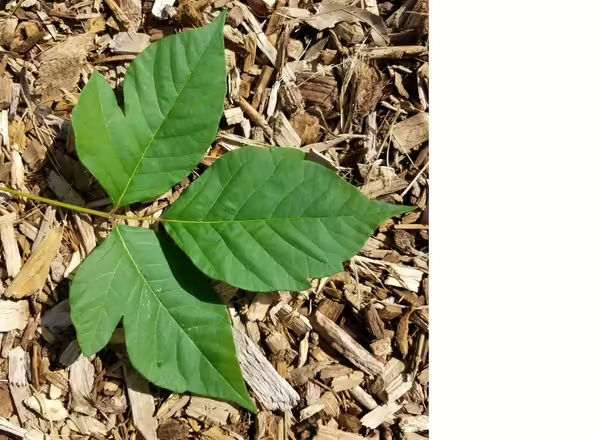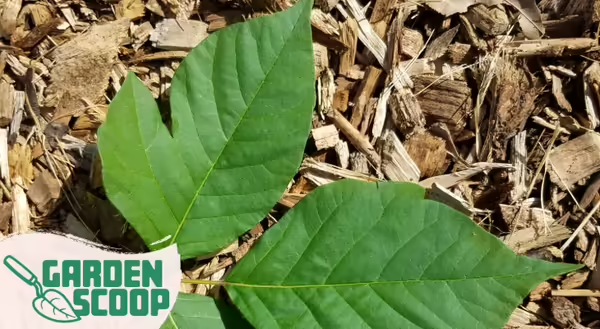
Among the plants that grow in the Illinois landscape, poison ivy (Toxicodendron radicans) is perhaps the most notorious. This plant is certainly well known by name among most gardeners, nature goers and outdoor folks, but many are unable to identify it correctly in the field. The result of misidentification and subsequent exposure to the resinous oil produced by this plant, called urushiol, can cause anything from an itchy rash to a severe allergic reaction.
For many who have severe reactions to poison ivy, the identification of this plant has been forced upon them for fear of another emergency room visit. For me, this is one of the first plants I can remember identifying down to species. As early as Cub Scouts, I remember learning the mantra, “Leaves of three, let it be.” It took some time before I could relate the handy phrase to the plant physiology it refers to, but it is a useful mnemonic, although a bit inaccurate.
Where does it grow?
Poison ivy grows in a variety of forms, from a small shrub of varying heights (up to 3 or 4 ft.) to a climbing vine. It readily spreads by roots and typically exists as a patch in partly shaded woodlands and woodland edges. While it prefers some shade, it's perfectly happy to grow in full sun as well and can be found in nearly any natural habitat except areas with significant flooding.
In the home landscape, it can pop anywhere that isn't regularly mowed, often occurring as a single plant or a few sparse plants that may eventually grow into a patch if left long enough. I often find it as a single, tiny seedling in the mulch between plants in a landscape bed, which can be a tricky size of plant to pick out from other common weeds.
Poison ivy is quite prevalent as a vine, in both the natural and built environment. It is very easy to overlook a single stem as it slowly creeps up a tree trunk but beware of this form of the plant. The woody stems of poison ivy contain higher levels of urushiol when compared to leaves, making it especially important to catch these sneaky stems quickly.
Across the state of Illinois, poison ivy is known to occur in every county. Amazingly, this adaptable plant occurs in 48 U.S. states, with the only exceptions being Hawaii and Alaska. Given its wide distribution, it really pays to learn the identification of this plant!
Identification
Poison ivy doesn’t technically have “leaves of three” as the phrase implies. Instead, each poison ivy leaf is a compound leaf containing 3 leaflets. This may seem like an arbitrary point to some, but to a true botanist, it is a very important detail. The key identification feature of this plant is the grouping of 3 leaflets per leaf. While growth habit may vary from a single plant to a shrub-like patch or vine, the leaf characteristics across these various shapes and sizes are consistent.
The leaf margins of poison ivy are mostly entire, meaning they lack any kind of toothed or jagged edge. However, poison ivy will develop an irregular toothed pattern along the leaf margin, but the teeth are large and blunt, and do not have sharp points like other species. This can be another very key identification feature and many refer to poison ivy leaves with a single tooth on one side as a “mitten” shape. Teeth may appear on both edges of the leaf but most commonly occur on a single side.
Although not every poison ivy plant has the mitten-shaped leaves, you can always find several in a patch that do. This identification feature is what really stuck out to me over the years. By looking for it over and over again, I became much more familiar with poison ivy leaves, leading me to be able to identify the leaves by color (often a lighter green) and shape because I spent so much time looking for the “mittens”.
Twigs are a distinctive reddish to orangish-brown color that differs from much of our other native vegetation. At the end of each twig is a naked bud, meaning the bud lacks bud scales. This type of bud is also fairly uncommon among other plants that grow around poison ivy in Illinois. Winter identification can be tricky in the absence of leaves, relying entirely on twigs and buds, but I’ve become quite proficient at picking out the orangish-brown twigs from other vegetation through repeated observation. Practice does make perfect!
Poison ivy lookalikes
There are a number of plants that can very easily be confused with poison ivy. Among them, seedlings of the box elder tree (Acer negundo) bear a striking resemblance to small sprigs of poison ivy, causing me to look twice sometimes. The main difference between box elder and poison ivy is that box elder has an opposite leaf arrangement (meaning leaves are arranged on the stem directly across from each other) while poison ivy has an alternate leaf arrangement (leaves that do not connect to the stem across from each other).
Poison ivy is technically not an ivy or poisonous, but rather a member of the cashew family (Anacardiaceae), making it a close relative to sumac species native to Illinois. Consequently, our native fragrant sumac (Rhus aromatica) bears a striking resemblance. However, this plant is absent in central Illinois, confined to northern, western, and southern portions of the state. There are a number of herbaceous plants that have some kind of “3-leafed” arrangement, but can easily be differentiated from poison ivy by their lack of a woody stem.
Our native blackberry (Rubus allegheniensis) is second only to box elder in its similarity to poison ivy. Common blackberry has thorns, which are a key differentiation, although its alternate leaves are another clue. These compound leaves consist of three leaflets, but the leaf veins are more deeply incised into the leaves than poison ivy, and the leaf margin is jaggedly toothed.
If you have mysteriously developed the itchy rash associated with urushiol in the past, it may be worth practicing your field identification to better avoid poison ivy. However, the sage advice to avoid anything that resembles “leaves of 3” may be easiest to follow.