Every growing season brings a few plant issues that stand out and prompt attention from inquiring plant people. Whether it is something environmental, such as last year's extreme drought, or a rising pest or disease, there are sure to be folks asking questions and wondering about next steps.
Why does my honeylocust look terrible?
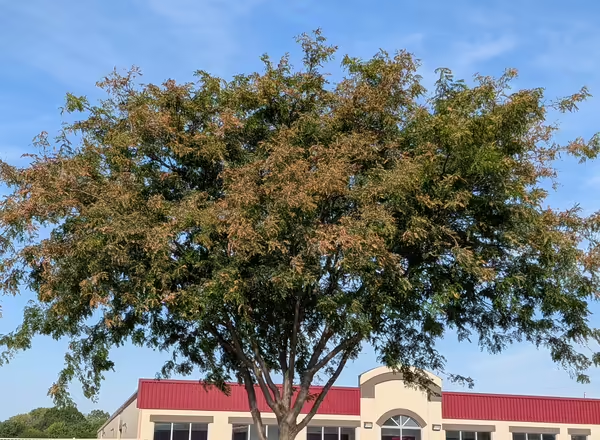
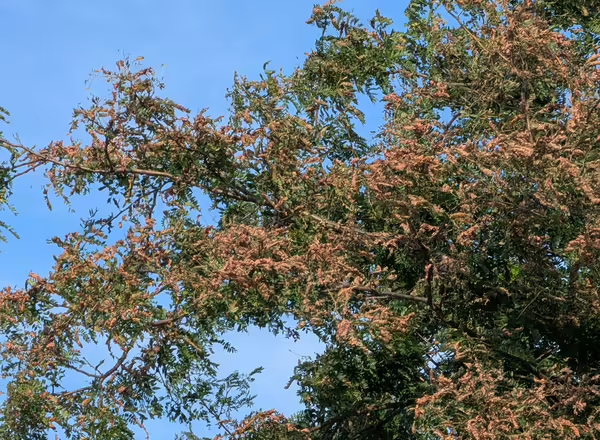
This year, honeylocust (Gleditsia tricanthose) trees are simultaneously looking terrible across central Illinois. Damage is centered on urban trees, but I am seeing some plants in more rural locations showing signs. I’ve been following this all summer and it is becoming increasingly difficult to find a single tree not showing some kind of damage around Champaign-Urbana.
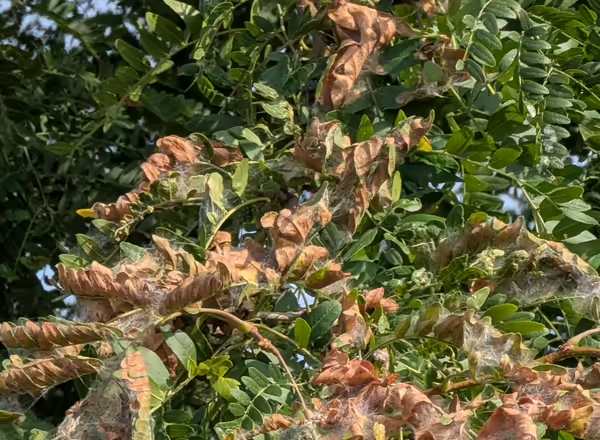
The culprit behind these sickly-looking trees is a tiny moth caterpillar that can be surprisingly difficult to find despite the widespread mark it has left on our urban forests. However, close inspection of the browning tips on a low-hanging honeylocust branch will reveal a telltale web encasing damaged leaves. Inside that web is a mixture of dead or dying leaves, insect frass and the tiny, wiggling caterpillars of mimosa webworm (Homadaula anisocentra).
First detection and spread
This non-native pest was first noted in the early 1940’s with a 1943 scientific paper documenting an initial encounter in the District of Columbia and nearby areas of Maryland. It was described as a pest on its namesake plant, the non-native mimosas tree (Albizia julibrissin), but a soon-to-be-published paper (1947) would document its shift to our native host, the honeylocust.
With this leap to honeylocust and the tree’s ever-expanding popularity in urban areas throughout the 20th century, mimosa webworm had a highway for spread across the country. Currently, its primary range is centered on more southern states, with sparser distribution further north due to the moth’s lack of cold tolerance. However, in recent years, populations throughout the Midwest are on the rise.
Mimosa webworm in Illinois
In Illinois, mimosa webworm typically has two generations each growing season, with initial emergence around mid-May here in Central Illinois. Mimosa webworms overwinter as pupae in the soil, so the first insects to emerge in spring are the adult moths who quickly begin laying eggs. Caterpillar feeding becomes evident about a month or so after emergence, showing up as small webs in mid- to late-June.
The first generation of the season is sometimes unnoticed since webs remain small and the damage is less noticeable. However, the webs these caterpillars spin for protection also contain a chemical attractant that draws in egg-laying female moths.
As the second generation of mimosa webworms start to feed heavily and spin webs, the ensuing damage is much more noticeable. This population is always much larger than the first generation and, since they are using and expanding the same webs, they tend to amplify the presence of this pest. Feeding continues until this final generation drops to the soil to pupate and overwinter, sometime in late September.
At this point in the season, the lifecycle of mimosa webworm is wrapping up and honeylocust trees are looking their worst. However, the damage from this voracious caterpillar is typically not life-threatening for a healthy honeylocust. Damage is confined to leaf structures only and a healthy tree will easily produce a full canopy of new leaves next year.
Identification and treatment
To identify mimosa webworm damage, look closely at infected limbs to find the silky webs filled with dead leaves and frass. If you cannot find webs, your tree may be suffering from drought damage or other environmental stresses that look very similar, minus the web material.
Populations of mimosa webworms are cyclical, with up to 9 species of predatory wasps and lots of native birds keeping this pest in check. So, control measures are rarely recommended on mature, healthy trees.
Newly planted trees and older or stressed trees can require protection if exposed to multiple years of high populations and extensive feeding. If you are concerned about mimosa webworm damage on a vulnerable tree, contact a certified arborist or another landscape professional for control options.
References
Bastian, RA and ER Hart. 1990. Honeylocust clonal effects on developmental biology of mimosa webworm. Journal of Economic Entomology. 83(2), 533-538.
Clarke, J and JF Gates. 1943. A new pest of Albizzia in the District of Columbia (Lepidoptera: Glyphipterygidae). Proceedings of the United States National Museum. 93, 205-208.
Hart, ER et al. 1986. Tree location and winter temperature influence on mimosa webworm populations in a northern urban environment. Arboriculture and Urban Forestry. 12(10), 237-240.
Wester, HV and I Shiller. 1947. Life history and control of the webworm, Homadaula albizziae. Journal of Economic Entomology. 40(4), 546-553.
Ryan Pankau is a University of Illinois Extension Horticulture Educator serving Champaign, Ford, Iroquois, and Vermilion Counties.