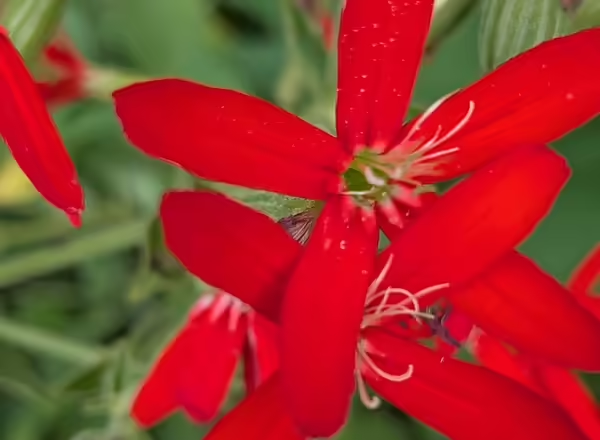
Royal catchfly (Silene regia) is one of the few Illinois native plants that sports a red bloom, making it a sought-after plant both out in natural areas and in the garden. This eye-catching plant is currently in full bloom across central Illinois, attracting butterflies and wooing gardens alike.
Where it grows
In nature, royal catchfly is a rare plant, with state-endangered status due to severe habitat loss over the years. Natural populations are absent throughout most of the state, but do occur in a small handful of northeastern and southern counties. It prefers habitats with rocky, well-drained soil in prairies, barrens, savannahs and more open woodlands, all of which have historically been heavily impacted in Illinois.
Growing royal catchfly in the garden
Interestingly, this plant does surprisingly well in garden settings, which has set it up for somewhat of a comeback in the built environment. I’m starting to see its brilliant crimson red flowers in more and more garden spaces these days. In the garden, it tolerates part shade but does best in full sun, where it will develop a more abundant cluster of flowers.
It prefers good drainage and actually thrives in sandy or gravelly soils with low nutrient levels, so it can do well in poor site conditions once established. However, it does just fine in typical Illinois garden soils if the location drains well. Consider placing it on a small berm or slightly raised area of the garden if drainage is a concern.
Royal catchfly is a clump-forming, slender plant reaching 3 to 4 feet in height. It is easily intermixed with other plants given its slender profile, or works nicely as a solid grouping. I’ve not found it to be aggressive at all. Instead, it seems to be easily overtaken by more vigorous plant neighbors, making it important to consider plant composition around it.
Pollinators
While this flower may easily catch the human eye, not all pollinators can see the color red, leaving this star-shaped flower to those that can. Bees and flies are often the most productive pollinators in most ecosystems, and they cannot see red; instead, they see ultraviolet in their range of vision. However, butterflies and moths can see the color red and regularly seek out red-colored flowers.
Hummingbirds are also considered pollinators and are very attracted to the color red. Think of all the hummingbird feeders you see that are red in color! Since royal catchfly flowers are also tube-shaped, they make a spectacular hummingbird food source. In addition, hummingbirds are very effective pollinators for this plant, carrying pollen across the sparse remaining populations. Since this plant’s flowers cannot self-pollinate, pollinators are important for seed production in natural areas.
Why do they call it “catchfly”?
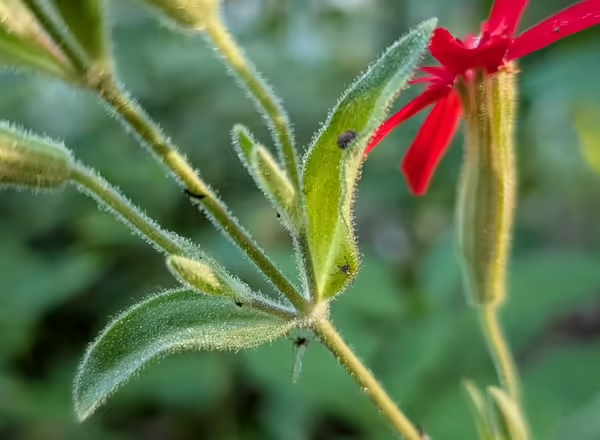
The “catchfly” part of this plant’s name implies a more sinister side of its insect relationship. Sticky hairs often line the upper stems and calyx (green, vase-shaped structure at the base of the flowers) of this plant, capturing smaller insects that encounter the gluey traps. This is a common trait of carnivorous plants, such as honeydews, which catch, retain and digest insects to gain nutrients. In the case of royal catchfly, the plant does not gain any nutrients from trapped insects. The sticky hairs are believed to be a defense mechanism from insects that may visit the plant but do not benefit its reproduction.
For example, smaller insects may crawl up the stem in search of nectar, but since they are not effective pollinators, it doesn’t benefit the plant to share. Other pollinators, known as “robbers”, lack a tongue long enough to reach nectar and must destructively chew their way into the flower. This damage may result in little or no seed production. The sticky hairs are thought to be a deterrent to this activity as well.
Some may call this plant a pollinator trap since it catches and kills insects on its stems. I’m not sure where I fall on this. Is it a problem, or is it an interesting rarity in nature to observe? I can think of other common garden plants with similar, small insect-trapping attributes (think of petunia leaves). In my own garden, I’ve limited royal catchfly to a few small plantings out of caution, but I do really enjoy observing its brilliant red blooms this time of year. Perhaps it means well, even if it has an evil side?
About the Author
Ryan Pankau is a University of Illinois Extension Horticulture Educator serving Champaign, Ford, Iroquois, and Vermilion Counties.