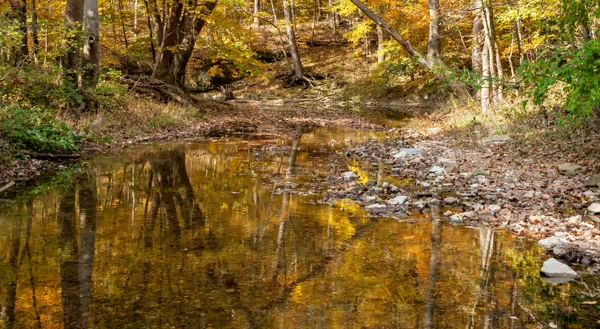
It was a hot September day. A yellow school bus plodded away, leaving a cloud of dust in its wake. Songbirds sang as the leaves rustled, patiently holding on until autumn called them from their perches. The forest was still, as the crunch of leaves beneath the footfalls of squirrels hopscotching about echoed across the hillside.
A flash of movement and a thunderous sound broke the doldrums of that hot day as a young boy, freed of his cumbersome backpack, careened down the slope with three canine companions. I was this boy. I knew the path well. My feet were sure of every step, and my head was aware of every branch. I shot down the steep wooded hillside like lightning, with little thought for the hazards that now plague my adult mind. I would glide to the bottom of the bluff to my destination, Mill Creek.
Much of my childhood was spent roaming the woods and engineering stone bridges over the creek. The rocks and logs that littered the beaches made for endless scavenging. My rock collection grew, with stashes hidden behind trees on the bank, out of reach of flash floods.
As humans do, I became acutely aware of the patterns in my natural surroundings. Seasonal changes prompted a new landscape for exploration. Dutchman's breeches and Virginia bluebells of spring gave way to mayapples and trilliums. Running through a grove of scouring rush made it hiss like the sizzle of bacon dropped in a hot pan. Winter meant frozen water and easy hiking. Often, a frozen creek led me farther upstream or downstream than time would ever allow me to dare during the summer.
It was the flood of 1993 that first jarred my perception of nature’s rhythm.
During the Great Flood of 1993, my beloved creek transformed into a swollen monster. My parents forbade me to venture into the woods for fear of high floodwaters and landslides on our steep bluff. After the waters had subsided, I ventured into a very different forest.
Most of the sandy beaches were gone. The sand was swept up and deposited atop the creek banks in the floodplain. Most of my rock collections were also gone or buried. And my materials for bridge construction were now large fallen trees or boulders that my wiry arms did not have the strength to move.
The composition of plant material had changed. Most of the herbaceous understory drowned or was choked out by the water and sand. My recurring morel mushroom spot never yielded after that summer. It took several years for the beaches to return, though they were different now. Some reappeared downstream, while others transformed almost entirely to rock.
Another disruption soon followed the flood. The adjacent landowner felled trees on the opposite bank and pushed the boundary of their cropland to the bank’s edge. Black drainage tile now discharged continuously from the streambank. It didn’t take long for the creek to respond by eroding and caving in its edges. Heavy equipment was brought out to rebuild and shore up the creek banks with rock and timber from cut trees. The natural bank on my family's side of the creek stood in stark contrast to the wall of white rock on the neighbors' streambank.
Nearby parcels of land were sold and developed. Four-wheeler tracks appeared in the woods and in the creek bed. Trash accumulated in eddies, and an almost constant oil slick snaked through the water’s current.
The forest changed, too. Bush honeysuckle crept in, and the oak and hickory appeared to weaken in my eyes. Erosion began to run rampant on our hillsides. In the span of a little over a decade, the forest and creek had changed, and I was there to witness it.
As we busy ourselves in the garden and landscape, we may be reminded of our time spent as a child exploring the outdoors. I didn’t realize it then, but now I know that spending time outdoors established my roots in conservation and laid the foundation for my career choices. It is a sharp reminder of how important it is that we get our youth outside. Ask any professional who makes a living outdoors, and most can recall a fondness for a particular landscape, relative, or teacher who showed them something fascinating about our living world.
After drafting this article, I will begin preparing for McDonough County’s Conservation Day, a time when local 5th graders get to explore the outdoors. It is truly my fortune to speak with our youth, share something fascinating, and see the spark in their eyes as voices echo “Wow,” “Cool,” or “Eww!” And maybe, just maybe, some of those kids will find their profession in the great outdoors, building our knowledge in the realm of living things and stewarding us toward the future.
Good Growing Fact of the Week: Nature is good for our brains. That may seem obvious, but science has reinforced our instinct. Youth exposed to nature perform better on cognitive tests and have lower stress levels. These effects and many others have been studied at the University of Illinois for decades.