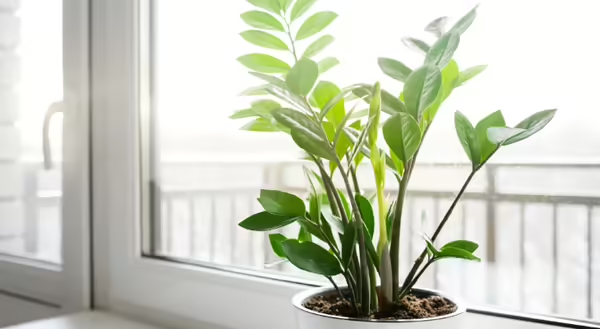
During these dormant months, my houseplants are receiving more of my attention than they usually get (which is usually very little). While watering and rotating my collection, I noticed new growth on my ZZ plant, and I couldn’t help but celebrate this small victory with all of you.
This plant was given to me a few years ago as a memorial, so I am especially attached to this specimen. When I received the gift, I had never been the caretaker of a ZZ plant before, but I understood them to be relatively easy plants to care for and forgiving. I did research on how to care for the plant (lighting requirements, watering preferences, pest and disease challenges, etc.) and confirmed that the low-maintenance approach I typically take to houseplants would be suitable for the new addition.
For the past few years, my ZZ plant and I have been getting along well; the plant has had no significant changes in overall health…until the recent growth spurt…so let’s explore this common household plant.
ZZ Plant
Zamioculcus zamiifolia, also known as ZZ plant, originates from East Africa and is a member of the Araceae family. This family includes plants familiar to the horticulture industry, such as peace lilies (Spathiphyllum spp), monsteras (Monstera spp), calla lilies (Zantedeschia spp), and jack-in-the-pulpit (Arisaema triphyllum). Members of the Araceae family, also known as the Arum family, are characterized by a unique flower form called a spadix, which is often partially enclosed by a leaf-like bract or spathe.
Its native range throughout East Africa is characterized by a climate pattern of alternating periods of heavy rainfall and prolonged drought. In response to these climate patterns, the species has a rhizomatous root system that is capable of storing water and nutrients. Leaves are thick and waxy to minimize water loss through transpiration, and plant growth is slow due to nutrient-poor soils. With time, ZZ plants are capable of reaching up to four feet in height and an equal spread.
Although easy to care for, ZZ plants are still susceptible to common houseplant pests. Be sure to regularly check ZZ plants for signs of pests such as aphids, mealy bugs, thrips, and whiteflies. If a pest is present, take action to control the infestation.
As A Houseplant
As a houseplant, the ZZ plant is relatively easy to care for. It tolerates low levels of light but thrives in areas of bright, indirect light, is forgiving of an infrequent watering schedule, and adapts to variable humidity levels. Grow the plant in a medium that is well-drained, water routinely while allowing the soil to dry between each watering. ZZ plant can be grown in a similar manner to cacti and other succulents. It is intolerant of sustained soil moisture.
Provide a light supply of balanced fertilizer once or twice a month at the time of watering during the spring and summer months. Reduce watering to once a month during the fall and winter months.
Propagation
Plant propagation can be done in one of two ways. Division is the most common and fastest way to create more ZZ plants. Leaf cuttings take more time but can produce many more offspring.
Division: Carefully remove the plant from the original pot and gently loosen the soil from the root ball. Once the roots and rhizomes have been exposed, select a section that is healthy with at least one attached stem. Carefully separate the roots from the main plant using your hands or a clean, sharp tool if needed. Maintain an adequate number of roots on the new plant segment to sustain itself once replanted. Place the division into a pot filled with well-draining soil and water lightly. Position the new plant in bright, indirect light and monitor while it becomes established.
Leaf cuttings: Select a healthy stalk of the ZZ plant and remove it at the base using a clean, sharp pair of snips. Cut each leaf from the stalk, keeping the petiole intact. Allow the cutting to callus for a few days to reduce the risk of rot. Once the cut end is dry, insert it into a clean, sterile potting medium approximately one-half inch into the moistened soil medium, or in a shallow container of water. Place the cutting in a location with bright, indirect light. Cuttings will do best when air temperatures are kept near 80 degrees F and relatively high humidity. Monitor the cuttings over the following few months, keeping the soil medium moist or water fresh. Roots will emerge first, followed by the development of a small rhizome at the cutting location. If rooting in water, transplant cuttings into a soil medium once roots and a rhizome have developed.
Good Growing Fact of the Week: A study from the University of Michigan considered the best methods of propagation by cutting and found that apical leaf cuttings produced the most new rhizomes when compared to other leaf cutting methods. It also found that a stem cutting that lacked an attached leaf did not callus or develop roots.
Bonus Good Growing Fact of the Week: Recent varieties have been introduced to the market with unique foliage colors. Varieties of ZZ plant are now available with dark purple or almost black foliage, chartreuse leaves with variegation, and bright yellow leaves that deepen to green with time. Some varieties have more rounded leaf shapes or a more compact growth habit, too.
Thank You for Reading!
Sign up for our emails! Want to get notified when new Good Growing posts are available? SIGN ME UP
Give us feedback! How helpful was this information (click one): Very helpful | Somewhat helpful | Not very helpful
MEET THE AUTHOR
Emily Swihart is a horticulture educator with University of Illinois Extension, serving Henry, Mercer, Rock Island, and Stark counties since 2021. Emily provides horticulture programming with an emphasis on the home gardener, the urban forest, native plant ecosystems, and landscape design. Additional responsibilities include supporting local county Master Gardener and Master Naturalist volunteers - providing training, continuing education, advanced training, and their involvement in seasonal events and community outreach programs.