Exploding trees made quite a few headlines this past week when winter temperatures dropped across much of the country. While the claim of trees exploding certainly grabs attention, it is a little exaggerated. So, what was behind the frenzy? Is there some truth to the concern?
The reality behind these dramatic headlines is a process known as frost cracking. While a sharp crack may be heard in the woods on a silent night, the tree explosion is not the catastrophic fire-filled explosions of an action movie…although the plot line of what leads up to the big event is captivating.
Frost Cracking
During winter, trees face a variety of environmental stresses. Frost cracking, also called frost splitting or sunscald-related cracking, is a dramatic ailment that can lead to long-term health challenges for a tree.
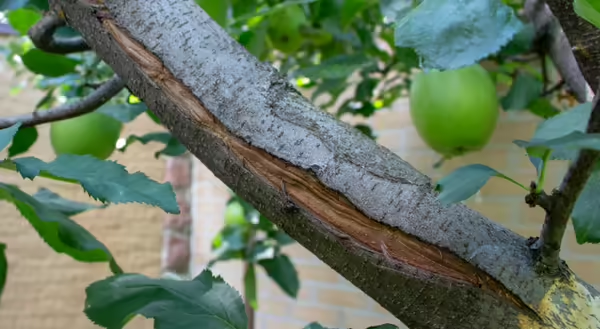
Frost cracks appear as vertical splits in the trunk of a tree and are the result of plant tissue expansion and contraction following winter temperature fluctuations. During winter days, sunlight warms the bark and outer layers of tree trunks, especially on the southern side of a tree. When night falls, temperatures can drop quickly, causing the warmed tissue to cool and contract. If the contraction of outer layers happens faster than inner layers, resistance can cause stress that may exceed the strength of the wood fibers, resulting in a split. The release of built-up pressure can sometimes create a loud sound that has been described as resembling a gunshot.
The severity of the damage caused by frost cracking can vary. Frost cracking is a challenge to trees because it is a wound that breaks the protective seal of the bark, opening the interior up to moisture, fungi, bacteria, and insects, thereby increasing the risk of decline. If a tree suffers from small, infrequent cracking, it can survive and seal the split over time. When repeated cracking occurs at the same site, the prolonged exposure and severity of the damage can weaken the tree structurally, resulting in increased susceptibility to breakage. Even if trees survive, frost cracks can leave scars on the surface that affect the structural integrity of the bark and the appearance of the tree.
Species Susceptibility
Some trees are more susceptible to frost cracking than others. Thin-barked trees are especially vulnerable because the thin bark provides less insulation against temperature fluctuations than thicker bark does. Thin-barked species common throughout Illinois include maples (Acer spp.), beech (Fagus spp.), linden (Tilia spp.), honey-locust (Gleditsia spp.), willow (Salix spp.), and fruit trees such as apple (Malus spp.), cherry (Prunus spp.), and pear (Pyrus spp.). Regardless of the species, young trees are more susceptible because their bark is also thinner.
How to Help
Actions can be taken to help minimize the risk of developing frost cracks in landscape trees.
Keep tree trunks healthy and wound-free. During the growing season, be sure to avoid wounding the trunk with mowers, string trimmers, or improper pruning. If trunk damage does occur, do not apply a wound treatment such as paint or tar. These treatments interfere with the tree’s natural response processes, like compartmentalization or formation of callus tissue.
Protect tree trunks during the winter with a white tree wrap. The white color helps reflect sunlight, reducing temperature fluctuations in bark. Apply the wrap in the autumn, before temperatures freeze, and remove the wrap in the spring once nighttime temperatures remain above freezing. Prioritize wrapping young trees; older trees have developed a thicker bark that is more resistant to temperature fluctuations and cracking.
- Hydrate trees prior to winter. Trees that enter winter under moisture stress are more vulnerable to winter injury. Trees continue to absorb and store water in the fall until the soil freezes. Throughout the winter, stored moisture supports cellular function and response to temperature fluctuations.
Good Growing Fact of the Week: Sunscald is another form of winter injury that affects tree bark and can lead to frost cracking. Sunscald occurs when the sun warms bark, bringing it out of dormancy. When temperatures cool, cells within the bark can rupture. Sunscald appears as elongated, sunken, or discolored patches of bark, typically on the south or southwest side of a tree.
Thank You for Reading!
Sign up for our emails! Want to get notified when new Good Growing posts are available? SIGN ME UP
Give us feedback! How helpful was this information (click one): Very helpful | Somewhat helpful | Not very helpful
MEET THE AUTHOR
Emily Swihart is a horticulture educator with University of Illinois Extension, serving Henry, Mercer, Rock Island, and Stark counties since 2021. Emily provides horticulture programming with an emphasis on the home gardener, the urban forest, native plant ecosystems, and landscape design. Additional responsibilities include supporting local county Master Gardener and Master Naturalist volunteers - providing training, continuing education, advanced training, and their involvement in seasonal events and community outreach programs.