Grow what you eat
I often suggest that the best things to grow in your garden are fruits and vegetables we enjoy eating. Sometimes, though, our gardens may exceed our appetites. After growing fifteen kale plants, my family determined that we could probably live off two. And ten cherry tomato bushes were nine too many. One vegetable my family enjoys regularly is the sweet potato. Baked, boiled, or fried, sweet potatoes are used more often than white potatoes in my home, making them a good candidate for my garden. Let’s examine what it takes to grow sweet potatoes in our central Illinois climate.
What is a sweet potato?
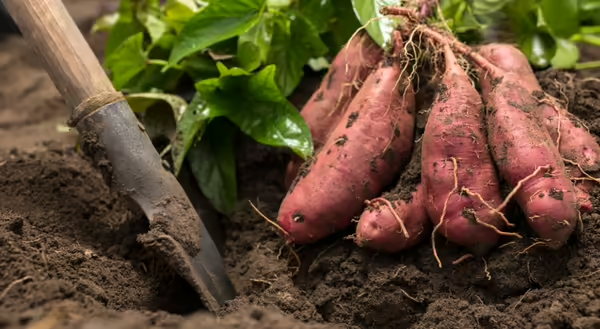
Sweet potato (Ipomoea batatas) is a tender vegetable native to Central and South America that requires a long, frost-free growing season to mature. Sweet potatoes are not true potatoes. What is harvested from the sweet potato is a modified root called a tuberous root, as opposed to a white potato, which is a modified stem called a tuber.
Selecting sweet potatoes
Sweet potatoes have many different varieties. 'Beauregard' does well in the northern parts of the US and is the only one I’ve grown. Here are some selections to investigate for your garden:
- Beauregard (100 days to harvest, light purple skin, dark orange flesh, extremely high yielding from Louisiana State University)
- Bush Porto Rico (110 days, compact vines, copper skin, orange flesh, heavy yield)
- Centennial (100 days; orange skin, flesh; good keeper; resistant to internal cork, wilt)
- Georgia Jet (100 days, red skin, orange flesh, somewhat cold-tolerant)
- Jewell (100 days, orange flesh, good yield, excellent keeper)
- Sumor (ivory to very light-yellow flesh, may be substituted for Irish potatoes in very warm regions)
- Vardaman (110 days, golden skin, orange flesh, compact bush type, young foliage purple)
Growing sweet potatoes
Slips
Early spring is the time to start sweet potato “slips.” Slips can be started by taking a disease-free, fully grown sweet potato from last year’s crop or the supermarket, burying the bottom three-quarters in moist sand. Soon, the sweet potato will sprout slips, which are green shoots with exposed roots. Carefully remove the slips and plant them in the garden once all danger of frost has passed. If you don’t feel like starting your own slips, you can order them from a reputable seed company.
Planting
Plant slips in the garden in a mound of loose, loamy soil that reaches eight inches high. Give sweet potatoes plenty of room, as these vining plants prefer to spread. At a minimum, space sweet potatoes 12 inches apart and three feet between rows.
Care during the season
Little care is required once the sweet potato vines establish themselves. It can take a few weeks for the plants to establish. During this time, keep on top of weeds sprouting in the garden bed. After establishment, the vines will take off in growth and ultimately cover the exposed soil in the garden bed. Where leaf nodes touch the ground, the plant sends out roots that can eventually yield more sweet potatoes. Much of my summer maintenance is redirecting sweet potato vines out of walking paths and back into the growing bed.
Ensure even irrigation; however, don’t keep the root zone constantly wet. Do not water during the last four weeks before harvest to protect the developing roots from splitting.
The biggest issue for my sweet potatoes is rodents. Voles and other small critters enjoy the taste of sweet potatoes as much as me. The best option I found is planting in containers, which provides an effective physical exclusion from these pests.
Harvest and storage
Ideally, wait until after the first frost to harvest sweet potatoes—this concentrates the sugars in the roots. Once frost hits, harvest immediately to keep any decay from spreading from aboveground to belowground. If a long stretch of freezing weather is forecast, it would be wise to harvest.
Sweet potatoes you buy at the grocery store are graded by size. When harvesting at home, you’ll notice that some of the tuberous roots are very large. In my garden, it’s common to have one large sweet potato per plant, along with several smaller ones. Commercially, these massive roots are sent to factories to be processed into products such as sweet potato fries. The medium-sized roots make their way to grocery store produce aisles. You’ll undoubtedly get some smaller sweet potatoes. I call these “fingerling” sweet potatoes, and they taste just as good as the big ones.
Cure sweet potato roots by allowing them to dry on the ground for two to three hours, then place them in a warm room for 10 to 14 days at 85°F and 85% relative humidity. To keep humidity high, wrap individual sweet potatoes in perforated plastic bags or newspaper. Cover the sweet potatoes with a plastic sheet or cloth. After curing, store in a cool (55°F), dry location. Basements work well. Properly cured sweet potatoes should keep throughout the winter.
Cooking sweet potatoes
My favorite way to prepare sweet potatoes is to bake them in a 375°F oven for 45 minutes to an hour (depending on the size). Place your sweet potato in a cast-iron skillet to keep the drippings from making a mess in your oven. After baking, I cut open the potato, sprinkle a pinch of salt, and add just a drop of honey to bring out the sweet flavor.
Additional recipes and nutritional information for sweet potatoes.
Sweet potatoes vs. yams
Oh, and just so we can clear this up, sweet potato is not related to the yam, though in the marketplace the two names are often used interchangeably. The true yam, Dioscorea sp., is an entirely separate species that grows only in the tropics. Ken Johnson dives into this topic to help you settle any botanical argument. At dinner, when someone asks to "Pass the yams," you'll be ready. Check his article here What's the Difference Between Sweet Potatoes and Yams?
One sweet potato plant will yield at least two pounds. This year I ordered twenty-five slips. Hopefully, my garden hasn’t exceeded my appetite once again.
Good Growing Tip of the Week: When harvesting, rake the vines off the growing bed and cut the stems emerging from the ground to act as “flags” to show where to dig.
Thank you for reading!
Sign up for our emails! Want to get notified when new Good Growing posts are available? SIGN ME UP
Give us feedback! How helpful was this information (click one): Very helpful | Somewhat helpful | Not very helpful
MEET THE AUTHOR
Chris Enroth is a horticulture educator with University of Illinois Extension, serving Henderson, McDonough, Knox, and Warren counties since 2012. Chris provides horticulture programming with an emphasis on the home gardener, landscape maintenance personnel, and commercial landscapers. Additional responsibilities include coordinating local county Master Gardener and Master Naturalist volunteers - providing their training, continuing education, advanced training, seasonal events, and organizing community outreach programs for horticulture and conservation assistance/education. In his spare time, Chris enjoys the outdoors, lounging in the garden among the flowers (weeds to most).


