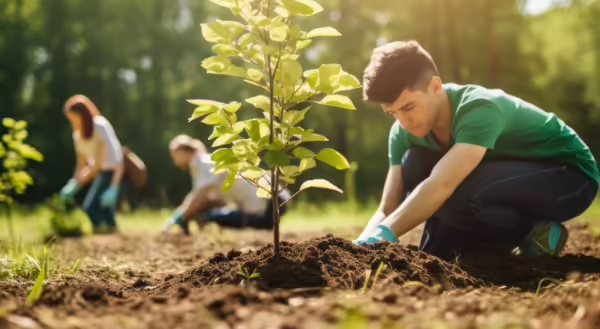
This week, we celebrate two holidays: Earth Day and Arbor Day. Although they were inspired by different moments in history, both share the purpose of inspiring environmental stewardship. Together, their histories and modern observances reflect our ever-evolving understanding of the human-nature connection.
Below are summaries of the history of these milestone observances and a few recommendations for getting involved.
Arbor Day
Arbor Day is an observance dedicated to the planting, care, and appreciation of trees, reflecting their ecological, economic, and social value. The holiday originated in the United States in 1872, during a period of rapid westward expansion when large areas of the Great Plains lacked tree cover reminiscent of the landscapes of the East. The founder of Arbor Day, Julius Sterling Morton, was a Nebraska journalist, educator, and public official who recognized the importance of trees for soil conservation, wind protection, fuel, construction materials, and overall environmental improvement.
Morton became the secretary of the Nebraska Territory and continued to promote the value of trees. On January 4, 1872, Morton proposed the establishment of a tree‑planting holiday to be celebrated at a meeting of the State Board of Agriculture. The first Arbor Day was held on April 10, 1872, and was met with widespread public participation; historical accounts estimate that more than one million trees were planted across the state. The success of this effort led Nebraska to officially recognize Arbor Day as a state holiday in 1885, celebrated on April 22, Morton’s birthday.
The Arbor Day concept soon spread beyond Nebraska, with other states and countries adopting similar observances. Because optimal tree‑planting seasons vary by climate, Arbor Day is celebrated on different dates depending on location. The most common date is the last Friday of April.
Earth Day
Earth Day is an annual event focused on protecting the environment, raising awareness about environmental problems, and encouraging collective action to address these issues. It was first celebrated on April 22, 1970, during a time when pollution, oil spills, and environmental damage were becoming major public concerns in the United States.
Earth Day was founded by Wisconsin Senator Gaylord Nelson, who was inspired by the energy of student activism from the 1960s and wanted to apply it to environmental protection. With the help of activist Denis Hayes, the first Earth Day became a nationwide event involving approximately 20 million Americans—students, teachers, workers, and families—who participated in rallies, teach‑ins, and clean‑up activities.
The success of the first Earth Day helped lead to significant environmental changes. Shortly afterward, the U.S. government created the Environmental Protection Agency (EPA) and passed major environmental laws, including the Clean Air Act, Clean Water Act, and Endangered Species Act.
In 1990, Earth Day became a global event, with participation from over 140 countries. Today, Earth Day is celebrated worldwide each year on April 22, focusing on issues such as climate change, conservation, renewable energy, and sustainability.
How to celebrate
Although these celebrations occur this week, there are ways to celebrate all year long. Here are a few ideas to get you started, but the possibilities are endless.
- Plant a tree in your yard or with a community group
- Teach a program to share the role of trees in a healthy ecosystem and environment
- Go on a nature walk and observe the scene
- Volunteer with a local environmental agency
- Visit a nature center to learn more about the local environment
- Talk with your family about implementing sustainable habits at home (turning of lights, conserving water, minimizing food waste, etc.)
- Attend local conservation programs or Earth Day and Arbor Day celebrations
Good Growing Fact of the Week: Julius Sterling Morton’s son, Joy Sterling Morton, founded the Morton Salt Company and the Morton Arboretum in Lisle, Illinois.
Thank You for Reading!
Sign up for our emails! Want to get notified when new Good Growing posts are available? SIGN ME UP
Give us feedback! How helpful was this information (click one): Very helpful | Somewhat helpful | Not very helpful
Meet the Author
Emily Swihart is a horticulture educator with University of Illinois Extension, serving Henry, Mercer, Rock Island, and Stark counties since 2021. Emily provides horticulture programming with an emphasis on the home gardener, the urban forest, native plant ecosystems, and landscape design. Additional responsibilities include supporting local county Master Gardener and Master Naturalist volunteers - providing training, continuing education, advanced training, and their involvement in seasonal events and community outreach programs.