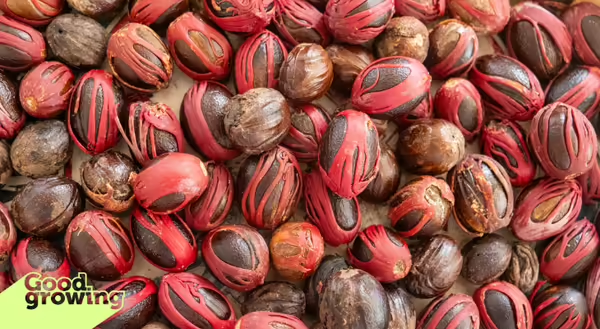
While spices are used year-round, they often take center stage during the holidays. From cookies and cakes to eggnog and savory dishes, spices provide many seasonal foods with their distinct and memorable flavors. One of the most recognizable holiday spices is nutmeg.
Where does nutmeg come from?
Nutmeg (Myristica fragrans) is native to the Banda Islands, a small group of volcanic islands in Indonesia's Maluku Islands, historically known as the Spice Islands. Archaeological evidence indicates people have been using nutmeg for at least 3,500 years.
Like many spices, nutmeg played a significant role in global exploration and trade, helping fuel the Age of Exploration. For centuries, the Spice Islands were the only source of nutmeg, making the spice incredibly valuable, often commanding extraordinarily high prices, at times rivaling the value of gold.
In the 1600s, the Dutch sought to establish a monopoly on the nutmeg trade, and, after conflicts with the British, the 1667 Treaty of Breda gave the Dutch control of the tiny nutmeg-producing island of Run, while the British gained control of Manhattan.
One fruit produces two spices
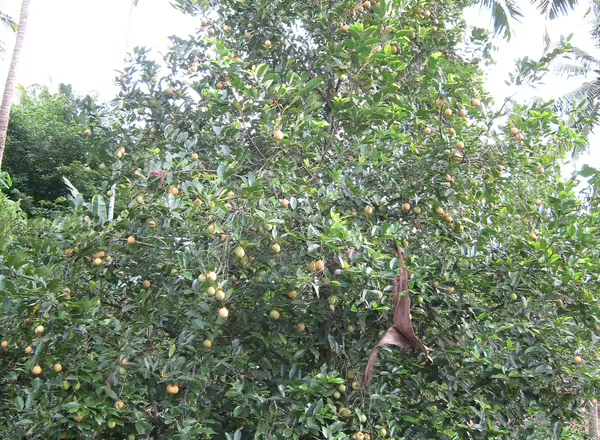
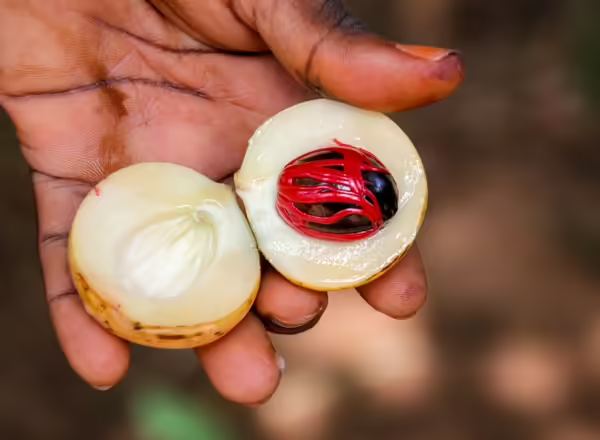
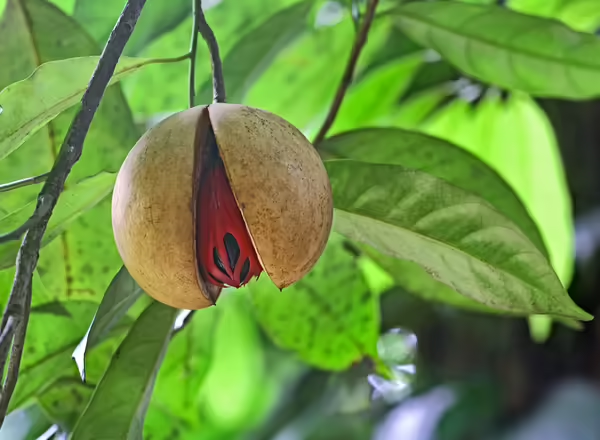
Nutmeg trees are evergreen tropical trees that can grow 30 to 60 feet tall. They produce yellow fruits that resemble small apricots or peaches. When ripe, the fruit naturally splits open, revealing a glossy brown seed surrounded by a bright red, lacy covering called an aril.
The seed becomes nutmeg, while the aril is processed into mace. While the two spices share a similar aroma, their flavors differ slightly. Nutmeg is typically described as warm, sweet, and rich, while mace is often considered more delicate and fruity.
Growing, harvesting, and processing nutmeg
Indonesia remains the leading producer of nutmeg. It is also grown commercially in Grenada, India, Sri Lanka, and other tropical regions around the world.
Nutmeg trees are long-lived crops that can remain productive for more than 50 years. Trees thrive in warm, humid tropical climates with well-drained soils and consistent rainfall. Nutmeg trees are dioecious, meaning individual trees are either male or female (only female trees will produce fruit).
Trees that are grown from seed will take around 6 to 8 years to flower, at which point growers can determine if they have a male or female tree. Because of this, growers often use grafted trees to ensure most of their orchard consists of fruit-producing female trees. Additionally, grafted trees begin producing sooner, usually in 3 to 4 years.
Harvesting nutmeg is a labor-intensive process. Fruits are collected as they begin to split open, often using long poles fitted with cutting blades and baskets to collect ripe fruits directly from the tree. Harvesting directly from the tree helps reduce contamination that can occur when fruits fall to the ground.
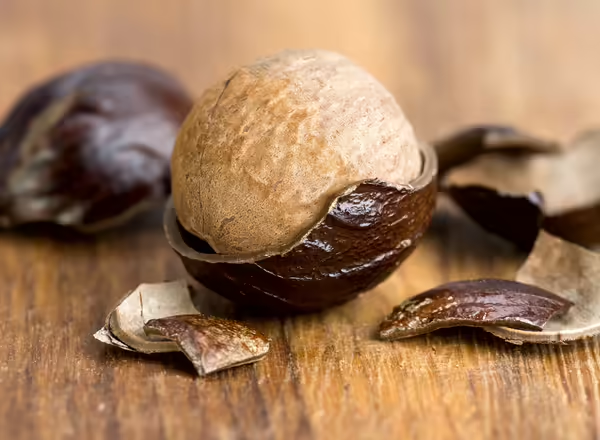
After harvest, the red aril is carefully removed and dried separately to produce mace. The nutmeg seed is typically dried within its shell for several weeks. Seeds are dried in the sun or in drying structures, although ovens may be used to speed the process. As the seed loses moisture, it shrinks and eventually rattles inside the shell, signaling that it is ready for processing. The shell is then cracked open to reveal the nutmeg kernel that is sold whole or ground into powder. Because each fruit produces much less mace than nutmeg, mace is often the more expensive spice.
Good Growing Fact of the Week: The seed and aril aren’t the only parts of nutmeg that can be used. In some parts of Southeast Asia, the fleshy outer rind (pericarp) is used to make jams, candies, preserves, and beverages.
Want to learn more about nutmeg, mace, and other ‘holiday’ spices? Check out the Spice up your holiday with these holiday spices Good Growing Podcast episode!
Photos
Nutmeg tree - കാക്കര - Own work, CC BY-SA 3.0, https://commons.wikimedia.org/wiki/Special:Redirect/page/20182753
Nutmeg fruit in tree - JoseMathew, AdobeStock
Nutmeg fruit - Caroline, AdobeStock
Nutmeg kernel in shell - leonid_shtandel, AdobeStock
Want to get notified when new Good Growing posts are available? SIGN ME UP!
Give us feedback! How helpful was this information (click one): Very helpful | Somewhat helpful | Not very helpful
MEET THE AUTHOR
Ken Johnson is a Horticulture Educator with University of Illinois Extension, serving Calhoun, Cass, Greene, Morgan, and Scott counties since 2013. Ken provides horticulture programming with an emphasis on fruit and vegetable production, pest management, and beneficial insects. Through his programming, he aims to increase backyard food production and foster a greater appreciation of insects.