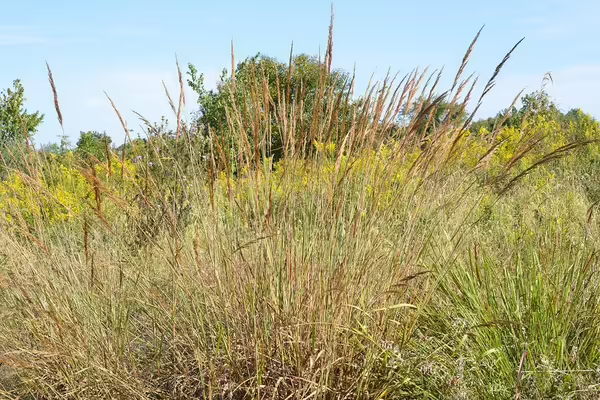
URBANA, Ill. — Grasses play a big role in natural ecosystems — from controlling soil erosion to supporting pollinators to providing food for livestock — but telling one from another isn’t always easy. This summer, learn the basics of grass identification and how to identify more than 50 common prairie, woodland, and weedy grasses found in Illinois in the Which Grass is Which online workshops from University of Illinois Extension.
Grasses are a small and subtle backbone of many ecosystems. Knowing how to tell a sedge from a rush gives insights into a natural area and helps land managers understand if a grass is valuable for grazing animals or a potential weed that needs to be removed, said program host Erin Garrett, Extension natural resources, environment, and energy educator.
"When you’re surrounded by a field of grasses, picking out one grass can feel impossible,” said Garrett, who works in Alexander, Johnson, Massac, Pulaski, and Union counties. “But getting familiar with the characteristics of grasses and asking a few questions goes a long way in identifying it.”
The three-part series begins on July 28 with Basics of Grass Identification and Identification of Common Woodland Grasses, which explores how to identify grasses, including terms and characteristics, as well as woodland grasses. The second workshop on July 29, Identification of Common Prairie Grasses, examines the variety of grasses found in Midwestern prairies. The final program on July 30, Identification of Common Nuisance Grasses, covers weedy grasses commonly found on roadsides and disturbed areas.
The workshops all start at 1 p.m. They are free, open to the public, and recommended for those working in the natural resource field and Master Naturalist volunteers. Participants can attend one or all three workshops. The workshops will be recorded and made available on the Illinois Extension YouTube account for those unable to attend live.
Sign up by July 24 at go.illinois.edu/grassworkshop to access the webinar link.
If you need a reasonable accommodation to participate, contact Erin Garrett at emedvecz@illinois.edu. Early requests are strongly encouraged to allow sufficient time to meet access needs.
Find more information about grasses in Illinois at go.illinois.edu/Grasses. To connect with Extension natural resources, environment, and energy staff about a program or for a consultation, visit go.illinois.edu/NREEstaff. Extension’s natural resources, environment, and energy program provides research-based education for awareness and action to sustain healthy environments and ecosystems that support quality living and resilient communities. Extension staff empower people across Illinois to make a difference through the Master Naturalists, Climate Stewards, and Watershed Steward volunteer and training programs.
University of Illinois Extension develops educational programs, extends knowledge, and builds partnerships to support people, communities, and their environments as part of the state's land-grant institution. Extension serves as the leading public outreach effort for University of Illinois Urbana-Champaign and the College of Agricultural, Consumer and Environmental Sciences in all 102 Illinois counties through a network of 27 multi-county units and over 500 staff statewide. Extension’s mission is responsive to eight strategic priorities — community, economy, environment, food and agriculture, health, partnerships, technology and discovery, and workforce excellence — that are served through five program areas — 4-H youth development, agriculture and agribusiness, community and economic development, health and community wellness, and natural resources, environment, and energy.