A Growing Market for a Globally Loved Spice
Last year, the U.S. consumed about 99,000 tons of ginger rhizome—the knobby, brown-skinned, yellow-fleshed, aromatic spice (sometimes incorrectly called ginger “root”) used in stir-fries, candies, curries, teas, sodas, supplements, and more. Nearly all the world’s ginger is grown in tropical or subtropical regions, including India, China, Indonesia, Nepal, Nigeria, Peru, Sri Lanka, and Bangladesh.
In the United States, only about 664 tons of ginger were produced in 2024—just 0.7% of what Americans consumed. Few crops illustrate U.S. dependence on foreign markets as strongly as ginger.
Why Ginger Could Work in Illinois
Two crops often cited as near total imports are coffee and cacao. But unlike these tropical commodities, fresh ginger rhizome, according to emerging University of Illinois Extension research, has real potential to become an economically meaningful crop for specialty growers in Illinois and the Midwest.
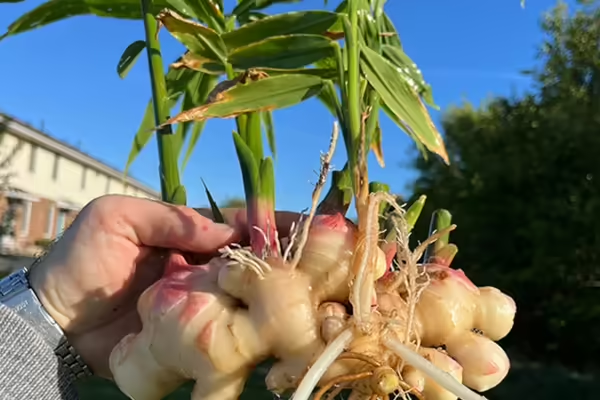
Ginger rhizomes take 8–10 months to reach full maturity—much longer than the Illinois outdoor growing season. However, “fresh” or “baby” ginger is harvested at around five months, making it well-suited for production in temperate climates.
Baby ginger differs from mature grocery store ginger in several ways: it is more colorful, more aromatic, not fibrous, has a shorter shelf life, and requires no peeling. These traits make it highly desirable for sushi ginger, candied ginger, and other high-end culinary uses. While baby ginger yields are lower than mature ginger, the price premium is substantial: locally grown fresh ginger can command $20–$25 per pound, retail, compared to $5–$6 per pound for mature retail ginger.
Additionally, harvest and sale take place at the end of the growing season, generating cash flow at a time of year when almost all other specialty grower income is waning.
Grant Supported Research to Improve Ginger Production
In late 2024, a collaborative team led by Nick Frillman, Local Food Systems & Small Farms Extension Educator (Bloomington), received an Illinois Specialty Crop Block Grant supporting fresh ginger research during the 2025–2026 growing seasons. The project expands upon previous Extension affiliated initiatives and is aimed at refining and communicating best practices of fresh ginger production to Illinois growers, from seed sourcing to transplanting, fertility and water management, integrated pest management, harvest, post-harvest handling, and more.
Statewide Variety & Environment Trials
Beginning in spring 2025, 7 specialty crop farmers and 5 Illinois Extension educators across the state launched a two-year field study. The project is evaluating:
- 5 ginger varieties (procured from three vendors)
- 4 types of growing environments were identified as potentially viable for Illinois conditions
The goal: determine whether certain varieties or environments deliver significantly better yields, improving growers’ likelihood of crop production success.
Early 2025 results suggested small performance differences among varieties, but one growing environment dramatically outperformed the others. Results will be formally disclosed after data from the 2026 season is collected to ensure reliability.
Scaling Up for Year Two of Statewide Ginger Initiative
To add power to the collected data, more specialty growers were recruited for 2026. Beginning in late March, the ginger growing season kicks off when 14 specialty crop farmers and 6 IL Extension field staff will begin the extended germination process (pre-sprout) for the ginger.
Several factors influencing optimal baby ginger production under Illinois conditions are becoming clearer. According to Frillman, “regular watering (every 1–2 days depending on soil type or potting media), regular fertility applications, and monthly hilling of soil around the base of plants, as is done for field potatoes,” appear to be the strongest predictors of high-quality yields, among other factors.
One of the ginger growers – J. Balmer, Greenhouse Manager at Epiphany Farms Estate in Downs, Illinois – had this to say about the project. “It’s broadened our product offerings, introduced me to several like-minded growers, and provided the educational foundations to continue developing a high-value addition to our bottom line.”
University of Illinois Extension develops educational programs, extends knowledge, and builds partnerships to support people, communities, and their environments as part of the state's land-grant institution. Extension serves as the leading public outreach effort for University of Illinois Urbana-Champaign and the College of Agricultural, Consumer and Environmental Sciences in all 102 Illinois counties through a network of 27 multi-county units and over 700 staff statewide. Extension’s mission is responsive to eight strategic priorities — community, economy, environment, food and agriculture, health, partnerships, technology and discovery, and workforce excellence — that are served through five program areas — 4-H youth development, agriculture and agribusiness, community and economic development, health and community wellness, and natural resources, environment, and energy.