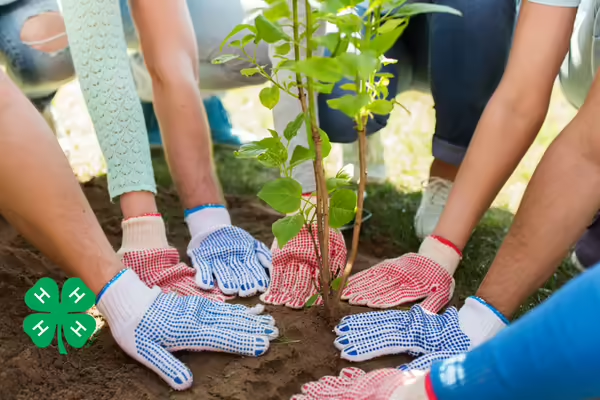
Carlock, Ill. – Woodford County is looking for volunteers to help with planting a grouping of 25 oak trees at Parklands Chinquapin Bluffs in Woodford County with the goal of tackling global issues at the local level. Carbon neutrality and nutrient runoff are complex issues facing our environment that can be combatted through planting new trees.
“We need to become ‘carbon neutral’ by producing less CO2 gas and finding new ways to absorb and hold these carbon molecules so they don’t get trapped in the atmosphere, which adds to the warming of our planet,” says Curt Sinclair, University of Illinois Extension 4-H natural resources and shooting sports specialist. “At the same time, we need to reduce stormwater runoff to improve water quality.”
The 2020-2030 Illinois Forest Action Plan, part of the Food, Conservation, and Energy Act of 2008, outlines the benefits of trees to Illinois residents.
“More trees will move us closer to cleaner water, healthier soils, more animals and birds, greater biological diversity, and cleaner air,” Sinclair says. “All these are critical to people’s health and quality of life.”
Illinois once held 14 million acres of trees, according to Sinclair. That number dropped to 3 million acres before intentional efforts 50 years ago began to reverse the decline. Today, Illinois has 5 million acres of trees.
In the spring of 2026, 4-H youth in Woodford County and 40 other counties throughout Illinois will each plant a grouping of 25 oak trees on public properties in their county. The groups, called savanna, will bring new life to oak-hickory forests currently under threat in Illinois, with total plantings across the state anticipated to hit 1000 new trees.
Woodford County is proud to participate in the 4-H Green Communities Tree Program because it aligns with our commitment to strengthening our environment, our communities, and our youth. Planting trees is more than a beautification effort—it’s an investment in cleaner air, healthier ecosystems, and hands-on learning opportunities for young people. Through this program, we empower our 4H members to take an active role in caring for the places they call home and to build a greener future for generations to come
Planting in Woodford County will take place on April 25. Youth, adults, businesses, and other organizations that would like to participate in the planting process should contact Blaine Troyer to register here.
We chose The Parklands—Chinquapin Bluffs site because it represents one of the most ecologically meaningful and community-connected spaces in Woodford County. Its natural landscape, public accessibility, and long-term conservation potential make it an ideal location for strengthening our environmental stewardship efforts. We also returned to this site because our team planted trees here in 2022, and continuing our work allows us to build on that investment, support the site’s ongoing restoration, and show our 4H youth how sustained care can transform and protect a community space over time.
The 4-H Green Communities Tree Program follows the "learn-by-doing" philosophy of 4-H and is guided by the priorities of the Illinois Forest Action Plan.
University of Illinois Extension develops educational programs, extends knowledge, and builds partnerships to support people, communities, and their environments as part of the state's land-grant institution. Extension serves as the leading public outreach effort for University of Illinois Urbana-Champaign and the College of Agricultural, Consumer and Environmental Sciences in all 102 Illinois counties through a network of 27 multi-county units and over 500 staff statewide. Extension’s mission is responsive to eight strategic priorities — community, economy, environment, food and agriculture, health, partnerships, technology and discovery, and workforce excellence — that are served through five program areas — 4-H youth development, agriculture and agribusiness, community and economic development, health and community wellness, and natural resources, environment, and energy.