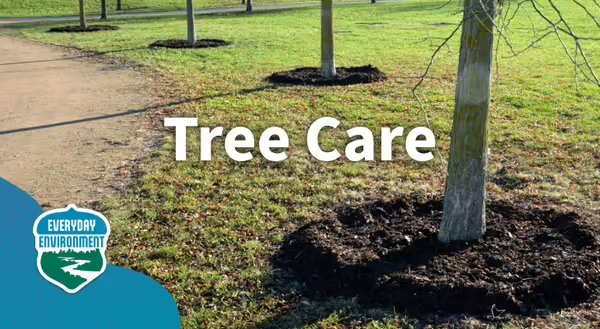
Trees provide shade, ecosystem services, and economic value in both urban and rural landscapes. Because trees are dominant features, their health has a big impact on the function and aesthetics of community forests. We invest time, money, and effort in our backyards and parks. Understanding factors that influence tree health can inform better management decisions to sustain these valuable resources.
Unlike herbaceous perennials with foliage that dies back and resprouts each year, trees and shrubs are woody perennials. These types of plants have a woody structure that remains present all year. Therefore, accumulated stress over several years can gradually worsen the health of individual trees in the urban forest.
Right tree, right place
A tree’s success begins with choosing to plant a species suited to the site; one that will thrive in soil pH, amount of sunlight, root space, and proximity to utilities or other structures. Unsuitable placement or planting practices can lead to ongoing health issues that may not become apparent for years. Fine absorbing roots are largely concentrated in the top 6-18 inches of soil and are especially vulnerable to stress, making water crucial during dry spells, especially to newly planted trees.
Not all problems are pests
When yellowing leaves, thinning branches, or splitting bark are first noticed, it is common to assume that insects or disease have suddenly caused the problem. However, trees often decline over time in a process called the "decline spiral", where pests and pathogens are simply taking advantage of an already stressed plant. With some exceptions, tree stress is not typically caused by a single factor, but by a combination of living and non-living (abiotic) factors like site limitations of soil, water, or temperature.
Predisposing, or existing factors, in declining tree health might be soil compaction and poor drainage, or even species genetic suitability to the site. This already disadvantaged tree is further weakened by additional inciting factors like being planted too deeply, drought, construction damage, or pruning errors. By the time contributing factors like insects or disease become visible, the tree is already more susceptible to failure.
Diagnosing tree problems
Effective diagnosis involves examining the entire tree from the roots to the shoots, gathering clues, and understanding patterns. Use a systematic approach and note the observations:
- Identify the tree. What characteristics are normal for the species? How old and in what condition is the tree?
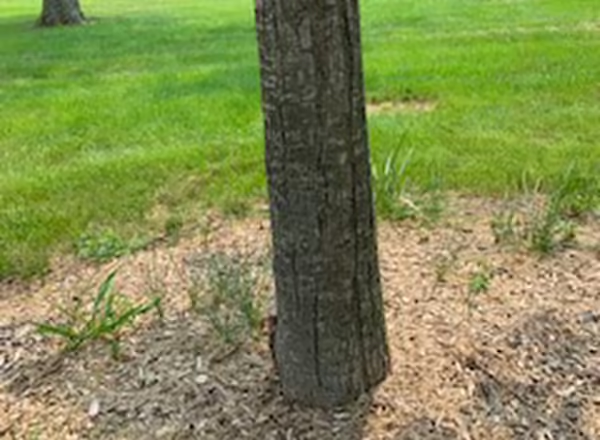
- Look at the roots. Is a root flare visible above ground? Has there been nearby construction? Are there stem-girdling roots (roots that wrap around the trunk) interrupting the vascular flow of moisture and nutrients?
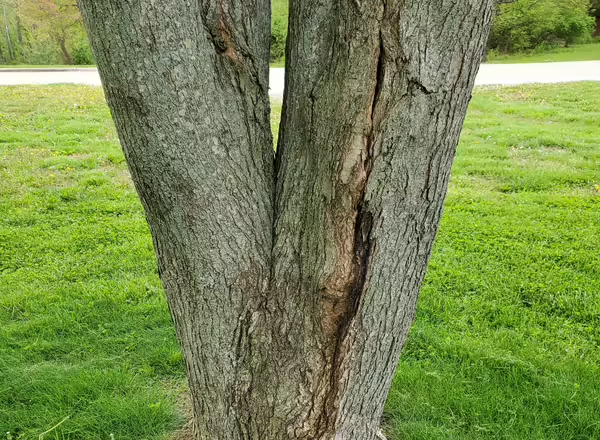
- Look at the trunk and branches. Is there damage from mowers or animals? Are there large cavities or splits? How much of the canopy is intact?
- Look at the foliage. Is it wilted, discolored, or smaller than normal? Is the tree dropping leaves or showing early fall color? Are there spots, holes, or bumps?
- Consider other factors. Where do symptoms appear in the tree canopy? Are there patterns of symptoms across the landscape? How quickly did symptoms develop? Has there been nearby construction? What maintenance has been performed and when?
Supporting tree health
The most effective approach to long-term tree health is proper care. Use appropriate planting techniques, water adequately during establishment, and minimize physical damage.
For more tips on tree care, use resources like Illinois Extension’s Tree Maintenance Schedule, or the USDA Forest Service’s Tree Owner’s Manual.
Tree Challenges
About Everyday Environment
Everyday Environment is a series of blogs, podcasts, webinars, and videos exploring the intricate web of connections that tie us to the natural world.
Was there something about this blog's topic we didn’t cover? See something cool in nature? Let us know! Hit "Connect with Us" below to send us your question or share your everyday nature observation with and we may share it in a future blog or podcast.
Subscribe to the Newsletter Connect with Us Find Your Local Extension Office