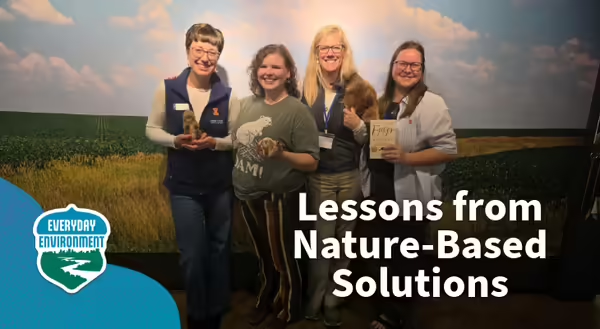
Thanks for following along with the Everyday Environment team this fall as we — Abigail, Erin, Amy, and Emily — explored nature-based solutions in our fifth season!
This concept was a little different of a topic for our team. We all had experience with individual solutions, but we hadn't thought about it from the big picture. We debated this topic for months, moving from “backyard ecology” to “community-based conservation” to “human and nature interface.” All of those ideas never quite described what we were going for. We wanted to focus on how our landscape and its inhabitants live and interact, and the complex elements within. We decided to explore how that complexity shapes decisions in our everyday lives. But this concept doesn't easily boil down to a quippy podcast heading.
The term “nature-based solutions” can cover anything from nature as a solution to nature/ecology information as a solution, or even elements of nature as a problem in which the solution is acceptance. From your backyard to a broader community, having a deeper understanding of the natural world enriches our lives and provides many explanations and solutions.
Throughout this season, a few key themes popped up as we explored these solutions.
(P.S. If you have a minute, please take a 5-minute survey to let us know what you think about this season of Everyday Environment!)
Be curious and ask “why?”
When an insect is eating our prized squash, or a patch of lawn simply won’t grow, it’s easy to go for the quick “solution.” Herbicide spray, fertilizer, etc., all seem to address the "problem." But we’ve discovered that when we reach for the easy solution, we don’t take the time to ask questions and understand why. What is out of balance?
By asking questions like “What does this particular insect eat?” or “What eats this insect?” or “What are the preferred growing conditions of that plant?” and “What are the current growing conditions?” we can better understand. By slowing down and asking “why,” we can often find a longer-lasting solution than the quick fixes that we turn to over and over again.
That is why we want to think like Ted Lasso, from the namesake TV series, in this scenario. If you’re familiar with the show, Ted (falsely) quotes Walt Whitman as saying, “Be curious, not judgmental.” Although this isn't actually a Whitman quote, the idea still applies as we look at the various conflicts people have with insects, plants, water, etc.
Sometimes, “damage” is not necessarily something to be concerned about. In the What’s Wrong with my Tree episode, Sarah Vogel talks about this when it comes to insect damage on a tree. There is a natural push and pull to the various resources in nature. Insect “damage” isn’t necessarily a bad thing and is even considered a sign of a healthy ecosystem; therefore, observing the “damage” and asking questions about it can help get to the root of what is going on there. Everyday Environment has explored this concept before with Dr. Agustin Jimenez when discussing zoonotic diseases during the Wildlife season.
No one will tell you that having mice in your house is a good thing, but being curious about this phenomenon helps you discover why mice are in your house and how they get there. Knowing the why can help you better prevent mice from entering your home in the first place.
Nature knows no borders
As humans, we tend to want everything to fit into neat little boxes or follow rules. We create lines that divide the landscape: your property versus my property, Cook County versus DuPage County, Illinois versus Indiana. We even do it when classifying the natural world: coneflowers are different from asters, trees are distinct from shrubs, wetlands and prairies are separate ecosystems with their own unique qualities.
We see these categories everywhere, and while they help us understand the natural world, we need to challenge that idea when we use nature as inspiration for our work because nature knows no borders. As home gardeners know, windblown milkweed seeds pass easily between property lines, and honeysuckle seeds from bird droppings come from miles away. Mosquitoes that breed on your neighbor's property have no problem flying to your yard, and rain that falls on your driveway will run off and make its way to the nearest stream one way or another.
Nature’s “disregard” for our human-created boundaries makes management difficult and challenges our brains as we try to troubleshoot various challenges. Crossing boundaries can be a good thing, though; think of Amy Powers in her episode on naturalistic gardening. Amy mentioned that she did not have to provide artificial control measures on her collard greens and kale because birds were eating the cabbage loopers. Birds thriving across the landscape provided some natural control.
Fireflies as the new monarch butterflies?
For more than a few podcasts, guest after guest brought up a particular group of insects. Fireflies or lightning bugs, whatever name you prefer, are an insect moving up in popularity. Folks brag if they spot them in their yard and talk nostalgically about them — saying “they don’t come out like they used to.” As Extension professionals, we’ve received more and more calls asking how communities can help support more fireflies. It's exciting to see momentum growing for this group of beetles, known for their summer bioluminescence.
Fireflies differ from monarch butterflies because their habitat requirements are more complex than growing a particular plant species. Fireflies spend most of their lives as larvae in leaf litter and in the soil. This means reducing pesticide use and “leaving the leaves” is essential to the survival of these species. Additionally, they need a more “wild” landscape with taller grasses and undisturbed groundcover for the larval stage to survive. Finally, because of their unique lighting feature, known as bioluminescence, light pollution threatens their breeding behavior. Practices that support fireflies address multiple elements of a healthy ecosystem, from management decisions and plant choices to providing education on the complexity of natural interactions in a landscape.
Folks who instill these practices and see results are proud to have fireflies. Some go so far as to claim them as “my fireflies,” as Brodie Dunn jokingly said in his everyday observation. That’s an exciting shift in landscape management culture.
Fireflies are the mascot of the Homegrown National Park movement, which encourages folks to make a difference in their own yards to support biodiversity. In our interview with Homegrown National Park founder Doug Tallamy, he wraps up nature-based solutions season nicely by stating:
“If we claim to own a piece of the earth, we’re also owning the stewardship that is necessary for that piece of the earth.”
Part of “owning the stewardship” is recognizing the complexity of the natural world and working with it to achieve your goals. Whether you want to support a particular species, enjoy your space for entertainment, or cultivate a space for its beauty, you can achieve all of these goals through a nature-based approach.
What’s coming next? Join us in spring 2027 to explore ecological restoration!
Healthy ecosystems support healthy communities, but restoring natural areas takes more than planting native species. What does it mean to "restore" a natural area? Who decides what the restoration process looks like, and how do people work together to make it happen?
Join Everyday Environment starting March 2027, as we look at restoration projects across Illinois, efforts to boost at-risk wildlife populations, legislation that drives decision-making, and the volunteers and professionals working to steward the Prairie State.
In the meantime...
- Explore and share our library blogs, podcasts, short videos, and webinars.
- Have a nature question? Send it our way!
- You are also always welcome to visit your local county Illinois Extension office and connect with staff for more information, good conversations, and helpful tips.
Thank you for supporting the Everyday Environment series, and we'll see you next season!
— Abigail, Amy, Erin, and Emily
About Everyday Environment
Everyday Environment is a series of blogs, podcasts, webinars, and videos exploring the intricate web of connections that tie us to the natural world.
Was there something about this blog's topic we didn’t cover? See something cool in nature? Let us know! Hit "Connect with Us" below to send us your question or share your everyday nature observation with and we may share it in a future blog or podcast.
Subscribe to the Newsletter Connect with Us Find Your Local Extension Office
Everyday Environment is a production of University of Illinois Extension. ©2026 University of Illinois Board of Trustees. For permission to reprint, revise, or otherwise use, contact extension@illinois.edu. The production team uses AI technology to draft the podcast transcript.