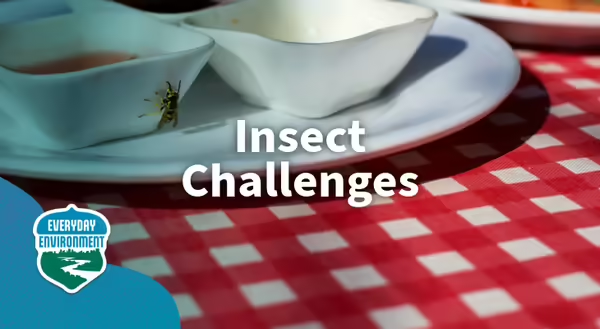
While enjoying the outdoors, we often come into contact with insects, for better or worse. From buzzing mosquitoes to wasps interrupting outdoor meals, these encounters often lead people to think about control or elimination.
Yet, insects play critical roles in our environment, from pollination and soil health to food webs and pest management. Rather than trying to remove them entirely, we can take steps to coexist with them more effectively.
Insects (and their friends) are all around us
As much as people may want to avoid insects, they are all around us. Scientists have identified more than 1 million insect species — over 20,000 in Illinois — and it’s estimated that there could be between 3 million and 30 million on Earth. Additionally, it’s estimated that there are 1.4 billion insects per person on Earth, or around 10 quintillion — 1 followed by 19 zeros.
We’ll never be able to get rid of all the insects, so we need to find a way to coexist with them.
Avoiding those pesky mosquitoes
One of the easiest ways to avoid mosquitoes is to stay indoors. While that may not always be practical, limiting outdoor activities when mosquitoes are most active at dawn and dusk can go a long way in reducing mosquito bites. If you are outdoors and aren’t actively moving around, consider using a fan to keep mosquitoes away because they aren’t very strong fliers.
Mosquitoes need water to reproduce. Therefore, removing, eliminating, or draining as many water sources as possible, such as clogged gutters, old tires, toys, and drip trays under pots, will help to reduce mosquito populations. Additionally, water in birdbaths should be emptied and replaced weekly.
Insect repellents are among the best and simplest ways to prevent mosquito bites. There are a variety of different EPA-registered insect repellents. You can also buy clothing treated with permethrin, or treat it yourself. Permethrin is an insecticide that kills or repels mosquitoes and can continue to protect after multiple washings. Regardless of what you use, make sure to read and follow all label directions and reapply as directed.
Insects around outdoor lighting
Enjoying the outdoors at night with lights on often results in people being bombarded by flying insects. While it’s commonly believed that insects are attracted to light, that’s not entirely accurate. Insects use light to help orient themselves by keeping the light source on their back, a dorsal light response.
With outdoor lighting, insects get "trapped," constantly trying to keep the light over their back, causing them to fly erratically around lights. This can leave insects exhausted and dehydrated, leading to their death. It also increases predation and disrupts their life cycle.
To help preserve insect populations and avoid conflicts with insects around lights:
- Reduce the amount of outdoor lighting in your landscape and leave lights off except when needed.
- Use a motion sensor so that the lights will automatically turn off.
- Close blinds or curtains on windows so indoor lighting does not "bleed" outside.
- Use yellow or amber colored lights, which are “less attractive” to insects.
Wasps, the unwelcome picnic guests
Wasps are beneficial insects. The larvae are meat eaters, consuming caterpillars and other insects that adults have captured and brought back to the nest. Adults, on the other hand, feed on flower nectar and other sweet liquids and can serve as pollinators. However, in the fall, wasps, particularly yellowjackets, can become unwelcome guests during outdoor events, especially when food is involved.
As fall arrives, there are often fewer flowers blooming in our landscapes. This is also when social populations of wasps are typically highest. This can lead to conflicts with people as they search for food. They are attracted to various sweet foods and beverages, such as carbonated beverages, juices, candy, fruit, and ice cream.
When consuming beverages outdoors, make sure to use cups so you can see what you are drinking. Planting more fall-blooming plants can also be helpful, giving them somewhere else to look for food. If a yellowjacket decides to check you out, blow on it or brush it away rather than swatting at it, which can lead to you being stung.
The importance of insects
Insects are incredibly important; without the various ecosystem services they provide — pollination, pest and weed control, decomposition, food sources for other animals, etc. — the world would be a very different place. Instead of trying to control or eliminate them, we should strive to coexist with them. Besides, they were here long before us, 480 million years, and will be here long after we’re gone.
Resources and more information
- Managing mosquitoes at home
- Fabian, S.T., Sondhi, Y., Allen, P.E. et al. Why flying insects gather at artificial light. Nat Commun 15, 689 (2024). https://doi.org/10.1038/s41467-024-44785-3.
About Everyday Environment
Everyday Environment is a series of blogs, podcasts, webinars, and videos exploring the intricate web of connections that tie us to the natural world.
Was there something about this blog's topic we didn’t cover? See something cool in nature? Let us know! Hit "Connect with Us" below to send us your question or share your everyday nature observation with and we may share it in a future blog or podcast.
Subscribe to the Newsletter Connect with Us Find Your Local Extension Office