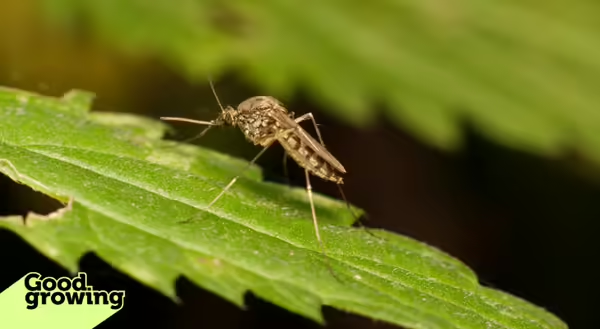
With the arrival of warm, wet weather, mosquitoes are becoming more prevalent. Unfortunately, this can turn relaxing evenings outdoors into a constant battle against these buzzing and biting insects. Fortunately, there are several steps we can take to prevent mosquito bites while enjoying the outdoors.
Understanding mosquito biology
Before trying to manage mosquitoes, it helps to understand their biology. Mosquitoes have a complete life cycle, with four stages: egg, larva, pupa, and adult. The eggs are laid in or near water and hatch into larvae within a few days. The larvae feed on algae, bacteria, and organic debris in the water. They will pupate in the water, and eventually the adults will emerge. During warm weather, it can take as little as 7 to 10 days for a mosquito to complete this cycle, which can lead populations rapidly increasing.
Both male and female mosquitoes will feed on nectar and fruit juices. Additionally, female mosquitoes bite people and animals to get a blood meal. Female mosquitoes need a blood meal to produce eggs.
Start with the source: Eliminate standing water
Mosquitoes need water to reproduce, and they don’t necessarily need a lot of it; some need as little as one tablespoon of water to develop (about the size of a bottle cap). Therefore, removing, eliminating, or draining as many water sources as possible, such as clogged gutters, old tires, toys, and drip trays under pots, will help to reduce mosquito populations. Water in birdbaths should be emptied and replaced weekly.
If standing water can’t be removed, for example, in an ornamental/garden pond, water can be treated with Bacillus thuringiensis israeliensis (Bti). Bti is a naturally occurring bacterium that kills mosquitoes but does not harm humans, pets, fish, or other wildlife.
Make your yard less appealing
Most mosquitoes are most active around dawn and dusk. During the day, they seek out cool, shaded, and humid areas where they can rest. Avoiding dense plantings, pruning plants to increase air flow, and keeping grass mowed can make the area around a home less attractive to adult mosquitoes.
Avoid mosquitoes
Because most mosquitoes are most active at dawn and dusk, limiting outdoor activity during those times (often easier said than done) can reduce the chances of being bitten. Mosquitoes are weak fliers, so if you are outdoors in the evening, using a fan can help keep them off people.
Choose the right clothing
Mosquitoes tend to be attracted to darker colored objects. Wearing light colored clothing can make you less attractive to mosquitoes. Additionally, loose-fitting long-sleeved shirts and long pants made of tightly woven materials can help prevent mosquitoes from biting you through your clothing.
Use repellents
Insect repellents are among the best and simplest ways to prevent mosquito bites. There are a variety of different EPA-registered insect repellents, including:
- DEET
- Picaridin
- IR3535
- Para-menthane-diol (PMD)
- Oil of lemon eucalyptus (OLE)
- 2-undecanone
Clothing can also be purchased treated with permethrin, or you can treat it yourself. Permethrin is an insecticide that kills or repels mosquitoes and can provide protection after multiple washings.
Whether using repellents or treating clothing with permethrin, make sure to read and follow all label directions and reapply as directed.
Things that don’t work well (or at all) to manage mosquitoes
Fogging and spraying yards are often touted as effective ways to manage mosquitoes. While they can be very effective at managing adult mosquitoes, they are usually only effective for a few days (new mosquitoes will fly in), so they are not a good long-term strategy for managing mosquitoes. Additionally, they can have negative impacts on non-target organisms, such as beneficial insects.
Bug zappers aren’t very effective at managing mosquitoes because mosquitoes aren’t strongly attracted to light (they’re attracted to carbon dioxide, body heat, and odors). Instead, bug zappers kill a variety of insects, including many beneficial insects.
Ultrasonic repellent devices claim they mimic predator sounds or male mosquitoes are not supported by research. However, studies have shown mosquitoes are not deterred.
Attracting bats or purple martins is often touted as a way to reduce mosquito populations. While these animals may eat mosquitoes, they only make up a small portion of their diet and are unlikely to significantly reduce mosquito populations.
Some plants are marketed as being mosquito-repelling. While these plants contain compounds that may repel mosquitoes, they aren’t naturally released in high enough amounts to repel them (they need to be damaged to release large amounts). One study conducted in Illinois found that people surrounded by mosquito-repelling plants had more mosquitoes land on them than those in the control group.
Citronella candles and torches can help repel mosquitoes, but you need to be directly in the smoke, and they're still not as effective as repellents like DEET.
Good Growing tip of the week: When applying insect repellent, make sure to apply it after sunscreen. If sunscreen is applied over repellents, they will not be effective.
Bonus fact of the week: Mosquito larvae are commonly called “wigglers” because they wiggle back and forth as they move through water. Mosquito pupae are known as “tumblers” because they tumble through the water when they move.
Want to learn more? Check out the Good Growing Podcast episode on Summer Mosquito Control: What Really Works to Keep Bites Away
For more information
“Field Efficacy of Commercial Antimosquito Products in Illinois.” 2000. Journal of the American Mosquito Control Association 16 (2): 148–52. https://www.biodiversitylibrary.org/part/127137.
Want to get notified when new Good Growing posts are available? SIGN ME UP!
Give us feedback! How helpful was this information (click one): Very helpful | Somewhat helpful | Not very helpful
MEET THE AUTHORS
Ken Johnson is a Horticulture Educator with University of Illinois Extension, serving Calhoun, Cass, Greene, Morgan, and Scott counties since 2013. Ken provides horticulture programming with an emphasis on fruit and vegetable production, pest management, and beneficial insects. Through his programming, he aims to increase backyard food production and foster a greater appreciation of insects.
Chris Enroth is a horticulture educator with University of Illinois Extension, serving Henderson, McDonough, Knox, and Warren counties since 2012. Chris provides horticulture programming with an emphasis on the home gardener, landscape maintenance personnel, and commercial landscapers. Additional responsibilities include coordinating local county Master Gardener and Master Naturalist volunteers - providing their training, continuing education, advanced training, seasonal events, and organizing community outreach programs for horticulture and conservation assistance/education. In his spare time, Chris enjoys the outdoors, lounging in the garden among the flowers (weeds to most).