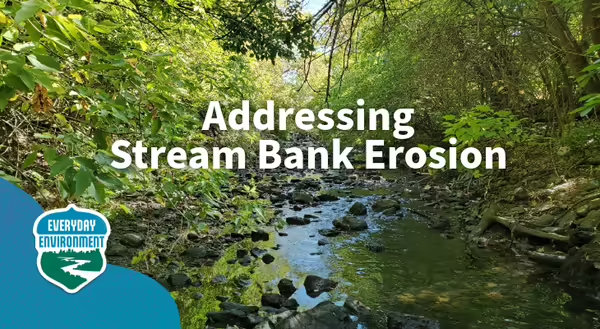
Stable streambanks are an important aspect of watershed management in Illinois. Across the state, we are experiencing increased rainfall and intensifying storms as the effects of climate change continue to ramp up.
These changes create additional strain on Illinois streambanks, leading to increased erosion and changes in streamflow capacity, and, in extreme cases, the loss of land area. In the face of these challenges, how we manage streambanks and riparian areas, the area along a river or stream, is becoming increasingly important.
Plants naturally stabilize streambanks.
One of the most effective and sustainable strategies for stabilizing streambanks and managing erosion is the use of vegetation. A network of deep-rooted plants stabilizes connections within the soil profile, increasing resistance to erosion and bank failure during storms and floods.
The dense aboveground stems also slow water flow during flooding, reducing the erosive force on the soil surface.
Streambank vegetation also improves infiltration and increases evapotranspiration, which can help to reduce soil saturation. The risk of streambank sloughing, or the mass collapse of large areas, is much higher when soils remain saturated for long periods.
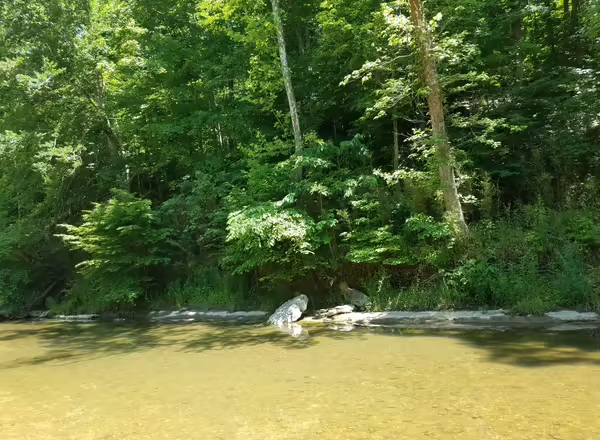
Should we stabilize streambanks with grasses or trees?
There has long been scientific debate on the type of vegetation that provides the greatest benefit and function in riparian areas, with grasses typically pitted against trees. In the context of streambank stabilization, both types of vegetation have a role as they provide stability in different ways.
Trees are generally best suited for stabilizing taller, steeper banks where deeper root reinforcement is needed. Their larger, coarser, and more extensive woody root structure helps to increase soil shear strength, which reduces mass bank failure. In most cases, tree roots have been shown to provide the greatest increase in evapotranspiration, which dries out the soil profile more quickly.
Trees also excel at protecting areas at risk of bank sloughing from higher velocity streamflow, such as the outer edge of a meander bend. In these cases, trees are a good choice due to their ability to hold taller banks together and slow streamflow with large trunks, exposed roots, and other woody debris.
Grasses have their own strengths, providing bank protection through dense, fibrous root systems that have more root biomass near the soil surface. This dense root mat armors the soil surface, reducing the risk of surface erosion and detachment of smaller soil particles.
Grasses tend to provide better protection in areas dominated by surface erosion, such as headwater locations, rather than areas with tall banks and significant stormflow. The use of their dense, more fibrous root system is often better suited to gently sloping inner bends or reaches of stream with lower banks.
Riparian Management Considerations
Neither grasses nor trees are universally better at providing bank stability. Each has its own specific niche. Decisions about which types of bank vegetation to plant or promote are often made based on long-term management availability.
In Illinois, grasses typically require some type of management intervention (mowing, burning, etc.) to deter the development of trees. Also, there is significant pressure from invasive species that may not provide the same stabilizing benefits and present a large ecological risk if allowed to establish.
Grasses are most effective at providing stability for shorter streambanks and smaller channels, which often occur in headwater locations. Since grasses are much quicker to establish than trees, developing both stems and roots faster, they do well in more dynamic headwater locations and do not require the space needed for a forested riparian buffer.
Tree-covered riparian areas are also at risk from invasion by both woody and herbaceous, shade-tolerant invasive species. Most of the shade-tolerant invasive species threatening Illinois riparian areas are especially shallow-rooted and extremely competitive with other plants. Care must be taken to monitor and remove these aggressive species and ensure a healthy understory plant community.
Trees provide the biggest benefit on taller, steeper streambanks, which leaves them at risk of windthrow, resulting in collapse into the stream channel and subsequent bank erosion and stream widening or alteration. To prevent this, regular assessment of riparian trees is needed, followed by the periodic removal of high-risk trees before a wind event topples them. In addition, plans should include replanting or management of existing understory vegetation to ensure the next generation of streambank trees is in place.
Given the unique attributes of both trees and grasses, the best management strategy often involves a mixture of species. By understanding the limitations and benefits of each, streambanks can be maintained to maximize bank stability while also creating a diverse and resilient plant community.
About Everyday Environment
Everyday Environment is a series of blogs, podcasts, webinars, and videos exploring the intricate web of connections that tie us to the natural world.
Was there something about this blog's topic we didn’t cover? See something cool in nature? Let us know! Hit "Connect with Us" below to send us your question or share your everyday nature observation with and we may share it in a future blog or podcast.
Subscribe to the Newsletter Connect with Us Find Your Local Extension Office