“Dad, why can’t we just have grass in our yard?” asked my 12-year-old son. His question has been bouncing around in my head for a few days now.
He and his siblings have started mowing lawns for a few others in our neighborhood, and while mowing, he noticed something — our home lawn has a lot more than grass in it.
Why do lawns exist?
Lawns are not a new concept. With imagery borne from bucolic rolling pastures in the English countryside, as seen in Romantic-era paintings, the lawn began as a functional piece of a working farm or estate. As wealth increased, the height of the pasture decreased to being neatly clipped around mansions and villas among clipped hedged parterres, which are geometric plant beds separated by walking paths.
The status of clipped lawns spread around the world, including in the United States. Where this green carpet of living plants was mostly reserved for the wealthy who retreated from the city to their countryside estates. However, following World War II, the U.S. boomed with growth. New building materials and techniques allowed us to build faster, and suburbs rose on the city’s periphery. But what to do with the space between all those houses? The answer, lawns!
The lawn's status symbol was quickly adopted by Americans; now, like the wealthy estates, they too had their slice of countryside. World War II taught us efficient production methods that the lawn care industry used to expand rapidly alongside suburban development.
Are lawns "good"?
What a silly question! Plants don’t live in a world of morality like good or bad — at least as far as I know. But lawns can serve a purpose. After all, it would be tough to play baseball if the outfield was 6-foot-tall big bluestem grass.
Lawns are an important part of our landscape. It is a spot where we gather with others. Lawns give us a surface to play. Lawns also offer a buffer against the more dangerous parts of nature, such as ticks and wildfires. They’re also fairly easy to maintain if all you plan to do is mow it.
From a human perspective, lawns are important parts of the landscape. This might tie back to our initial question, “Why lawns?” because the lawn serves as a void in the design scheme. A void is useful, as it allows our brains to rest. Just as our brains rest on ripples in the water or flames in a fire, the simplicity of lawn grass allows rest.
For example, as a person’s eyes move across a pollinator garden, their brain interprets the varying colors, shapes, and textures. Even perhaps deep within the brain, there is a threat analysis of possible dangers lurking in that pollinator garden. While we may not think of a pollinator garden as dangerous, our instinctual brain might.
When it comes to landscape design, the void of a lawn also offers juxtaposition to a decorative or wild landscape. It sets the stage for the perennials, shrubs, and trees in a residential landscape. Lawns can connect different spaces in a yard and tie the design together.
Lawns are useful, but nothing's perfect.
The problems with lawns
The biggest issue often mentioned with lawns is that we did too good a job of turning wild or agricultural land into mowed grass. We have a lot of the lawn in this country. Estimates I’ve heard vary, but most conservative numbers say the U.S. has enough lawn to cover all New England. That sounds big, and remember, it's the lower end of the estimates.
With all this lawn around us, how has it changed things? Well, most turfgrasses in Illinois are non-native cool-season grasses. Kentucky bluegrass (not actually from Kentucky), Turf-type tall fescue, fine fescue, and bentgrass (for golf courses) are all Eurasian species. Compared to more diverse plantings, these monoculture carpets offer little habitat to native wildlife unless you are a grub or golfer.
The status symbol of a "perfect lawn" persists for many homeowners to this day. Or at least the idea to appear well-adjusted and “normal,” you better not have any crabgrass in the front lawn. I’ve even talked some homeowners through what I can only describe as a nervous breakdown over weeds in the lawn.
Achieving the “perfect lawn” requires a lot of inputs — money, time, and materials. Many homeowners seek a golf-course-like lawn, but I need to remind them that athletic fields are often managed by turf specialists who went to school and/or spent their careers learning the ins and outs of high-end turf management. These athletic surfaces also have specialized equipment, bigger budgets, and staff to help with the workload.
Problems commonly arise from lawn monoculture. Therefore, when a disease or a strange weed appears, or a bare spot shows up, these problems stand out far more in a uniform lawn. Fixes for these problems often require additional input. Very often, these fixes for lawn problems treat the symptom, not the actual problem. Sometimes it is the over-application of fertilizers, pesticides, or irrigation that causes issues in turfgrass.
In many situations, this is not a sustainable approach to lawn management and can create an ecological vacuum.
Can lawns contribute ecologically?
If you want your lawn to have a healthier ecological relationship with the landscape, you have options.
1. Have Less Lawn
The first is the most obvious — have less lawn. Lawns have come to define many of our residential landscapes, but some of the most aesthetically pleasing spaces are lawns defined by the landscape. I often recommend to folks wishing to mow less or contribute ecologically, to consider adding planting beds that help to shape their lawn area and make mowing easier.
2. Reduce Inputs
Here is where a homeowner’s tolerance level for weeds comes into play. More than likely, as you start to cut out lawn herbicides and fertilizers, you’ll start seeing more lawn weeds. So, individuals need to decide what level of weediness is acceptable. Some people are fine with clover intermixed into the lawn. Others don’t mind violets. But perhaps creeping Charlie is a line you must draw in the sand as an unwanted lawn weed.
3. Keep Mowing
If you live by the “If it’s green, it’s good” mindset for lawns, then you may have hit the Zen level of lawncare. However, the greens still need to be mowed. For basic lawn care — even those of you who don’t care about lawns — mowing is a critical maintenance activity.
I highly recommend the Mowing Mantra:
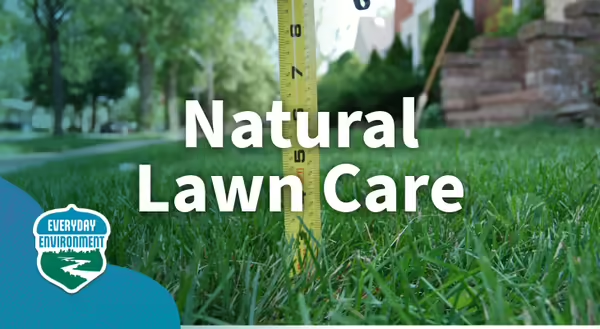
- Mow high at a 2- to 4-inch cut height for cool-season lawns.
- Mow often to avoid cutting more than one-third of the leaf blade at any one mowing.
- Keep your blades sharp so you cut the grass rather than rip or shred it.
What about lawns and pollinators?
While it seems simple, I am somewhat conflicted about this subject. It stems back to what kids said about just having grass in our lawn. My home lawn receives few inputs from me, but it does have turfgrass. It also has:
- Dandelions
- Creeping Charlie
- Mock strawberry
- Dutch white clover
- Plantains (narrow and wide-leaf)
- Common lespedeza (Kummerowia striata)
What are the commonalities of these plants? They all thrive in frequently disturbed space. They do well in low-input lawns. None are native to Illinois or North America.
All these plants also produce flowers that are visited by insect pollinators, but is a lawn that is routinely disturbed by mowing and walking the best place to attract insects? I’m not really sure. Plus, some emerging research suggests these may be lower-quality forage compared to native plants. However, these plants remain pollinator resources, particularly in early-season or resource-limited areas.
The only native plants that grow in my lawn are the common blue violet and nimblewill, a warm-season grass. I’ve never personally observed anything eating my nimblewill, though several species of leafhoppers, aphids, flies, and katydids have been documented on it. Additionally, it is a minor food source for some birds. The common blue violet is considered a moderate to low habitat quality plant, with a C-value of 1. It is a larval host for a few species of fritillary butterflies. I’d hate to be a caterpillar trying to make a go of it on violet in a mowed lawn.
In my opinion, the best way to help our pollinators is to provide more habitat, but the lawn — whether it's perfectly manicured or just mowed occasionally — may not be the ideal spot.
Leave Room for "Mess"
I will say this much about my own lawn: Since the whole thing is a diverse mess, I don’t notice minor issues like turf disease or a patch of weeds. And for me, "if it is green, it is good." I’m still working on convincing my kid.
About Everyday Environment
Everyday Environment is a series of blogs, podcasts, webinars, and videos exploring the intricate web of connections that tie us to the natural world.
Was there something about this blog's topic we didn’t cover? See something cool in nature? Let us know! Hit "Connect with Us" below to send us your question or share your everyday nature observation with and we may share it in a future blog or podcast.
Subscribe to the Newsletter Connect with Us Find Your Local Extension Office
Photo by Janice Milanovich from Lawn to Lake, an Illinois-Indiana Sea Grant program.