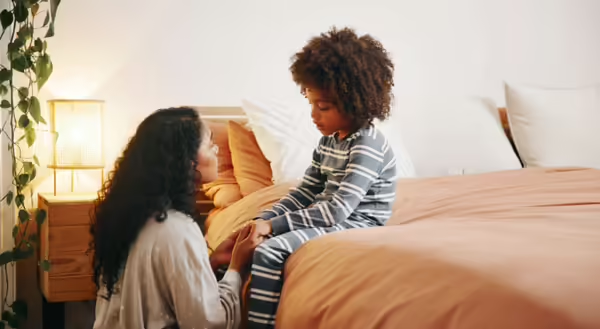
As kids grow older, they face new challenges at school, with friends, and at home. Reflect on your own childhood experiences with all of these factors. You can probably recall at least one past experience that you really appreciated having a parent or trusted adult you could talk to. Talking with a parent or trusted adult can help children handle stress and solve problems. But a new study found that where these conversations happen can make a big difference.
Researchers asked 100 fifth-grade students and their mothers about the places they like to talk about daily problems and worries. They wanted to learn which places felt most comfortable and why. This study specifically talks about the mother/child relationships. But I think it’s important to note that this can be applicable to any trusted adult or parent.
Here are some tips you can use when planning to talk about a sensitive topic with your own children.
Kids Like Comfortable Spaces
Many kids said they preferred talking at home. Their favorite places were their bedroom, the kitchen, and the living room.
Kids liked their bedrooms because they felt private and safe. If they wanted to talk about something personal, their room was a good place to do it. Think about your own childhood bedroom and how much comfort that space provided you. The kitchen and living room were also popular. These spaces made it easy for family members to join the conversation if needed.
Moms Have Different Favorites
Mothers also liked talking at home, but their top choices were the kitchen, their child's bedroom, and the car. Many mothers said the car was a great place to talk. Sitting side by side felt less stressful than sitting face to face. Children often seemed more relaxed and willing to share their thoughts during a drive.
Mothers also liked the kitchen because families often spend time there during meals and daily routines. The dinner table can be used as place where the family reconnects after a busy or hectic day.
Why Place Matters
The study found that both mothers and children liked places that felt comfortable, quiet, and private. They wanted spaces where they could talk without distractions or interruptions.
The researchers also found that regular family routines helped create opportunities for conversations. Talking during mealtime or before bed made it easier for families to connect and discuss problems.
What Parents Can Learn
Parents do not always need to plan a formal talk with their child. Sometimes the best conversations happen during normal daily activities. A chat while making dinner, sitting in the living room, or riding in the car can help children feel safe and heard.
Every child is different. Some may prefer talking in a private space, while others may feel more comfortable in a shared family area. Paying attention to where a child likes to talk can help parents build stronger relationships and better communication.
The study reminds us that good conversations are not only about what we say. They are also about creating a place where children feel comfortable sharing their thoughts and feelings.
Reference
Izenstark, D., Bang, J. Y., Tu, K. M., & Maynard, N. (2025). An exploration of the environmental setting mothers and early adolescent youth prefer to have conversations about daily stressors. The Journal of Early Adolescence, 42(2), 200-229. https://doi.org/10.1177/02724316241240111

Meet the Author
Emily Harmon is responsible for family life programming in the counties of Champaign, Ford, Iroquois, Vermilion, and other parts of Illinois as needed. Emily's areas of interest include working with older adults to provide healthy living and healthy aging programming. She is passionate about providing resources to empower individuals to make decisions for themselves to improve their overall well-being.
Emily is a Champaign County native and earned her Bachelor's and Master's of Science from Eastern Illinois University