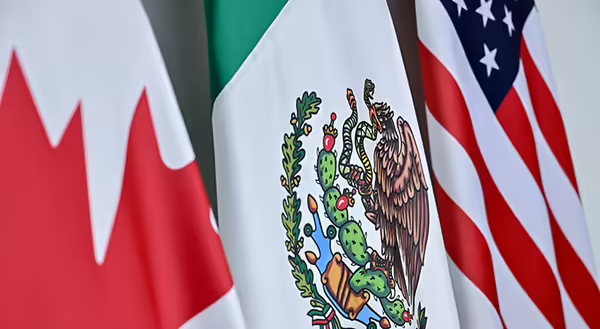
In two previous blog posts, I discussed the importance of international trade for agricultural producers in central Illinois and across the United States, particularly how tariffs impact international trade. International trade agreements can take many forms, with one of the most common being a free trade agreement, which is entered into between two or more countries. An example of a free trade agreement is the United States-Mexico-Canada Agreement, commonly known as the USMCA. First going into effect in 2020, the agreement is facing its first important hurdle: a review by the three nations this summer. The outcomes of the review could massively shape the future of trade and agriculture in North America. This blog post will examine the history of the USMCA and free trade in North America, the agreement's importance to agriculture, and the likely outcomes of the review.
History of the USMCA
Before attempting to understand the future of the USMCA, we must first go back and examine its history and how it came to be. Following the end of World War Two, many countries began exploring opportunities to expand global trade and commerce. However, there were very few rules and laws that governed international trade. The first attempt to set rules for international trade was the General Agreement on Tariffs and Trade (GATT), signed by 153 countries in 1947, which sought to reduce trade barriers and tariffs. While GATT was not an organization, countries that signed the agreement met regularly for negotiations to discuss trade issues and resolve disputes. During the Uruguay Round of negotiations in 1994, 117 countries agreed to create the World Trade Organization (WTO) to establish clearer rules and to serve as a neutral dispute-resolution body.
It is in the context of the WTO and the broader push towards free trade agreements that the predecessor of the USMCA came to be. In 1992, the United States, Mexico, and Canada signed the North American Free Trade Agreement (NAFTA), which came into effect in January 1994. NAFTA eliminated nearly all tariffs and non-tariff barriers on goods produced and shipped between the three countries. This opened the economies of all three countries to new goods and increased investments due to the overall reduction in barriers and increased economic activity. With respect to agriculture, NAFTA required that sanitary and phytosanitary inspections and standards for agricultural products be based on science, a common hurdle for agricultural exports at the time. Studies have shown that NAFTA increased real incomes, expanded trade across all three countries, and significantly increased U.S. agricultural exports to Mexico and Canada. In August 2017, the renegotiation of NAFTA began, which resulted in the USMCA. The USMCA came into effect on July 1, 2020.
USMCA and Agriculture
A 2024 report from the Congressional Research Service found that the agricultural provisions of NAFTA were largely carried over into the USMCA, with some additional changes to sanitary and phytosanitary regulations and biotechnology standards. Tariffs on food and agricultural products eliminated under NAFTA were also eliminated under the USMCA, and products that still had tariffs, such as dairy and poultry, gained new market access opportunities. For example, according to the Office of the U.S. Trade Representative, Canada amended its tariff rate quota for U.S. dairy products that would allow up to 50,000 metric tons of fluid milk and 12,500 metric tons of cheese to enter the Canadian market at a lower tariff rate, and Canadian tariffs on margarine would be eliminated within five years.
A 2019 study analyzed the impacts of the USMCA agricultural policies on agricultural production and labor markets in each country. Specifically, the authors examined what eliminating NAFTA and USMCA policies would mean for agricultural producers. The study found that production of U.S. labor-intensive agricultural products (such as fruits and vegetables) decreased, as much of this production shifted to Mexico, where labor costs are lower. On the contrary, capital-intensive agricultural production in the U.S. (such as row crops) increased. Exports of U.S. agricultural products to Canada and Mexico increased, with Mexico benefiting most from expanded trade opportunities. If the USMCA policies were eliminated and tariffs were reimplemented, then labor shortages in the U.S. would become more severe.
Review Process and Potential Outcomes
Beginning this summer, negotiators from the three countries will meet to discuss the future of the USMCA and decide on the next steps. The USMCA was ratified for an initial 16-year period, with a review at the sixth anniversary of the agreement's entry into force. This means, by July 1 of this year, the three countries will need to reach some kind of agreement on what to do next. Article 34.7 of the USMCA requires that any member wishing to make changes submit the proposed changes at least a month before the joint review. If all countries wish to extend the agreement as is, it automatically extends for another 16 years, with another review after six years. However, if at least one country does not agree to extend, then the countries must conduct annual reviews until an agreement is reached, or the USMCA expires.
An analysis by the Center for Strategic and International Studies (CSIS) examined six scenarios and the likelihood of each. Two scenarios have the lowest likelihood of occurring: a clean renewal (where all countries agree to keep the agreement unchanged) that extends it for another 16 years, and an expiration in 2036. The next lowest possible outcomes are a country withdrawing from the agreement before its expiration in 2036 (which would follow Article 34.6) or the countries moving towards bilateral deals separately from each other. The next most likely scenario is a continuous cycle of yearly reviews and negotiations until a new agreement is reached. This would be caused by one or more countries seeking changes that require extensive negotiations. The most likely scenario in this analysis is an extension, but a painful one. In this scenario, two countries would make concessions to the third to keep the agreement going, even if those concessions may not be popular in their own countries.
So, what will happen with the USMCA review process this summer? The short answer: no one really knows. As I have discussed in previous blog posts, the current state of trade policy in the U.S. remains in limbo after the Supreme Court struck down a slew of tariffs imposed by the current administration in 2025. The USMCA joint review is undoubtedly going to be contentious and possibly messy. What cannot be denied is the overall benefit of economic cooperation between the United States, Mexico, and Canada. As agricultural producers continue to face mounting economic pressures amid high input costs and volatile commodity markets, stability in trade agreements would certainly be a welcome sign as the growing season progresses into the key summer months.