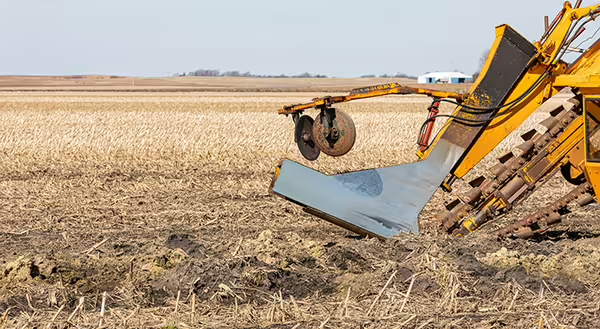
Central Illinois and the Midwest region more broadly is responsible for growing much of the key crops that drive the U.S. agricultural economy. Whether it is corn grown for animal feed or soybeans grown for biofuels, the high quality of farmland in this region is perhaps the most important factor behind crop growth. But there is something else that is vitally important to grow crops in the Midwest; something that is below the soil surface that many people do not think about. Sub-surface drainage systems, often called tile drainage, helped transform Midwest fields from being oversaturated to the best fields in the world. Utilizing these drainage systems offers many benefits to producers, but there are some environmental concerns, particularly with nutrient losses through water runoff.
A recently published report from the United States Department of Agriculture Economic Research Service (USDA-ERS) explores the trends in drainage system adoption and usage, along with the conservation practices used in the fields with these systems. Given how popular drainage systems are in central Illinois fields, understanding how these systems work and how farmers can properly manage them can have a significant impact in future crop production.
How does artificial drainage work?
A brief note on the term tile drainage. When artificial drainage systems first became popular in crop production, they were commonly constructed using clay tiles that would be installed by hand. In fact, many of the drainage systems in fields today may still be older clay tiles. However, since the 1960s, clay tiles have been replaced with plastic tubing or pipes that contain pores and are installed using specialized trenchers or plows.
The pipes are installed at a depth which prevents the root zone in a field from becoming oversaturated during rainfall events. When the soils become too saturated, the excess water seeps into the pipes through the pores and drains towards the outlet. An outlet can be a ditch, wetland, pond, or even another pipe managed by a drainage district. Since these systems rely purely on gravity to move the water, the slope in a field and in the pipes themselves is important. The higher the slope, the faster water can move through them and take water away from the field. The spacing, depth, and size of drainage pipes can also have an impact on how effective they are in moving excess water. Pipes in the field are usually three to four inches in diameter, with outlets being as big as 12 inches wide.
Trends in Drainage System Adoption
It comes with little surprise when the report, using data from the USDA Census of Agriculture, found that Illinois, Indiana, Iowa, and other Midwestern states have the most tiled acres in the United States. The report found that, in 2022, there were approximately 53.2 million acres that had a tile drainage system, which is roughly the size of the state of Idaho. For context, there were roughly 382 million acres of cropland in the entire United States in 2022. It is also no surprise that corn and soybean acres have the highest share of tile drainage, with roughly 40% of corn and soybean acres having a tile drainage system.
Spacing of drainage pipes can have an impact on the ability to move water away from the field, but the closer the spacing, the more expensive it is to install and maintain. Relying on soybean production data from 2018 and corn production data from 2021, the report examined the average spacing and age of tile systems. Nationally, the average spacing was roughly 60 feet between runs in both corn and soybean acres. In Illinois, the average spacing in both corn and soybean acres was roughly 80 feet. The average age of tile systems in the United States is roughly 30 years, with the Illinois average increasing to over 40 years.
Conservation Practices and Considerations
Tile drainage can be a beneficial management tool for producers, but a field with tiling requires a different approach that a non-tiled field. Because runoff from a field is the primary source of nutrient loss, farmers must consider how their nutrient and other input applications affect the local ecosystem. The report found that, on average, farmers apply 151 pounds of nitrogen per acre and 56 pounds of phosphorus per acre on tiled fields compared to 140 pounds of nitrogen and 47 pounds phosphorus on non-tiled fields. The report notes that this is usually down to tiled fields having higher yields, so more nutrients are needed. Furthermore, 46% of tile drained fields see fall nitrogen and phosphorus applications, which is higher than non-tiled fields. Because nitrate-nitrogen is easily carried by water, many producers will us a nitrogen inhibitor product to lock the nitrogen in the soil. Around 30% of tiled fields had a nitrogen inhibitor applied compared to only 14% of non-tiled fields.
To further prevent nutrient loss through runoff, producers can adopt several practices that prevent excess nutrient loading into the water system. Perhaps the most widely known is cover crops. Certain species of cover crops are best at locking nutrients in the soil for the following cash crop. However, despite the benefits of cover crops, the report found that tiled-drained acres had lower adoption rates than non-tiled drained acres. In addition to cover crops, producers can install a saturated buffer or retention pond at the outlet. This serves as another barrier to prevent nutrients from escaping into the water system. Less than 10% of tiled corn acres in 2021 emptied into a receiving system such as a constructed wetland or bioreactor. Only five percent of tiled corn acres emptied into a saturated buffer or retention pond. This report emphasizes that, despite the benefits of these conservation practices, famers with tiled acres have been slow to adopt them.
Of all the production tools and practices that crop producers in central Illinois have at their disposal, tile drainage is one of the most important. Artificial drainage systems have transformed Midwest cropland from soggy, swampy mess into the most productive cropland in the world. As the USDA report discusses, farmers with a drainage system in their field can enjoy several benefits, but there are also some environmental concerns that must be considered. Proper management and use of these drainage systems is vital for producers if they want to maintain productivity. Additionally, environmental practices to protect the water system must be considered in order to achieve broader conservation goals.