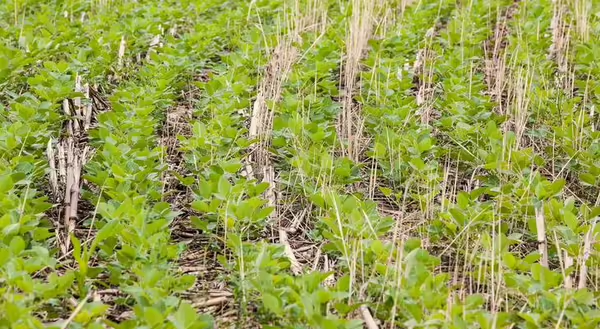
Crop producers in central Illinois have a wide range of management decisions to make throughout the year. This leads to a series of often difficult decisions to make before, during, and after the growing season. What type of tillage is needed? How much fertilizer should be applied? When is the desired planting date, population, and row spacing? When should an herbicide or fungicide be applied? All these decisions require adequate time and understanding of the pros and cons. As harvest is beginning across central Illinois and the rest of the Midwest, one decision that may loom at the forefront of a producer’s mind is cover crops.
The benefits of adopting cover crops have been widely explored and explained for some time. They offer a wide range of benefits, including (but not limited to): protecting soil from erosion, controlling weed pressure, holding moisture in the soil, locking soil nutrients (such as nitrogen) into the soil, and building organic matter. Certain species of cover crops are better at some of these than others, so the decision as to what cover crop to plant and how much to plant is an important one. Two recent studies attempt to answer these questions by not only exploring the benefits of different cover crops, but also how various characteristics affect the cash crop that follows. These studies highlight how proper cover crop management can help producers maximize the benefits cover crops provide.
More Time Means More Biomass
To help get the full benefits of some cover crop species, biomass is the most significant factor. Simply put, the more biomass, the better a cover crop can help control weeds, lock nutrients and moisture into the soil, and protect the soil from erosion. However, terminating cover crops at the right time to plant the following cash crop is another important consideration. So, when should cover crops be seeded, and when should they be terminated in order to maximize biomass while also not interfering with cash crops? An article published in Agrosystems, Geosciences, and Environment examined how planting and termination timing influences biomass production in different cover crops.
Across two trial years in Nebraska, researchers planted four different cover crops: wheat, winter rye, triticale, and canola. With each cover crop, the researchers studied the difference in biomass between two different seeding/termination periods: seeding in early October and termination in mid-April, and seeding in mid-September and termination in early May. The seeding rates for each cover crop was 103 kg/ha (91.89 lbs./acre) for wheat, 68 kg/ha (60.67 lbs./acre) for rye, 93 kg/ha (82.97 lbs./acre) for triticale, and 9 kg/ha (8.03 lbs./acre) for canola.
The results from this study found that seeding earlier and terminating later increased biomass across all four cover crops. Specifically, by moving seeding to mid-September and termination to early May, there was a 158% increase in wheat biomass, a 112% increase in rye biomass, a 131% increase in triticale biomass, and a 247% increase in canola biomass. Maximizing the growing period in the fall gave the cover crop enough time to grow and develop biomass before the first frost and freeze.
Among the four cover crops, winter rye produced the most biomass, producing as much as 7,249 kg/ha (6,467.06 lbs./acre). It should be noted that the study found variation in biomass production depending on the area in Nebraska and the conditions during the growing season. According to the researchers, winter rye performed so well due to its excellent cold and drought tolerance, an extensive root system, and its ability to rapidly grow a canopy. Furthermore, according to the Midwest Cover Crops Field Guide, winter rye also is excellent at preventing erosion, fighting weeds, and locking nitrogen into the soil. The researchers further noted that triticale performed well, partially due to it being a hybrid between rye and wheat, and thus having many of the same traits as rye.
This study further demonstrates how important planting and termination timing are when managing cover crops. Seeding a cover crop early and giving it enough time to grow before the first frost/freeze dates, regardless of the species, helps to further maximize biomass production and the overall benefits that a cover crop can provide. The study suggests that extending the growing period may be one of the most effective ways to increase biomass production.
Impact of More Biomass on Corn Yields
The Nebraska study highlighted the biomass-producing potential of winter rye. But the study solely focused on biomass and how seeding and termination timing affected biomass production. It is important, therefore, to consider how more biomass impacts corn production. A study published in the Agronomy Journal in 2026 examined how rye seeding rate and biomass production affected corn stands and yields in southern Illinois.
There were two simultaneous studies across 2020 and 2021. The first tested biomass production across four different seeding rates: 34 kg/ha (30.33 lbs./acre), 56 kg/ha (49.96 lbs./acre), 84 kg/ha (74.94 lbs./acre), 112 kg ha/kg (99.92 lbs./acre). The rye was seeded in mid-November (year 1) and mid-October (year 2), and then was terminated using glyphosate in late April (year 1) and early May (year 2). The second study tested two different rye varieties (one normal and one hybrid) at two seeding rates to evaluate the effects on biomass production, nitrogen in the soil, and the effects on corn growth and yields. The seeding rates for both varieties were 67 kg/ha (59.78 lbs./acre) and 101 kg/ha (90.11 lbs./acre). The varieties were seeded in mid-to-late October in both years and terminated in late April (year 1) and early May (year 2).
The results for the first study (the four seeding rates) showed some variations but did provide some key findings. First, the researchers found that for each 1 kg/ha (0.89 lbs./acre) increase in seeding rate, the biomass increased by 72 kg/ha (64.24 lbs./acre). This result was expected, as more plants generally resulted in greater biomass production. Second, nitrogen uptake and soil nitrate levels were similar across all seeding rates, indicating that even lower seeding rates can offer the same retention rates as the higher seeding rates. Third, while tasseling and plant height were not impacted, the corn yield was 14% higher at the lower seeding rates than the higher seeding rates in year 2, but no yield impacts were observed in year 1. Fourth, each 1 kg/ha increase in seeding rate decreased the corn stand density by roughly 61 plants/ha (24.7 plants/acre). These results indicate there are some tradeoffs between seeding rates and corn production, an important factor to consider when picking a seeding rate.
Turning to the second study (different rye varieties), there were again some variances between year 1 and year 2. In year 1, the hybrid variety (regardless of seeding rate) produced more biomass than the normal variety, though this was not seen in year 2. The researchers also found no difference in the nitrogen concentration in the plant across both years no matter the variety. Furthermore, neither variety affected yields, but both varieties affected stand counts at different levels. The stand count for the normal variety at both seeding rates was slightly higher than the stand count for the hybrid variety at both seeding rates. Together, the two trials suggest that while higher seeding rates can increase biomass production, they may not provide additional agronomic benefits. In fact, the lower seeding rates offer the same benefits as the higher rates, particularly with nitrogen and nitrate concentrations.
Using cover crops is a popular management strategy that countless producers across central Illinois and the Midwest utilize on a yearly basis. But the decision to adopt cover crops is a complex one that requires producers to weigh the pros and cons. The research discussed in this article shows that maximizing cover crop benefits involves more than simply maximizing biomass production. The study from Nebraska emphasizes that more growing time will lead to more biomass. The study from Illinois reminds producers that more biomass does not automatically lead to more benefits. Ultimately, the successful cover crop management comes down to selecting the right species, planting at the right time, and choosing a seeding rate that helps achieve the goals of the operation.