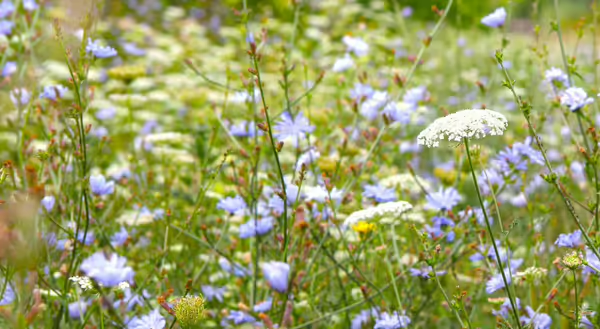
In 2017, Illinois Extension horticulture educator Rhonda Ferree shared a roadside inventory of late-summer flowers in her blog post, Roadside Flowers. Readers were encouraged to look for species such as chicory, red clover, Jerusalem artichoke, and Queen Anne's lace along Illinois roadsides.
After paying closer attention to roadsides during recent drives through central Illinois, I noticed many of those familiar plants. Goldenrod and Queen Anne's lace are commonly seen along the road. Smaller patches of chicory, red clover, evening primrose, and sunflower relatives can still be found. At the same time, many roadsides appear to be dominated by grasses and annual weeds such as giant ragweed.
These observations raise an interesting question: what factors help some roadsides support diverse wildflower communities while others have far fewer blooms?
Why Do Some Roadsides Support More Flowers Than Others?
Roadsides are difficult places for plants to grow. Heat from pavement, compacted soils, road salt, and regular disturbance all place stress on vegetation.
Research from the University of Illinois found native plants were less common in roadsides with higher nutrient levels and greater disturbance.
Conditions that favor fast-growing grasses and weeds may work against many native wildflowers.
Mowing practices also influence what grows along roadsides. Many flowering plants need time to bloom and produce seed. Frequent mowing during the growing season can limit flowering and reduce opportunities for plants to spread naturally. Over time, grasses and a few aggressive species may become more common than flowering plants.
Past roadside seed mixes may also play a role. Many roadsides were planted with grasses chosen for erosion control and quick ground cover. While these plantings serve important functions, they often provide less flower diversity than seed mixes that include native wildflowers.
Flowers Across the Growing Season
A healthy roadside does not bloom all at once. Different plants provide flowers at different times of the year.
Early-season flowers support bees and other insects emerging from winter. Summer blooms provide nectar and pollen during peak activity. Late-season flowers are especially important because many pollinators remain active into fall. Monarch butterflies also depend on late-season nectar sources during migration.
The flowers observed along roadsides this August represent only part of the growing season. A diverse roadside includes a mix of species that bloom from spring through fall.
Growing More Than Weeds
Improving roadside diversity does not always require more inputs. In many cases, management practices can be adjusted to encourage a wider range of plants.
One approach is to focus regular mowing near the pavement while reducing mowing farther from the road. Some roadside programs maintain a safety strip of about six feet next to the roadway while allowing vegetation beyond that area to grow and flower. This approach helps maintain visibility while providing habitat for pollinators and other wildlife.
Less frequent mowing gives flowers time to bloom and produce seed. It also allows desirable plants to compete more effectively with annual weeds.
Native plants can help control weeds as well. A healthy stand of native grasses and wildflowers occupies space that might otherwise be filled by giant ragweed and other problem species. Once established, these plants compete for sunlight, water, and nutrients, leaving fewer opportunities for weeds to become established.
When weed control is needed, targeted management of problem areas is often more effective than treating an entire roadside. Controlling invasive or noxious weeds while preserving desirable flowering plants can help maintain both plant diversity and habitat value.
Not all roadside flowers are native. Some familiar species, including chicory, Queen Anne's lace, and red clover, were introduced from Europe. Many current roadside restoration efforts focus on increasing the diversity of native grasses and wildflowers because they provide food and habitat for pollinators and are adapted to local growing conditions.
More Than Roadside Beauty
Roadside vegetation provides more than seasonal color.
Diverse plant communities help stabilize soil and reduce erosion. Their roots help hold soil in place and improve water infiltration. Vegetation can also help filter runoff before it reaches streams and lakes.
Roadsides provide habitat as well. In a fragmented landscape, roadsides can connect small patches of habitat. These corridors provide food and shelter for bees, butterflies, birds, and many other species.
Research conducted by the University of Illinois and the Illinois Department of Transportation suggests native species can be a practical part of roadside plantings when matched to site conditions and managed appropriately.
Illinois roadsides serve important transportation and safety functions. They can also provide habitat and seasonal interest. Goldenrod and Queen Anne's lace still brighten many roadsides in late summer. With thoughtful management, they can be joined by a wider variety of native flowers that support both wildlife and the people who enjoy the view.
Ferree, R. (2017). Roadside Flowers.
Illinois Center for Transportation (2025). Planting the seed for native species on Illinois roadsides.
Xerces Society. Managing Roadsides and Rights-of-Way for Pollinators.