by Sarah Smith, Extension Master Naturalist and Master Gardener
Rayo Boursier grew up on Grand Lake in Minnesota, immersed in nature and centering all her daily activities on the outdoors. As one of six children, she was free to spend her time independently swimming in the lake (a mile across!) or fishing, hiking to the creek a mile away or walking around the lake. Her outdoor educational encounters brought knowledge about bugs, insects, water and fish. She also learned how to survive the elements and read the lake through the foam on the shore, the algae and the weeds.
Rayo and her husband have moved several times, and each location has brought greater understanding of soils and climates. Their most recent move to their current home was in 2013, where they transplanted their ferns and hostas from their previous home in Wisconsin. Rayo’s love of hostas has grown through her involvement in the Central Illinois Hosta Society. However, she does realize they aren’t native and they require management from the deer population grazing. One year in a small area of their yard, there were fourteen deer and Rayo has noticed that the over population and overgrown tree canopy has drastically changed their woodland. She attributes her hostas’ survival to their Vizsla dog alerting them to the presence of deer.
Gardening exposure originating from Minnesota neighbors’ small gardens based in rich loam soil and lush in plants, didn’t adequately prepare Rayo for the Illinois clay soil. Seeking solutions, she signed up for the Extension Master Gardener program and subsequently Conservation@Home. It was there where she gained a greater understanding of working with clay soil, making soil amendments and figuring out what would successfully grow. She was inspired by a native perennial garden tour where Nicole Flowers-Kimmerle spoke extensively about native plants. Learning through trial and error in her home garden, Rayo found most of the successful plants were native plants that adapted with the soil without the need for amendments. As she recalls, she “used to joke that if it’s growing in my garden, I didn’t plant it, I just let it live.” She found beauty in letting the native plants be and gained knowledge through observing their natural habits and processes.
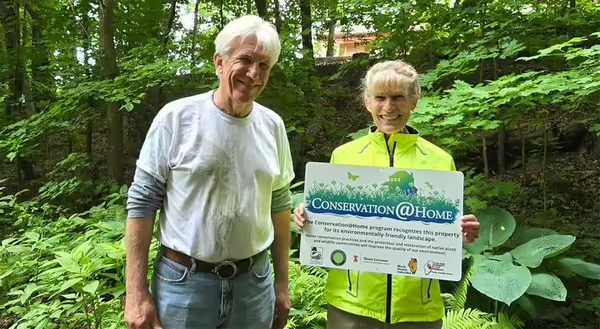
Having a son in the Eagle Scout program, Rayo gained additional conservation and environmental knowledge and through their involvement was able to take part in planting hundreds of small oak saplings. Though she didn’t initially expect to certify her yard, Rayo thought she would benefit from the process and recommendations of C@H evaluators. At just under seven acres, her wooded property is varied terrain and flora, with some areas cleared for entertaining. She already had most or all the certification elements in her yard including a compost pile to make leaf mulch. If needed, she supplements that with mulch from the local nursery. Sustainable yard practices that she’s incorporated into management of the property include reducing yard area/mowing and utilizing an electric mower, minimal use of herbicides for invasive eradication (poison ivy and bush honeysuckle) and continued work on water management. Some deterrents have been the constant pressure from the honeysuckle, deer, woodchucks, raccoons, fox and coyote. In the beginning, Rayo says she wasn’t using natives as an intentional sustainable practice. She used them because she recognized they were plants that could grow successfully in clay soil and in a direct way the plants themselves were her teachers. Examples of natives she started with and that did well were Joe Pye weed, boneset, asters, woodland phlox, ephemerals, iron weed, monarda, native geraniums, coneflowers and native ferns. Being surrounded by woodland, she says the plants that thrive the most are ephemerals in the spring. The woods are abundant with spring beauties, Dutchman’s breeches, bloodroot, asters and columbine. In the summer she finds success with goldenrod (that needs occasional thinning), monarda, Joe Pye weed, milkweed and coneflowers. Something new she has learned through the process is to read labels before use, stating that, “it’s the law and enlightening.” An example she gave was that she loves roses but had trouble with saw fly larvae and started spraying chemicals to alleviate the problems. Then she noticed the butterflies disappeared and ironically, the roses she didn’t spray were the ones that prospered.
Having limited time, Rayo appreciates that the C@H program isn’t concerned about perfection but about effort toward conservation goals. She says that ridding her property of bush honeysuckle is a daunting task and challenges the limits of her energy, but the effort is the goal. In her efforts, she looks to Extension resources with their many lists and blogs. She searches the internet for plant names and ideas and finds botanical gardens and Amy Powers (powers_plants on Instagram) to be knowledgeable sources. For those that want to incorporate C@H principles into their home landscapes, Rayo recommends asking a lot of questions. Current and future goals for her property include more flowers and less work, something we can all endorse.