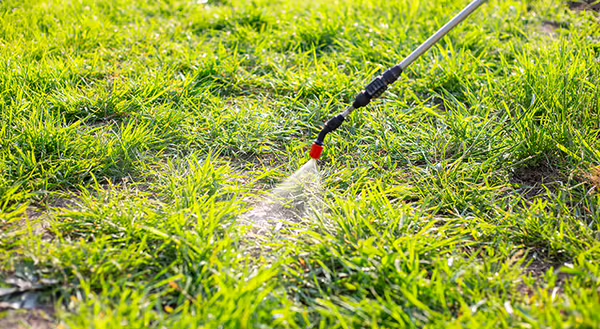
As a landscape professional, communicating with your clients is vital. A solid relationship built on trust can yield continuous business. Communication with clients should be informative and timely. That investment of time spent with them is valuable because you can gather their needs or wants and also be able to inform them of any needed procedures. This can be easy to do with single family units but for more commercial settings it isn't as easy to have those one on one conversations. In Illinois, there are some very specific requirements for communicating to clients when a lawn care product is applied. The Illinois Lawn Care Application and Notice Act, is in place so that regardless of a personal conversation where information may be forgotten, misinterpreted or misunderstood, clients or residents are notified quickly of applications. Also, they are provided a way to contact the applicator in case they have any questions about what was applied. Further information is provided about using the lawn after treatment, including reentry intervals or risks to animals. Applicators must provide all of this information at the time of application. Additionally, safety data sheets and product labels for each product applied are to be provided upon request.
Also, any neighbor whose property abuts or is adjacent to the application site may request prior notification of applications. This request may be made by providing to the applicator (or their company) their name, address, and phone number. Please keep in mind that if you live in an apartment complex, condo, or an Home Owners Association (HOA), it is your personal responsibility to make this request. No one is going to do it on your behalf. You will need to contact the appropriate lawn care company to request that prior notification be given to you. The applicator must then provide written or verbal notice at least one day before the application. If notice cannot be given because the person is absent or inaccessible, then written notice is left at the residence at the time of application that includes the date and approximate time of application.
The Lawn Care Application and Notice Act is found here on the Illinois General Assembly website. Below is a condensed version for just lawn care applicators. Please note that the Act also includes requirements for golf courses.
According to the Lawn Care Products Application and Notice Act and Rules, lawn markers (typically flags) are to be placed immediately following an application of lawn care products. Under the law, both fertilizers and pesticides are considered lawn care products. This also includes products that are registered to use as Organic.
So applicators, if you are under contract to treat the common areas of a townhouse subdivision, you need to post the lawn markers immediately after you treat the main entrance areas (usual points of entry). Do not wait to post until the entire subdivision has been treated. Single-family residences are much simpler, because they have a single point of entry and the placing of lawn markers is done immediately following the treatment.
In Illinois, there are very specific requirements for the size and color of the lawn markers. The marker must be a 4-inch by 5-inch sign attached to a dowel or other support, extending no less than 12 inches above the turf. Regardless of what your company's colors are, the lawn marker must be white with contrasting colored lettering and the lettering height must not be less than 3/8 inch. Each lawn marker must state the following:
"LAWN CARE APPLICATION – STAY OFF GRASS UNTIL DRY – FOR MORE INFORMATION CONTACT:" (your business name and telephone number should be inserted here).
Lawn Markers are required immediately after an application of the lawn care product. The lawn marker must be put at the point or points of entry. The marker can then be removed by the resident 24 hours after application.
These markers alert customers and nearby residents that an application has been made to the lawn. They also provide contact information so that one can ask what was applied to the lawn. As a lawn care applicator it is your responsibility to provide accurate information to the ones that call or make an inquiry. The information that you provide includes:
- Name brand of product, common name and scientific name
- Type of fertilizer or pesticide (regardless of organic or synthetic)
- The reason for use
- The amount applied and concentration of the product
- Any special instructions that might apply to the customer's use of the lawn (reentry or animal restrictions)
- The business name and phone number as well as the name of the applicator
- The Material Safety Data Sheet and a copy of approved product label, if this written product information is requested.
The time we take to discuss application information with our clients and neighbors can help build lasting relationships and trust. It allows for clients to have peace of mind and know that when they set out for a walk with their dog or have their children romp in the yard that they are keeping them safe. Remember regardless of organic status, if it is a fertilizer or a pesticide the same rules apply. If you should have any questions, please feel to contact the Pesticide Safety Education Program or the Illinois Department of Agriculture.
Adapted by Michelle Wiesbrook from an article by Maria Turner, formerly with PSEP, currently with the Illinois Department of Agriculture.
Photo credit: AdobeStock by Natalia
ABOUT THE AUTHOR: Michelle Wiesbrook provides subject matter expertise and training in pesticide safety with an emphasis on horticultural weed science. She serves as the Illinois Pesticide Review newsletter editor, collecting and organizing material; and co-coordinates social media information for the PSEP program and ensures its timely publication. Her other interests include herbicide injury and invasive species.