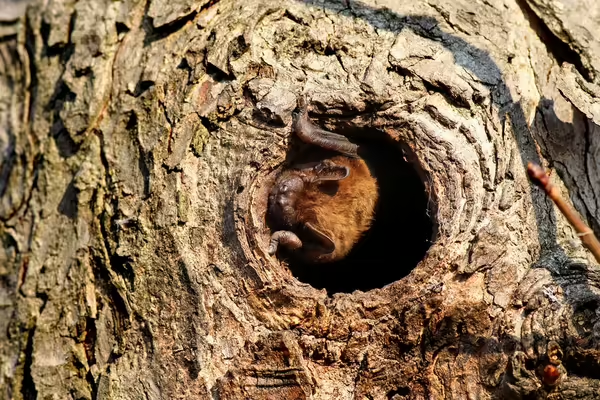
All over the world, from Oregon’s old-growth forests to Queensland’s eucalyptus groves, creatures depend on trees for shelter. A new analysis from the University of Illinois Urbana-Champaign suggests that as the climate destabilizes, the world’s trees may become an even more important respite. That’s because, the study finds, trees everywhere buffer their animal tenants from temperature extremes.
“We’ve seen mass mortality events in both birds and bats in recent years due to extreme heat. Our meta-analysis finds that, on average, tree cavities can stay 3-4 degrees Celsius cooler than the outside air, with some larger or deeper cavities staying up to 15 degrees cooler,” said senior study author Joy O’Keefe, associate professor and wildlife Extension specialist in the Department of Natural Resources and Environmental Sciences (NRES) and Illinois Extension, both part of the College of Agricultural, Consumer and Environmental Sciences at Illinois.
Three or four degrees doesn’t sound like a lot, but when the outside air approaches deadly extremes, that difference can keep cavity-dwelling animals alive. And not just on hot days. Tree cavities also provide slightly warmer microclimates when it’s cold, an especially important feature for some animals during gestation or when babies are left alone in the nest.
O’Keefe and her collaborators have spent more than a decade studying natural and artificial roosts for bats, focusing much of their attention on the animals’ ability to thermoregulate in various roost configurations. Among other insights, they’ve shown that natural roosts — tree cavities, peeling bark, and other tree crevices — offer greater protection from temperature extremes than most artificial roosts.
Read the full article from the College of ACES.
Photo: Many animals, including the common noctule bat, use tree cavities as habitat.
University of Illinois Extension develops educational programs, extends knowledge, and builds partnerships to support people, communities, and their environments as part of the state's land-grant institution. Extension serves as the leading public outreach effort for University of Illinois Urbana-Champaign and the College of Agricultural, Consumer and Environmental Sciences in all 102 Illinois counties through a network of 27 multi-county units and over 500 staff statewide. Extension’s mission is responsive to eight strategic priorities — community, economy, environment, food and agriculture, health, partnerships, technology and discovery, and workforce excellence — that are served through five program areas — 4-H youth development, agriculture and agribusiness, community and economic development, health and community wellness, and natural resources, environment, and energy.