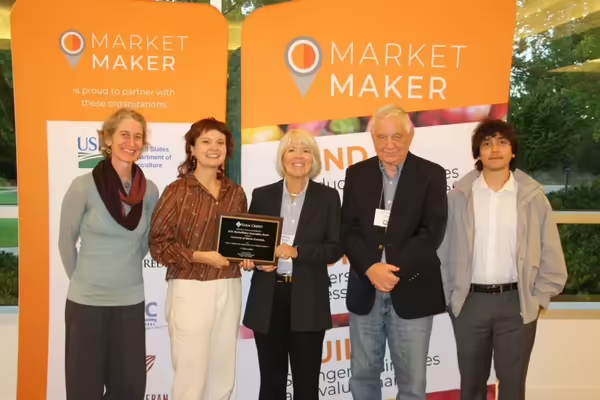
URBANA, Ill. – University of Illinois Extension won first place in the 2026 Farm Credit MarketMaker Innovation Awards for the Illinois Food System Asset Mapping Initiative. This recognizes Extension’s efforts to map the middle of the supply chain for Illinois farmers and food businesses. The awards showcase best practices in using the MarketMaker platform, and recognize projects that connect producers to markets and improve access to healthy, local foods.
Extension team members Makala Bach and Megan Murphy, along with Illinois undergraduate Santiago Pinilla Leon, accepted the award at the National Agricultural Marketing Summit in Raleigh, North Carolina, on Oct. 20.
The Illinois Asset Map is a public, statewide map of “missing middle” infrastructure in the local food supply chain. This includes activities between food production and consumption, such as processing, aggregation, and cold storage.
The Illinois Asset Map is designed to help:
- Producers identify options for processing, storing, and distributing their products.
- Policymakers and funders identify gaps and investment opportunities.
- Local leaders connect with existing assets, build partnerships, and avoid duplicating efforts.
“The Illinois Asset Mapping Initiative was born out of community listening sessions and continues to be shaped by farmers and food systems partners across Illinois. It’s incredibly rewarding to have our community-driven process recognized nationally. Thanks to the monetary award from Farm Credit, we can continue engaging students to support our data vetting process,” said Makala Bach, project lead for the initiative and Extension food systems outreach associate.
The Illinois Asset Map is in the beta phase. Visitors can explore and provide feedback regarding the map’s usability, data, and other features.
With over 150 food system stakeholders from across the state providing feedback during its development, the Illinois Asset Map lays the foundation for stronger regional food system connections. State policy organizations have expressed interest in using the map’s data to advance legislation supporting local food production and procurement. Other states have also expressed interest in adopting a similar tool for their regions. Overall, users nationwide have received the tool well, and it provides a strong platform for building a more resilient local food system across Illinois.
For more information about the Illinois Asset Map, visit the Illinois Food Systems Hub.
About Food MarketMaker: Food MarketMaker is a collaborative national network connecting agricultural producers, food businesses, buyers, and organizations through searchable business directories, georeferenced data and interactive mapping applications. Working with universities, state departments of agriculture, and agricultural organizations, MarketMaker develops shared digital resources to help users discover market opportunities, understand food supply chains, and inform business and investment decisions. Developed at the University of Illinois Urbana-Champaign, MarketMaker is licensed to and managed by Global Food and Agricultural Network, LLC.
SOURCE: Makala Bach, Extension outreach associate, Illinois Extension
WRITER: Beth Peralta, assistant director, digital education strategy, Center for Food Systems, Nutrition Security, and Health Integration, Illinois Extension
EDITOR: Herbert Chavez, media communications coordinator, Illinois Extension
INTERVIEWS: Contact Beth Peralta at cavaller@illinois.edu to request interviews on this.
University of Illinois Extension develops educational programs, extends knowledge, and builds partnerships to support people, communities, and their environments as part of the state's land-grant institution. Extension serves as the leading public outreach effort for University of Illinois Urbana-Champaign and the College of Agricultural, Consumer and Environmental Sciences in all 102 Illinois counties through a network of 27 multi-county units and over 500 staff statewide. Extension’s mission is responsive to eight strategic priorities — community, economy, environment, food and agriculture, health, partnerships, technology and discovery, and workforce excellence — that are served through five program areas — 4-H youth development, agriculture and agribusiness, community and economic development, health and community wellness, and natural resources, environment, and energy.