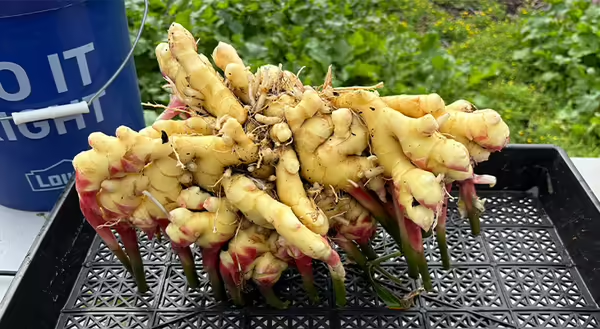
In 2025 and 2026, a group of Extension field staff and small farmers have been working together to better understand best practices of production for fresh (a.k.a. baby) ginger rhizome, so that future specialty growers wanting to grow ginger in Illinois will have a firm grasp of the pitfalls, possibilities, and expectations when approaching this niche crop. Pictured is ginger rhizome harvested by Nick Frillman, Illinois Extension, from the Unity Community Center Food Production and Research Garden in Normal, IL.
Over two field seasons, four production methods have been tested, and four cultivars have been evaluated from two “seed” rhizome vendors by our team to evaluate performance differences among production environment and cultivar. Production took place in 2025 and 2026. All project partners tested some but not all environments and cultivars, but cumulatively each growing environment and cultivar was tested at least twice per season.
Various specialty growers and Extension services across the country have evaluated most of these ginger production possibilities at one time or another in the last decade or so, but to our knowledge they have not been systematically evaluated simultaneously over multiple seasons in one project.
Production methods tested:
- High tunnel, in-ground production (soil plus compost and fertilizer amendments)
- High tunnel, container production (potting media plus compost and fertilizer amendments)
- Outdoor, in-ground production (soil plus compost and fertilizer amendments)
- Outdoor, container production (potting media plus compost and fertilizer amendments)
Cultivars tested:
- ‘Yellow’ (previously called Hawaiian Yellow)
- ‘Buffalo Gung’
- ‘Bird’
- VNS (variety not stated) yellow-colored ginger
At the Unity Community Center Food Production and Research Garden in Normal, two production methods (Outdoor container production and Outdoor in-ground production) along with two cultivars (VNS yellow and ‘Bird’) were tested in 2026. Harvest took place on October 13th and 14th, due to our weather forecast calling for unseasonably cool temperatures in the high 30s on the 17th and 18th of October. Ginger rhizome is a tropical crop, and the harvestable crop portion (the rhizome) can experience damage if soil temperatures drop below 45F for any prolonged period.
Data analysis has not yet been done but I wanted to give specialty growers around the state a preview of what is to come. Long story short, I think we are at the beginning of a very interesting ginger production phase in Illinois.
On October 13, we harvested our outdoor, container-grown ginger. The container-grown ginger at my site was part of a replicated trial that looked at how ginger rhizome would perform under differing levels of fertility applications. All treatments were grown in industry-standard potting media and given starter slow-release fertilizer, then varying levels of additional amendments of fertilizers. We used exclusively the variety-not-stated, yellow-colored ginger cultivar for our container treatments.
For the purposes of this newsletter addition, I will report only on the high-fertility treatment for now since it is the level of fertility we would expect for-profit specialty grower enterprises to utilize.
The average amount of harvested fresh-market ginger rhizome per 10-gallon polypropylene grow bag was 6.2 pounds, (3 rhizomes planted per grow bag), representing about $155 in retail value, (assuming $25/lb, retail). Per plant harvest averages were just over 2 pounds per plant.
The outdoor-grown ginger was grown in a silty clay loam soil with 5% organic matter. Rhizomes were planted in 8” trenches dug on May 14, filled with 2” of plant-based compost, and fertilizer applied in the trench, rhizomes placed on top of compost and fertilizer, and displaced native soil from planting trench broken up into small aggregate size and placed back over rhizomes. Rhizomes were planted 12” apart within row in single row plantings for the purposes of individual plant analysis at harvest. On October 14, we harvested our outdoor, in-ground ginger.
The average amount of fresh-market ginger rhizome harvested per plant was 2.5 pounds, representing about $62.50 per plant, assuming $25 per pound retail price). The total harvested rhizome from 2’ x 12’ by 3’ rows of ginger was just under 60lbs – about 75 ft. sq. of planting space.
I will be releasing more updates as the data analysis for other ginger projects takes place over the next few months together with my Illinois Ginger Collaborative team. Ginger production this year was not without its pitfalls. Perhaps the singular biggest challenge in fresh ginger production is the potential for seedborne disease outbreak, coming to growers on the exterior of ginger rhizome “seed”. Ginger – like garlic – is asexually propagated planting material and thus subject to the same issue of pathogen buildup in planting stock. In the next issue of IFVN, I will discuss diseases that were identified during the 2026 field season at the Unity Community Center Food Production and Research Area.