
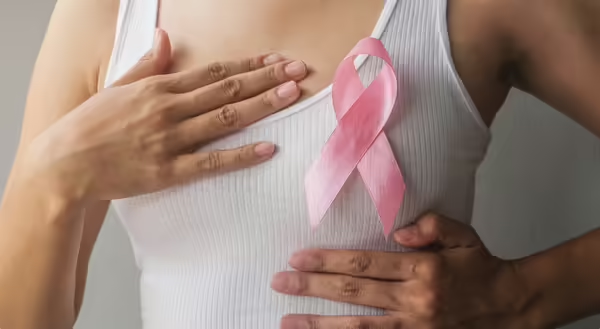
October commemorates Breast Cancer Awareness Month. We honor and support those affected, remember those we have lost, encourage regular screenings, and remind everyone that knowledge and early action can save lives. While October highlights breast cancer, the reality is that breast cancer is affecting lives every single day, twelve months of the year.
Key Stats in Women
Breast cancer is the second most common cancer in women, after skin cancer, affecting roughly 1 in 8 women in the United States over their lifetime. This year, approximately 382,640 women in the U.S. will be diagnosed with breast cancer—including 321,910 with invasive breast cancer and 60,730 with non-invasive (in situ) breast cancer. Invasive breast cancer occurs when cancer cells break through the lining of the milk ducts or lobules and grow into surrounding tissue, with the potential to spread to lymph nodes or other parts of the body.
Most breast cancers are found in women 50 years of age or older, but breast cancer in women under 50 is on the rise. It is estimated that 9% of all breast cancers diagnosed in U.S. women are in 45 years of age or younger. Breast cancers diagnosed in this age group tend to be more aggressive.
Early detection and treatment significantly increase survival rates. When caught in its earliest, localized stages (invasive cancer that has not spread outside of the breast), the 5-year relative survival rate is over 99%. Guidelines generally recommend annual screening mammograms for average-risk women starting at age 40. Talk with your medical provider, as certain risk factors may affect when and how often you should have screening mammograms.
Men and Breast Cancer
- The average lifetime risk of men developing breast cancer is about 1 in 755.
- It is estimated that 2,670 men will be diagnosed with invasive breast cancer. This is less than 1% of all breast cancer diagnoses in the United States.
Awareness
Raising awareness should happen every month. One way to do so is to get familiar with your body and learn what normal feels like for you. Monthly breast self-exams are not meant to diagnose but to help you become aware of what your body feels like and to detect any suspicious changes. If you notice any difference from the previous time you examined your breast, speak with your medical provider. The 5Ps of the MammaCare Method® Breast Self-Exam (Palpation, Pressures, Pattern, Perimeter, Positions) can guide you in performing a thorough examination. This method encourages you to use the most sensitive part of your fingers, the pads, to palpate the breast with small circular motions while applying light, medium, and deep pressure; examine beyond the breast using a vertical strip pattern, as breast tissue extends from the armpit to the sternum and from the collarbone to the bra line; and shows how different positions allow you to examine the inner and outer parts of the breast.
Additionally, it is important to do a visual inspection and look carefully at your breasts for any changes. To spot changes, you need to know the general appearance and unique characteristics of your breasts, including the nipples and areolas. Stare in the mirror and compare one breast to the other by size, shape, skin texture, color, and vein patterns. If you notice any changes, speak with your medical provider.
When October ends, continue to raise awareness, starting with breast self-awareness and learning what is normal for your body through breast self-exams.
About the author:
Veronica Aranda is a Community Health Educator with Illinois Extension serving Cook County. As a Certified Breast Self-Exam Instructor, she strongly advocates for and raises community awareness through various methods, including the Because You Matter: Breast Cancer Education program provided in English and Spanish to Cook County residents.