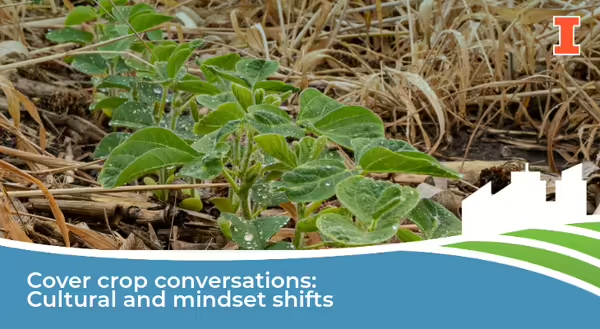
In episode 82 of the Illinois Nutrient Loss Reduction Podcast, Illinois farmers from northwest, west central, and southern Illinois shared how they successfully adopted cover crops despite facing very different challenges. While each operation looked different, one message was consistent: adopting cover crops is often less about the practice itself and more about changing management and mindset with a willingness to learn.
Cover crops remain the only in-field conservation practice identified in the Illinois Nutrient Loss Reduction Strategy that reduces both nitrogen and phosphorus losses, yet they are currently used on only about 6% to 10% of Illinois cropland.
Change often starts with curiosity
Brent Fowler, who farms in McDonough County, described how questioning long-standing tillage practices eventually led his family toward nearly full no-till and widespread cereal rye cover crop adoption. Rather than making large changes all at once, they relied on side-by-side comparisons over several years to build confidence in new practices.
Mindset is one of the biggest barriers
Adam Dahmer, a farmer from Williamson County, said the greatest challenge has not been equipment or seed availability, but maintaining an open mind. He encouraged farmers to:
- Stay flexible when selecting equipment.
- Focus on what works best for their operation instead of brand loyalty.
- Be willing to adapt management practices as cover crop systems evolve.
Cover crops require a different management system
Greg Thoren, a farmer from Jo Davies County and the 2026 Illinois Leopold Conservation Award winner, emphasized that cover crops should not be viewed as a single practice but as part of a holistic farming system.
He noted that cover crops can provide multiple benefits at the same time, including:
- Reduced soil erosion,
- Improved soil health,
- Better water quality,
- Increased biological diversity, and
- Long-term resilience of farming systems.
As his operation evolved, Greg expanded from single-species cereal rye to diverse multi-species cover crop mixes to further improve soil health.
Seeding methods continue to evolve
The panel also discussed several approaches to establishing cover crops, including:
- Grain drills
- Airplanes
- High-clearance seeders
- Drones
While drills remain the preferred method for achieving consistent stands, the farmers noted that drones are becoming an increasingly valuable option, especially when seeding into standing corn before harvest.
Other opportunities for support
Farmers who are successful with cover crops may explore programs outside the traditional state and federal cost-share programs. Programs like American Farmland Trust’s Farmer-Led Advances for Soil Health (FLASH) are designed to help accelerate that learning by connecting producers with local farmers who can share firsthand experiences and practical lessons. Precision Conservation Management is another program designed to identify in-field practices, such as cover crops, that address environmental issues without risking a farmer’s bottom line. The Illinois Sustainable Ag Partnership has also developed the Financial Incentives Database (FIND) Tool to help farmers identify financial payment opportunities available for adopting agricultural conservation practices such as cover crops.
The bottom line
Successful cover crop adoption looks different on every farm, but the conversation highlighted one common lesson: farmers who are willing to experiment, learn from others, and gradually adapt their management are often the most successful.
Explore more
Farmers from northwest, west central, and southern Illinois discuss how they use cover crops in their operations as part of this recorded presentation coordinated in part by the Illinois Nutrient Loss Reduction Strategy. Hear how they have incorporated cover crops on their farms, lessons learned...
About the Blog
At Illinois Extension, we’re working to improve water quality at home and downstream. Every month, our Watershed Outreach Associates bring you stories highlighting agricultural conservation practices, current research, and insights from the field. The Nutrient Loss Reduction blog covers conservation practices recommended by the Illinois Nutrient Loss Reduction Strategy, timely updates, and decision tools to help farmers reduce nutrients leaving their fields.
About the Authors
- Rachel Curry is an Agriculture and Agribusiness Educator specializing in agriculture and watershed education, and she is part of the Illinois Extension's Nutrient Loss Reduction Strategy implementation team. She holds a B.A. in Environmental Studies from Knox College and an M.S. in Environmental Science and Soil Science from Iowa State University, focusing on soil fertility. Her work centers on education and outreach related to the Illinois Nutrient Loss Reduction Strategy, promoting agricultural conservation practices that reduce nutrient loss while enhancing water quality and soil health across Illinois.
- Nicole Haverback serves as a Watershed Outreach Associate and is an Illinois Extension team member implementing the Nutrient Loss Reduction Strategy. She holds a B.S. in Agricultural and Rural Policy Studies from Iowa State University. In her role, Nicole coordinates watershed management efforts aimed at reducing nutrient losses in two nitrate-nitrogen priority watersheds, offers expertise on best management practices to minimize nutrient loss, and leads outreach initiatives promoting agricultural conservation practices outlined in the Illinois Nutrient Loss Reduction Strategy.
- Luke Zwilling serves as a Watershed Outreach Associate and is an Illinois Extension team member implementing the Nutrient Loss Reduction Strategy. He grew up on a farm in Jasper County and earned a B.S. in Agriculture and Biological Engineering from University of Illinois. Luke coordinates watershed-based activities to reduce nutrient loss in two phosphorus priority watersheds, provides expertise on best management practices for nutrient loss reduction, and conducts outreach on agricultural conservation practices in the Illinois Nutrient Loss Reduction Strategy.
- Spencer Brent is a junior in the Department of Agricultural and Consumer Economics at the University of Illinois Urbana-Champaign. Spencer is a summer intern with the Illinois Extension's Nutrient Loss Reduction Strategy implementation team as part of the Research and Extension Experiences for Undergraduates cohort. Growing up hunting and fishing led to a passion for conservation and the foundation of the first Ducks Unlimited Collegiate Chapter in Illinois.