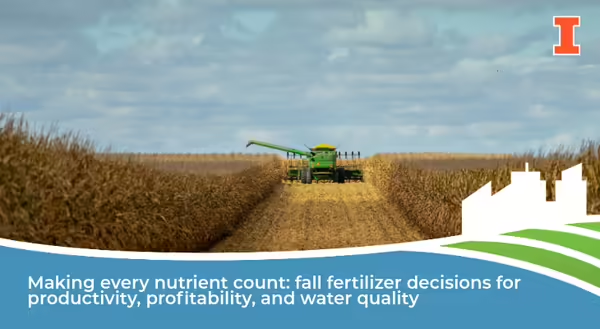
Fall fertilizer season brings decisions about when, where, and how much to apply.
In Episode 86 of the Illinois Nutrient Loss Reduction Podcast, University of Illinois Assistant Professor and State Soil Fertility Specialist John Jones shares what farmers should keep in mind when making fall fertilizer decisions. He discusses fall nitrogen timing, nitrification inhibitors, nitrogen rates, and using soil test results to guide phosphorus and potassium applications.
Wait for soils to cool
For fall nitrogen applications, Jones said soil temperature is one of the most important factors to watch. Farmers applying anhydrous ammonia in the fall should wait until soil temperatures at about a 4-inch depth reach 50 F and are continuing to cool. In the northern two-thirds of Illinois, Jones said those conditions often occur in late October into early November.
The goal is to keep fall-applied nitrogen in the ammonium form for as long as possible. Once ammonium converts to nitrate, it becomes more vulnerable to loss.
Nitrification inhibitors can help delay that conversion, but Jones emphasized they should not replace waiting for appropriate soil temperatures. Instead, proper timing and nitrification inhibitors work best when used together.
Use economics to guide nitrogen rates
Jones also recommended using the Maximum Return to Nitrogen approach when determining nitrogen rates. The approach uses results from Illinois nitrogen rate trials along with corn and nitrogen prices to identify the rate that provides the greatest economic return rather than simply targeting maximum yield.
Jones said the nitrogen rate that maximizes profit is often lower than the rate that produces the most bushels, with only a small difference in yield.
When using the nitrogen rate calculator, remember that the recommendation represents total nitrogen applied to the crop. Farmers should account for nitrogen from all sources, including fall-applied fertilizers and other applications made before corn.
Let soil tests guide P and K
For phosphorus and potassium applications, Jones said soil test levels should guide the decision. Fields testing very high in P or K may be unlikely to see a yield or economic response from additional fertilizer. With high fertilizer prices, soil testing can help identify where applications may be needed and where they can potentially be reduced or delayed.
Jones said farmers also have some flexibility in when P and K are applied within a corn-soybean rotation because research has not shown a large difference in yield response based on which crop receives the application.
Consider application timing
Moving some nitrogen from fall to spring may also improve nitrogen use efficiency.
Jones said published research has shown an optimum nitrogen rate about 16 to 20 pounds of N per acre lower with spring-applied anhydrous ammonia compared with fall-applied anhydrous when anhydrous provides most of the nitrogen for the corn crop. Yield differences between the two timings have been relatively small.
The bottom line
Fall fertilizer decisions will look different from one operation to another. Jones emphasized maintaining flexibility while finding ways to improve the efficiency of expensive nutrient inputs.
Consider:
- Wait until soil temperatures at a 4-inch depth reach 50 F and continue cooling before applying fall anhydrous ammonia.
- Use nitrification inhibitors along with proper application timing.
- Use current prices to help determine an economically optimum nitrogen rate to maximize profitability.
- Account for all nitrogen sources.
- Let soil test results guide P and K applications.
- Consider whether moving some nitrogen to spring fits your operation.
To hear the full conversation, listen to Episode 86 of the Illinois Nutrient Loss Reduction Podcast.
Explore more
About the blog
At Illinois Extension, we’re working to improve water quality at home and downstream. Every month, our Watershed Outreach Associates bring you stories highlighting agricultural conservation practices, current research, and insights from the field. The Nutrient Loss Reduction blog covers conservation practices recommended by the Illinois Nutrient Loss Reduction Strategy, provides timely updates, and offers decision tools to help farmers reduce nutrient losses from their fields.
About the authors
Rachel Curry is an Agriculture and Agribusiness Educator specializing in agriculture and watershed education, and a member of the Illinois Extension's Nutrient Loss Reduction Strategy implementation team. She holds a B.A. in Environmental Studies from Knox College and an M.S. in Environmental Science and Soil Science from Iowa State University, with a focus on soil fertility. Her work centers on education and outreach related to the Illinois Nutrient Loss Reduction Strategy, promoting agricultural conservation practices that reduce nutrient loss and enhance water quality and soil health across the state.
Nicole Haverback serves as a Watershed Outreach Associate and is an Illinois Extension team member implementing the Nutrient Loss Reduction Strategy. She holds a B.S. in Agricultural and Rural Policy Studies from Iowa State University. In her role, Nicole coordinates watershed management efforts to reduce nutrient losses in two nitrate-nitrogen priority watersheds, provides expertise on best management practices to minimize nutrient losses, and leads outreach initiatives that promote agricultural conservation practices outlined in the Illinois Nutrient Loss Reduction Strategy.
Luke Zwilling serves as a Watershed Outreach Associate and is an Illinois Extension team member implementing the Nutrient Loss Reduction Strategy. He grew up on a farm in Jasper County and earned a B.S. in Agriculture and Biological Engineering from University of Illinois. Luke coordinates watershed-based activities to reduce nutrient loss in two phosphorus-priority watersheds, provides expertise on best management practices for reducing nutrient loss, and conducts outreach on agricultural conservation practices within the Illinois Nutrient Loss Reduction Strategy.