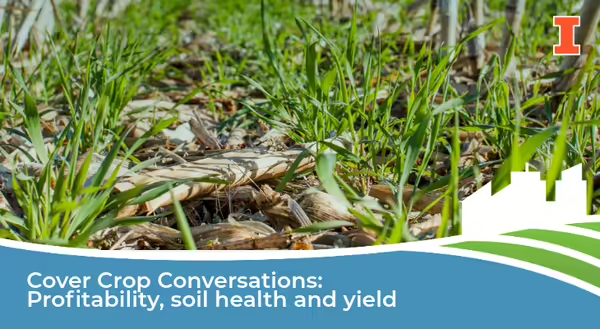
When evaluating cover crops, many conversations begin with one question: Are they profitable? In episode 83 of the Illinois Nutrient Loss Reduction Podcast, three farmers from across Illinois, Adam Dahmer, Brent Fowler, and Greg Thoren, share how years of experience with cover crops and no-till have shaped their answer.
Drawing from operations across the state, the panel explains why focusing on profit per acre and long-term soil health often provides a more complete measure of success than yield alone. They discuss how cover crop costs can be offset through reduced tillage, lower input expenses, financial incentive programs, and improved operational efficiency. The conversation also explores how healthier soil structure increases water infiltration and water-holding capacity over time, helping build more resilient cropping systems while protecting one of a farm's most valuable assets, its soil.
Look beyond the cost of cover crop seed
Southern Illinois farmer Adam Dahmer challenged producers to think differently about the cost of adopting cover crops.
He noted that many farmers carefully calculate the cost of cover crop seed but never determine what they spend on tillage. In many cases, reducing or eliminating tillage can offset much or all of the cost of establishing cover crops.
Instead of asking, "What do cover crops cost?" consider asking:
- What does each tillage pass cost per acre?
- Could reducing tillage lower fuel, labor, and equipment expenses?
- How do conservation practices affect profitability over multiple years?
Dahmer also shared that on farms with similar soil types and management histories, he has observed an average four-bushel-per-acre increase in corn yields after integrating no-till and cover crops into his system.
Thoren shared that his mantra is yield doesn’t pay the bills; it’s profit per acre. He allocates the cost of his cover crop seed from his annual fertilizer budget because cover crop management has reduced his fertilizer needs. Profitability increases when you can decrease your input costs while maintaining yields. Thoren notes that there are many benefits to cover crops that make them more profitable in the long run than a conventional system.
Healthy soils are a long-term investment
The panel emphasized that the value of cover crops extends well beyond annual yield.
Healthy soil develops a stronger structure over time, creating benefits that enhance both crop performance and field conditions, as well as resilience.
Long-term no-till and cover crop systems can:
- Improve soil aggregation and structure.
- Increase water infiltration and soil organic matter.
- Improve water-holding capacity during dry periods.
- Reduce soil compaction and erosion.
- Create better conditions for soil biology to thrive, supporting nutrient cycling.
As Dahmer explained, these improvements are not immediate—they develop over years of consistent management—but they can significantly improve the long-term productivity and resilience of farmland.
Financial incentives can help offset adoption costs
West-central Illinois farmer Brent Fowler outlined several programs and management savings that have helped make cover crops economically viable on his operation.
Examples included:
- $5 per acre crop insurance premium discount for planting certified cover crops.
- $5 per acre through Illinois Department of Agriculture conservation incentive programs (when available).
- Carbon market payments for regenerative farming practices.
- Reduced herbicide costs utilizing cover crops for weed suppression compared to conventional systems.
When combined, these savings helped offset the cost of seed and cover crop establishment, making conservation practices financially competitive while continuing to build long-term soil health.
The bottom line
The farmers agreed that cover crops should be evaluated as part of an entire farming system rather than as a standalone expense. Looking beyond seed costs to include reduced tillage, lower input expenses, healthier soils, and available financial incentives provides a more complete picture of their economic value. While soil health improvements take time to develop, they can contribute to more resilient and productive farming systems for years to come.
Explore more
- Cover Crop Conversations: Farmer-to-Farmer Insights Across Illinois – Part 2
- Illinois Extension Cover Crop Resources
- Illinois Department of Agriculture Cover Crop Premium Discount Program
- Illinois Sustainable Ag Partnership Financial Incentives Database (FIND) Tool
- Precision Conservation Management
- Cover Crop Conversations: Farmer-to-Farmer Insights Across Illinois – Part 1
About the Blog
At Illinois Extension, we're working to improve water quality at home and downstream. Every month, our Watershed Outreach Associates bring you stories highlighting agricultural conservation practices, current research, and insights from the field. The Nutrient Loss Reduction blog covers conservation practices recommended by the Illinois Nutrient Loss Reduction Strategy, timely updates, and decision tools to help farmers reduce nutrients leaving their fields.
About the authors
- Rachel Curry is an Agriculture and Agribusiness Educator specializing in agriculture and watershed education, and she is part of the Illinois Extension's Nutrient Loss Reduction Strategy implementation team. She holds a B.A. in Environmental Studies from Knox College and an M.S. in Environmental Science and Soil Science from Iowa State University, focusing on soil fertility. Her work centers on education and outreach related to the Illinois Nutrient Loss Reduction Strategy, promoting agricultural conservation practices that reduce nutrient loss while enhancing water quality and soil health across Illinois.
- Nicole Haverback serves as a Watershed Outreach Associate and is an Illinois Extension team member implementing the Nutrient Loss Reduction Strategy. She holds a B.S. in Agricultural and Rural Policy Studies from Iowa State University. In her role, Nicole coordinates watershed management efforts aimed at reducing nutrient losses in two nitrate-nitrogen priority watersheds, offers expertise on best management practices to minimize nutrient loss, and leads outreach initiatives promoting agricultural conservation practices outlined in the Illinois Nutrient Loss Reduction Strategy.
- Luke Zwilling serves as a Watershed Outreach Associate and is an Illinois Extension team member implementing the Nutrient Loss Reduction Strategy. He grew up on a farm in Jasper County and earned a B.S. in Agriculture and Biological Engineering from University of Illinois. Luke coordinates watershed-based activities to reduce nutrient loss in two phosphorus priority watersheds, provides expertise on best management practices for nutrient loss reduction, and conducts outreach on agricultural conservation practices in the Illinois Nutrient Loss Reduction Strategy.
- Spencer Brent is a junior in the Department of Agricultural and Consumer Economics at the University of Illinois Urbana-Champaign. Spencer is a summer intern with the Illinois Extension's Nutrient Loss Reduction Strategy implementation team as part of the Research and Extension Experiences for Undergraduates cohort. Growing up hunting and fishing led to a passion for conservation and the foundation of the first Ducks Unlimited Collegiate Chapter in Illinois.