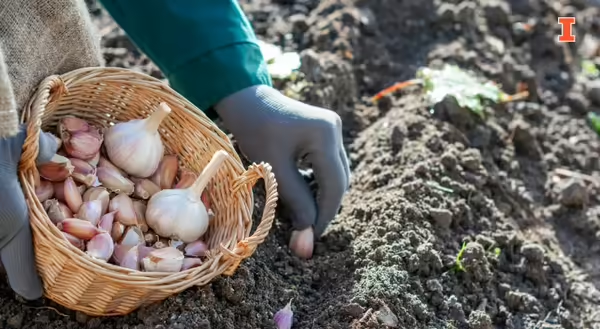
While most gardeners are slowing down the vegetable garden this time of year, there is one last thing you can plant this fall – garlic. While it feels late, gardeners still have time to plant garlic this fall for fun summer harvests.
Garlic is typically planted 6 to 8 weeks before the ground freezes, which is a bit delayed this year across the state. Most garlic varieties require a vernalization period for proper bulb development and clove division. Fall plantings also allow for root and shoot development before the ground freezes, and they will continue their growing period in the spring (Johnson 2019).
Types of garlic
There are two different types of garlic: hardneck and softneck.
Hardneck garlic is commonly grown across Illinois due to its cold-hardy nature. These varieties produce a flowering scape in the spring and have a hard stem “core” where the cloves attach. They have a shorter storage life and may be more fragrant compared to softneck varieties.
Softneck garlic is more easily grown in Southern Illinois and is most commonly found in grocery stores due to its longer storage life. These varieties usually do not produce a flowering scape like hardneck varieties.
It is recommended to buy garlic for planting from garden centers or reputable seed companies. Garlic from the grocery store is treated for storage and may be a softneck variety not hardy enough for Illinois.
Varieties to consider
Hardneck: Music, German Extra-hardy, Metechi, Georgian Crystal, Rocambole, Ivan
Softneck: Inchelium Red, Nootka Rose, Messidor*, Garcua*, Castano*,
*Varieties with an asterisk are better suited for growing zone 6 and above.
Well-drained soils and full sun is ideal for garlic plants. Garlic matures well in soils with high organic matter, which makes compost a good soil amendment in the fall (Johnson 2019). It is also best to apply a 10-10-10 or 12-12-12 fertilizer in the fall or the spring after shoots emerge to encourage plant development (Schuh et al., 2026).
Planting
To plant garlic, you must separate the cloves and plant them individually. Choosing the largest cloves will maximize yields. The pointed side of the clove should be facing up when planted into the ground. Garlic cloves can be planted 6 inches apart in a row and should be spaced 15-18 inches apart in between rows. The soil should be evenly watered at the time of planting to encourage rooting and growth. Once the garlic is planted and watered, covering the area with weed-free straw or leaves will help retain moisture and keep the soil covered during the winter.
Garlic is fun to grow and gives gardeners a surprise in the Spring when the green shoots start to emerge. For more information, contact your local Extension office or check out the University of Illinois Extension’s horticulture YouTube channel growing tips and other horticultural advice.
About the author: Alexis R. Barnes is the University of Illinois Extension Horticulture Educator serving Madison, Monroe and St. Clair Counties. Barnes’s areas of expertise include fruit & vegetable production and reduced tillage practices.
References:
Johnson, K. 2019. How to grow garlic, Good Growing Blog. University of Illinois Extension. https://extension.illinois.edu/blogs/good-growing/2019-09-17-how-grow-garlic[Accessed 28 October 2026].
Schuh, M., Rosen, C., and Tong, C. 2026. Growing garlic in home gardens. Yard and Garden. University of Minnesota Extension. https://extension.umn.edu/garden-and-home/yard-and-garden/gardening-in-minnesota/growing-garlic#preparing-the-soil--4420610[Accessed 29 October 2026].