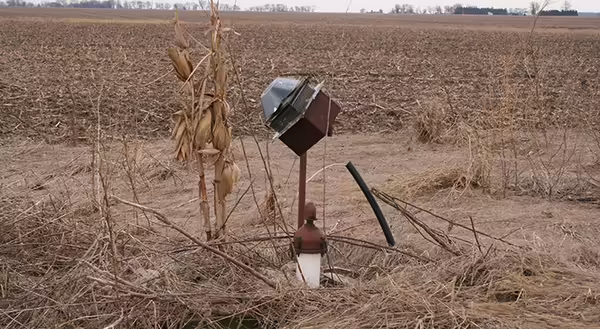
If you apply pesticides, good environmental safety practices can help protect sensitive areas that influence drinking water quality. Be aware of wells and geographic conditions such as sink holes. Read and follow all label directions. Know that different product labels may contain different protections when it comes to water. This is not one size fits all. Reading the label is the best way to make informed decisions and protect any water that could be near your application site. Those who rely on that water will thank you.
The Illinois Department of Agriculture receives multiple calls each year from new homeowners with property abutting farmland. A frequently expressed concern is about wells possibly being affected by nearby pesticide applications. Neighborly communication is needed. When planning applications, applicators should scout to look for the presence of wells, and most should be visible. Note their distance from the area to be sprayed. Take proper precautions and consider being proactive by meeting any new neighbors and letting them know the steps you’ll take to protect their water.
How can pesticides contaminate water?
With pest control, the goal is to apply the right amount at the right time to the right location. Pesticides that move away from the intended application site become environmental hazards. Groundwater and surface water may become contaminated. In some cases, this contamination makes the water unfit for drinking or drastically alters the aquatic ecosystem (think plants and animals). The mishandling of pesticides can result in direct contamination of water. In fact, many Illinois sites where pesticides have been found in groundwater have been traced to a single point source, such as an accidental spill, improper pesticide container disposal, or back-siphoning into a well by the reverse flow of liquids via a fill hose. Be sure to maintain a proper air gap when filling a tank. Dispose of pesticide containers properly. Start by checking the label for guidance. Finally, use safe practices that would minimize the risk of a spill occurring.
Pesticide contamination of water is always a great concern, but for groundwater, pesticide degradation is much slower than in surface water. When purification is possible, it is extremely expensive, time-consuming, and complicated. Prevention is much easier.
Groundwater, the source of water for wells and springs, supplies approximately 30% of the drinking water in Illinois (50% nationwide), including most farmsteads, homes, and businesses in rural Illinois. Water withdrawn from a contaminated well can expose humans to pesticides that may cause adverse health effects. Various types of wells can be found throughout the state, and some are more vulnerable than others to contamination from normal pesticide usage. The vulnerability of a well depends on its construction, lining, type, the integrity of its surface seal, and the vulnerability of the groundwater from which it withdraws water.
Pesticides contaminate groundwater through two main routes:
Run-in allows a pesticide to move directly from the soil surface to the groundwater below before it can be adsorbed onto soil particles or degraded by soil microbes. It can occur through sinkholes or improperly sealed abandoned wells. Sinkholes sometimes occur in areas where the soil is underlaid with fractured carbonate rock such as limestone or dolomite. Areas with numerous sinkholes are known as karst landscapes. A few carbonate aquifers can be found in northwestern and southern Illinois.
Leaching can contaminate groundwater by moving pesticides downward in the soil profile with water percolating out of the target area. Leaching occurs mainly in sandy, permeable soils and is of particular concern when there are shallow wells that draw from a water table close to the soil surface.
Four factors determine whether a pesticide is likely to reach the groundwater:
- Pesticide properties (persistence, adsorption, and solubility).
- Soil properties (soil texture and organic matter).
- Site conditions (depth to the groundwater, geologic conditions, and climate).
- Management practices (mishandling and not reading and following label directions)
What can pesticide applicators do to protect water?
When choosing which pesticide product to use, leaching potential must be considered if groundwater is near the surface at the application site and if the soil is permeable. Product labels must be consulted.
As you might surmise, all products, conditions, and situations are not the same and will require different protections. The U.S. EPA evaluates each pesticide for its potential risk to groundwater. While it can be good to educate yourself on these four factors, pesticide manufacturers carefully look at these factors and their interactions. That data is used to write label directions and advisory statements. If there is a risk, statements to that effect are included on the label. Thus, product labels are primarily what applicators need to focus on.
On the label, look in the “Environmental Hazards” section for a “Groundwater Advisory” statement. Note that many products will not have this language if there is not a demonstrated potential risk.
For example, the following excerpt language is found on the Surpass NXT label:
This chemical demonstrates the properties and characteristics associated with chemicals detected in groundwater. The use of this chemical in areas where soils are permeable, particularly where the groundwater is shallow, may result in groundwater contamination.
And in other part of the label:
On the following soil types, do not apply this product within 50 feet of any well where the depth to groundwater is 30 feet or less: sands with less than 3% organic matter; loamy sands with less than 2% organic matter; or sandy loams with less than 1 percent organic matter.
In contrast, the following excerpt language is found on the Aatrex 4L label:
Atrazine can travel (seep or leach) through soil and can enter ground water which may be used as drinking water. Atrazine has been found in ground water. Users are advised not to apply atrazine to sand and loamy sand soils where the water table (ground water) is close to the surface and where these soils are very permeable, i.e., well-drained. Your local agricultural agencies can provide further information on the type of soil in your area and the location of ground water. This product must not be mixed/loaded, or used within 50 feet of all wells, including abandoned wells, drainage wells, and sink holes…. Additional State imposed requirements regarding well-head setbacks and operational area containment must be observed.
Setbacks and buffer zones provide added safety by keeping pesticide applications away from sensitive areas. Check the pesticide label for any setback distances for wells or new mixing and loading sites. As a general practice, never mix chemicals near (within 200 feet of) wells, ditches, streams, and other water sources.
To protect all water sources, always follow label instructions. Many pesticide labels contain water advisory statements and state whether the product has been found in surface or groundwater areas. Examples of these statements include:
- Can travel through soils and enter groundwater.
- May not be mixed, loaded, or used within 50 feet of all wells and sinkholes.
- May not be mixed or loaded within 50 feet of intermittent streams.
- May not be applied aerially or by ground within 66 feet of the points.
- May not be applied to a sandy loam soil with less than 1% organic matter if groundwater depth is 30 feet or less.
Fortunately, with proper planning of pesticide applications, you can help alleviate many water contamination problems. Some ways to lessen contamination include:
- Use integrated pest management (IPM). Control pests only when necessary, and use nonchemical control methods whenever possible.
- Use the lowest possible rate of a pesticide to achieve economically determined pest control.
- Reduce the frequency of pesticide applications whenever possible.
- Reduce the size of the area applied and consequently the amount of pesticide applied whenever possible by making band applications or spot treatments rather than broadcast applications.
- Follow label directions. The label carries crucial information about the proper rate, timing, and placement of the pesticide.
- Become familiar with your site’s conditions. Consider the slope in relation to any well heads. Consider the cover of the land as plants can slow water movement.
- Know the locations of any nearby wells, sinkholes, or bodies of surface water.
- Know whether shallow aquifers are present.
- Determine whether the soil characteristics in your area are especially susceptible to leaching.
- Select pesticides that are appropriate for the leaching susceptibility of your site. Read labels for leaching warnings.
- Select pesticides with lower potential to move into water.
Additional information on protecting water from agrichemical contamination is given in 50 Ways Farmers Can Protect Their Groundwater and 60 Ways Farmers Can Protect Surface Water. Although written for farmers, these publications contain a wealth of useful and practical information for all pesticide users. These publications are available from University of Illinois Extension and can be ordered at the University of Illinois Distribution Services website or by calling 800-345-6087 or 217-333-2007.
For more information, visit the USGS Pesticides in Groundwater website and USEPA’s Water Topics website. For information about pesticide contamination of private wells and recommended testing, visit IDPH’s Well Water Testing website. For questions concerning pesticide toxicity, contact the National Pesticide Information Center.
Source: Adapted from Illinois Pesticide Safety Education Manual: General Standards 39
Photo credit: Michelle Wiesbrook
ABOUT THE AUTHOR: Michelle Wiesbrook provides subject matter expertise and training in pesticide safety with an emphasis on horticultural weed science. She serves as the Illinois Pesticide Review newsletter editor, collecting and organizing material; and co-coordinates social media information for the PSEP program and ensures its timely publication.