SIT and Public Perception
The Sterile Insect Technique (SIT) has received increased attention over the past year due to the expansion of SIT programs and its role in controlling insects of public health importance. The method uses laboratory-reared, sterilized male insects released into targeted areas to suppress or collapse local populations. The strategy is used in certain areas throughout the US, particularly in southern coastal states, to combat mosquitoes, especially where mosquito-borne illnesses are a concern. With the recent reinvasion of the New World screwworm into Texas, SIT has been selected as the principal strategy of control, and the United States Department of Agriculture (USDA) has committed to building a $750 million facility to produce sterile male insects. Google’s parent company Alphabet has even shifted attention towards SIT with plans to get EPA approval to release sterilized male mosquitoes to reduce disease-spreading mosquitoes. Talk and attention towards SIT is likely to continue as these programs expand.
To some members of the public, manipulating pest populations through SIT may raise safety concerns. Recent attention also has made SIT appear like a new, unvetted technology, but the truth is that SIT has been around for a long time. The process was first studied in the late 1930s, and government programs using the technology became established during the 1950s and 1960s. Once developed for a target species, sterilization protocols are highly effective. For certain species and in the right scenarios, SIT was found to be a highly effective non-chemical control method, and the strategy fits well into modern Integrated Pest Management (IPM) programs.
Advantages and Limitations of SIT
SIT uses ionizing radiation in the form of X-rays or gamma rays to sterilize male pupae or adults and is highly effective at appropriate doses. Irradiation causes insects to be more sluggish and less suitable mates, making mass production an important factor in SIT. Following sterilization, the insects are released from the ground or through aerial methods. Sterilizing and releasing females does not have a positive effect on control results. The method requires breeding/irradiating facilities to create the sterile insects for release, and it is only practical for species that are easily determined by sex, can be mass-reared, and irradiated easily. SIT is best for species that are monogamous, such as the New World screwworm.
Alternative SIT Approaches
Other forms of SIT are either still being developed or are not widely used in the United States. These forms are:
- Inherited sterility: where a male cannot be completely sterilized by irradiation, but its offspring will develop sterile. Primarily used for a handful of moth species.
- Incompatible Insect Technique (IIT): A method primarily using a bacterium called Wolbachia, which causes incompatibility between egg and sperm. This has been used extensively in Singapore and is being tested in other parts of the world.
- Precision-guided sterile insect technique (pgSIT): uses CRISPR gene editing technology to alter genes in males linked to fertility. This concept is still being tested and developed and is not being actively used to control insects.
Where SIT is being used
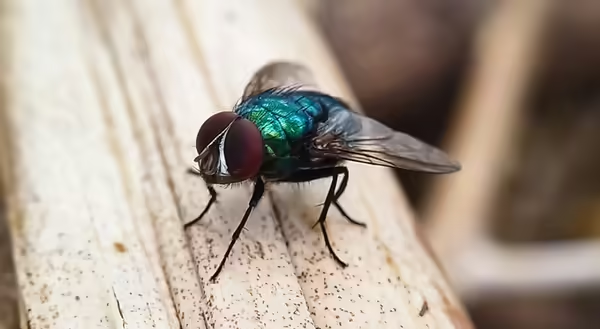
New World Screwworm: SIT was originally conceptualized and designed using the New World screwworm as a model and implemented in the 1950s as a nationwide control tactic. The results were so successful that SIT became the key control tactic responsible for eradicating the New World screwworm from the United States, eventually pushing the fly all the way past Panama. The eradication attempt had sterile males released in both the infested area and in surrounding uninfested areas to control the population while also creating a fertility desert where any female moving to an uninfested area would only be met with sterile males.
SIT continues to demonstrate effectiveness against the New World screwworm. When screwworm reinfested the United States in June 2026, cases peaked at 30 within the first month. Soon after, SIT was implemented, and U.S. cases dropped to a total of 4 by the month of August.
Mosquitoes: Mosquito Abatement districts in California and Florida are among the groups currently executing SIT programs. Typically, these are targeted against the species Aedes aegypti (yellow fever mosquito), which is invasive in the United States. In addition to being invasive, Ae. aegypti vectors yellow fever, dengue fever, Zika virus, and chikungunya. The species is difficult to control as it lays its eggs in small artificial containers, so treating large bodies of water and expecting control is not realistic. SIT control of this mosquito via mosquito abatement districts is done in tandem with conventional control methods for public health and for reduction of nuisance Ae. aegypti populations.
Illinois: While SIT is being conducted in other parts of the country, implementation of the control strategy is not used in Illinois for the purposes of public health.
Conclusion
SIT’s rise in interest has been largely driven by the current situation surrounding New World screwworm, while research continues in the background. For screwworm and mosquitoes, SIT is a proven and effective control method that can serve as either a primary management strategy or a complement to other IPM tactics. Traditional sterilization using radiation is safe and effective, especially in situations where males can be separated and sterilized exclusively. Additional forms of SIT and related techniques, such as IIT using Wolbachia, may become more common as research progresses. Sterilization methods such as pgSIT may generate additional public concern over the gene-editing nature of the strategy, but the technology remains largely experimental. In the coming years, we will likely see a decrease in the public focus on SIT as the screwworm population is pushed back into Central America. However, the strategy will likely continue to be used routinely, much as it was before 2026.
Photo Credit: Adobe Stock
ABOUT THE AUTHOR: John Schepis provides subject matter expertise and training in pesticide safety with an emphasis on entomology.