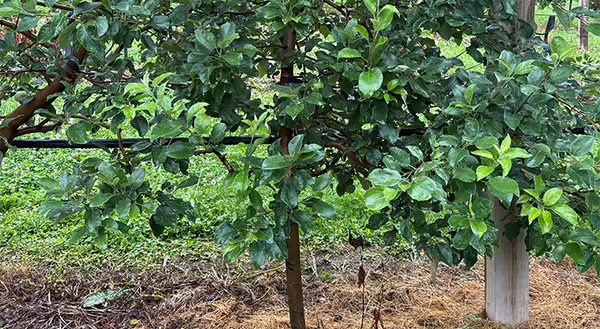
As I've talked with apple growers across northern Illinois this June and July, I've heard many variations of the same question:
"The crop is gone. What should I be doing now?"
For some growers, spring freeze events resulted in complete crop losses. Others have orchards with highly variable crop loads, where one block may carry a decent crop while the next has little or nothing to harvest.
By late August, many of the decisions that influence flower bud initiation and return bloom have already been made. The focus now shifts to protecting tree health, maintaining reserves, and preparing orchards for winter and the 2027 season. You cannot change what happened this spring, but you can influence how healthy and productive your trees are when they emerge next year.
What Questions Should Growers Be Asking Now?
As you walk your orchard, the questions become less about this season's crop and more about next year's potential:
- Are my trees healthy heading into fall?
- Am I maintaining adequate soil moisture?
- Is my canopy staying intact and functional?
- What did I learn from this year's freeze events? What varieties were most susceptible?
- What can I do this fall to improve orchard resilience?
- If next spring brings a strong bloom, am I prepared to manage it?
These are the questions that matter now.
No-Crop Orchard Checklist for Late Summer and Fall
Keep Leaves Healthy Until Natural Leaf Drop
In a no-crop year, the canopy becomes one of the most valuable parts of the orchard. Healthy leaves continue photosynthesizing and building carbohydrate reserves that support winter survival, spring growth, and next year's crop. Diseases, insects, and other stresses that cause premature defoliation can reduce reserve accumulation and weaken trees heading into dormancy. The goal is to maintain healthy foliage for as long as possible.
Continue Irrigating During Dry Periods
The absence of fruit does not eliminate the tree's need for water. Trees continue growing roots, storing carbohydrates, and preparing for winter. Drought stress during late summer and fall can reduce reserve accumulation and increase stress heading into dormancy. Young orchards deserve particular attention because they often have less extensive root systems and lower reserves.
Continue Monitoring Tree Health
Although fruit may be absent, insects and diseases have not disappeared. Foliar diseases, mites, aphids, scales, borers, and other pests can still affect tree health and reduce photosynthetic capacity. This may be a year to simplify management, but it is not a year to ignore the orchard. Continue scouting and address issues that threaten canopy health or long-term tree vigor.
Use the Season as a Learning Opportunity
While no grower wants to experience a crop-loss year, these seasons often reveal strengths and weaknesses within an orchard. Ask yourself:
- Which blocks experienced the greatest losses?
- Did elevation or air drainage influence damage?
- Which cultivars appeared most vulnerable?
- Were certain locations more frost-prone than others?
- Are there opportunities to improve frost protection, drainage, or orchard design?
The answers may help guide future investments and management decisions. For instance, some growers have now realized that they need an orchard fan, an expensive investment, but one that is now necessary if future weather patterns persist. You may also have moved ahead with removal of unproductive varieties based on this season though would still stress that a single season/observation is just one piece of determining whether varieties stay or go.
Start Planning for 2027
One of the most common questions growers ask after a crop-loss year is:
"Am I going to have too many apples next year?"
The honest answer is maybe.
Trees that carried little or no crop in 2026 often enter the following season with substantial reserves and strong bloom potential. That does not guarantee a large crop, because weather still has the final say, but it does mean growers should begin thinking now about crop-load management, thinning strategies, labor needs, and orchard priorities for 2027. We plan to have this topic covered extensively at next year’s Stateline Fruit and Vegetable Growers Conference.
For some orchards, the conversation may shift quickly from "How do I manage a no-crop year?" to "How do I manage a heavy bloom next spring?"
Focus on What You Can Control
One of the challenges following a crop-loss year is the temptation to look backward.
Growers understandably spend time reviewing weather events, freeze temperature thresholds, and bloom-stage conditions that led to losses. So, this can be a good time to learn and reflect. At the same time, the most productive conversations now focus on what can be controlled between August and dormancy.
If time allows, focus on healthy foliage, adequate soil moisture, tree health, and preparation for winter. These factors influence how trees emerge next spring and how well they respond to whatever conditions 2027 brings. This may also be a great time to work on weed management.
Looking Ahead
If you're reading this article with a crop hanging on your trees, your focus is probably on harvest. If you're reading this article after losing most or all your crop, next season may be foremost on your mind.
Either way, the priorities for the remainder of 2026 are surprisingly similar: maintain healthy foliage, avoid drought stress, protect tree health, and enter winter with as much reserve accumulation as possible.
The crop may be gone, but the orchard still matters. What happens between now and leaf drop will influence how those trees emerge next spring and how prepared they are for whatever 2027 brings.
Sources and Further Reading
Serra, S., Krawczyk, G., Combs, D., et al. Managing Orchards in a No Crop Year: Protecting Tree Health for Next Season. Penn State Extension, April 29, 2026.
McLaughlin, A. Pennsylvania Fruit Growers Face Catastrophic Losses After Historic Spring Freeze. Penn State University News, June 1, 2026.
Quinn, K., Spies, J., Nielsen, A., et al. Managing Orchards Through a Season With Limited Yields. Rutgers Plant & Pest Advisory, May 8, 2026.