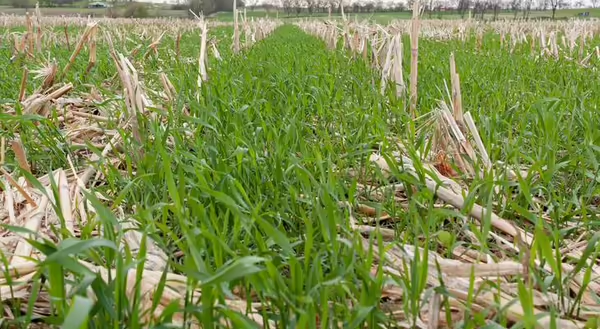
In recent years, interest in regenerative agriculture practices has grown among farmers, landowners, researchers, policymakers, and others. The goal of regenerative agriculture is straightforward: improve soil health and protect local ecosystems while maintaining productivity and profitability of an operation. Many of the practices considered part of regenerative agriculture are familiar to many producers and landowners in central Illinois, including cover crops and no-till. Previous posts on this blog have discussed the adoption and economics of these practices. However, a question that has not been explored on here is how long it takes for the benefits of these practices to become apparent. A study posted in Agronomy Journal examines how regenerative agriculture practices affect row crop production and soil properties. This post will go through the study while also going deeper into the concept of regenerative agriculture.
Adoption and Economics of Conservation Agriculture
Regenerative agriculture has grown in interest along with overall interest in conservation agriculture practices. In a blog post from July 2025, I discussed a report published by the United States Department of Agriculture’s Economic Research Service (USDA-ERS) on the economic cost to producers who incorporated conservation practices on their operations. While these practices offer many agronomic and environmental benefits, cost can be a barrier to adopting them on an operation. Upfront costs and long-term management costs of certain practices influence the overall adoption and participation in conservation programs.
Another blog post from March 2026 went deeper into this topic by analyzing another USDA-ERS report on adoption trends of conservation practices. The report found that, despite varying adoption across different parts of the United States, adoption of these practices has been increasing in recent years. Both posts highlighted the economic costs and benefits of adopting these practices on an operation. However, they did not cover the environmental benefits and any potential impacts on crop production.
What is Regenerative Agriculture?
Many of you will recognize the significant overlap between regenerative agriculture and conservation agriculture practices. One of the challenges surrounding the adoption regenerative agriculture practices is determining the impacts it has across existing management systems and production practices. In an article recently published in Sustainable Agriculture, the author notes that regenerative agriculture is often defined differently across different regions and by different entities, making it hard to come up with a way to measure the benefits of these practices.
Despite the growing popularity and adoption of regenerative agriculture practices, there is not a universally agreed definition of “regenerative agriculture.” The Regenerative Agriculture Foundation (RAF), an organization that offers funding to implement these practices, defines regenerative agriculture as a management approach focused on improving agricultural systems over time. Specifically, these practices are targeted at soil health, water cycling, biological activity, and economic viability of operations.
But while there may not be a widely accepted definition, there are practices and principles which are viewed as the core of regenerative agriculture. North Carolina State University Extension identifies five key principles of regenerative agriculture practices: minimizing soil disturbance, enhancing crop diversity, keeping the soil covered, maintaining living roots, and integrating livestock. Common practices that align with these principles include minimal till/no till, cover crops, using manure or non-synthetic fertilizers, rotational grazing, and adopting precision agriculture technologies.
Regenerative Agriculture and Row Crop Production
A study published in Agronomy Journal this fall examined how different regenerative agriculture practices and management systems affected productivity, crop quality, nutrient uptake, and soil health. The research was conducted over three years at an experiment station in Georgia and tested five different practices: conventional tillage, strip tillage, strip tillage with cereal rye, strip tillage with poultry litter, and strip tillage with biochar. The study looked specifically at cotton, peanuts, and corn. I will discuss the findings from the research on corn.
When looking at corn yield, the data indicated that there was no significant effect on corn yields no matter the practices utilized. The researchers expected that strip tillage + cereal rye + poultry litter combined would lead to higher yields due to the high availability of nutrients. However, it is believed that the nutrients from the poultry litter were not released when the crop needed them the most, and the environmental factors were not ideal. In addition to these findings, the data showed no difference in yields between conventional tillage and strip tillage, showing that strip tillage can do as good of a job in preparing the seedbed for planting.
Looking at nutrient uptake, only the uptake of Molybdenum (Mo) was significantly affected by management practices. Strip tillage + cereal rye + poultry litter and strip tillage + cereal rye + poultry litter + biochar saw higher levels of Mo uptake than any other system. This further demonstrates that these regenerative agriculture practices do not limit or inhibit a plant’s ability to uptake key nutrients. The data also showed that applying poultry litter lead to higher nutrient uptake in kernels and in residual biomass, but this did not lead to higher corn yields. The study found that soil organic matter was not different across the different management systems tested. The researchers noted that this was likely driven by environmental factors such as warmer temperatures and frequent precipitation speeding up the organic matter mineralization process. Additionally, soil pH levels remained neutral across all systems in each year of the study.
The findings in this study provide some insights into how regenerative agriculture practices affect row crop production and soil health. Despite this study being conducted in Georgia and analyzing crops that are not grown in central Illinois, it still offers a valuable perspective. The findings suggest that regenerative agriculture practices are not guaranteed to improve yields. Rather, they are a long-term strategy to protect productivity and soil health.
Regenerative agriculture has become more popular in recent years among producers and others to protect local ecosystems while maintaining productivity. However, there are still questions regarding whether these practices reduce yields at the expense of improving soil health. The study discussed in this post found that regenerative agriculture practices did not reduce yields and offer long-term benefits for an operation. Despite not being in the Midwest, this study clarifies that regenerative agriculture practices are a long-term investment in soil health and the local ecosystem without threatening yields in row crop production. Adopting these practices, as has been mentioned in previous posts, requires a producer to balance the costs of adopting with the management requirements and the long-term benefits.