Talking Turkey with Ed Dubrick, Small Livestock Farmer in Cissna Park, Illinois
An astounding number of turkeys were eaten this Thanksgiving in Illinois – about 1.5 million according to some annual estimates, with most of those having been purchased at a grocery store. But in recent years, an increasing number of turkeys are being purchased directly from farmers, by consumers who would like to know the answer to some important questions about the turkey their family will eat.
Where was our turkey raised? How was it raised? How are local families and regional businesses impacted if we keep our food dollars close to home? Did the turkey get to express its natural instincts in life?
To shed light on this small but growing consumer segment, I reached out to somebody who knows a thing or two about turkeys.
Ed Dubrick and his family own and operate DuChick Ranch in Cissna Park Illinois. They purchased their 2-acre small farm in 2019, began selling a few meat chickens as a proof-of-concept in 2020. “The few chickens we sold went over well, and in 2021 we said OK, there is a business opportunity here,” said Ed. In 2025 they rented an additional 5 acres. From there, they’ve steadily expanded and increased the number of farm enterprises to include a meat sheep flock, and pasture-raised turkeys, for parted out turkeys through the year and whole turkeys for Thanksgiving. Turkeys and sheep are raised and rotated as much as possible on their 6 acres of pasture. Broilers are raised in their barn year-round.
I wanted to dive into the pasture-raised turkey side of things with Ed to give readers an understanding that it is actually possible to raise smaller numbers of turkeys locally, profitably, and support other related local food business, simultaneously – if they would but extra for one meal per year.
Understanding the price difference between conventional and pasture-raised turkey
I wanted to know: What is pastured turkey business like? What is involved raising turkeys – poult (baby turkey) to processor – as opposed to chickens? Does the math pencil out? Are people paying the price, and who are those consumers? What about the taste?
We started on price, the elephant-sized turkey in the room. “We charge $3.75 a pound for our whole turkeys,” Ed shared. I told him that I have shamelessly gone to big box grocers the day after Thanksgiving before and purchased discounted turkeys for $0.99 a pound. On one hand, I have three kids that like to eat meat, as do I, and meat is expensive these days. However, I have always wondered how – or if – the farmer is making any money at all, looking at that Black Friday store price. “Grocery chains often use turkeys as a loss leader that day to get as many folks in the door as possible,” Ed said. “I do not see how any turkey producers could make money at that price. I have over $1/lb in processing expense alone and still have to pay for the poult (baby turkey), the feed, the labor, and the facilities.”
I continued, “$3.75 a pound is a fair bit more than people are used to paying, even pre-Thanksgiving. Do you find any resistance at that price?
Ed answered, “Yes and no, it is more than folks are used to spending. But we make sure people know (and see, on social media for instance) that these turkeys are pasture-raised. That means that they are scratching in the grass for insects, enjoying the sunshine, and exercising their growing muscles. They eat alfalfa, clover, and more. They also receive a balanced feed ration to ensure optimal growth. This results in a different nutritional profile and taste to our birds that you can’t readily buy at just any store.”
Additionally, that feed is milled at Cissna Park Co-op, just a ¼ mile from DuChick Ranch, made from corn and soybeans grown by their neighbors, allowing the farm to support multiple in-town businesses with their input purchases. Anybody buying turkeys from Ed or similar turkey farmers is likely supporting this kind of closed-loop small-farm economy.
The other thing Ed said that stuck with me is that they are selling “the farm family business. My kids help feed the livestock most days, we teach our kids where food comes from, we teach them hard work matters and it’s needed every day. And our customers see that and support that.”
I know several other pasture-raised turkey operations, and they all have a high-quality social media presence that conveys these and similar points very well all year.
Buyers, sellers, and marketing strategy in the farm-raised turkey economy
DuChick Ranch wholesales about half of their turkey to various farm business associates around the state, which are then retailed at those locations – allowing customers to have a pasture-raised turkey option for the Thanksgiving table that otherwise would not. “Many of those wholesale buyers are livestock farmers themselves and they might do pork and/or beef production, but they don’t raise turkeys – this allows them to offer it all, and people take them up on it, thankfully for us!” said Ed.
The turkeys that are retailed start getting bought and sold in July when DuChick Ranch opens pre-orders for a Thanksgiving bird, as is common with other pasture-raised turkey operations in Illinois. Ed said the business pre-sells quite a few of the 400 turkeys from July through August and then orders start to dwindle to hardly anything, only to revamp in a big way by November.
“On the retail side, I sell more turkeys in the two weeks prior to Thanksgiving than I do the rest of the year – which makes sense but is always hectic,” Ed shared. I asked him if he has ever had to sell a substantial number of birds after Thanksgiving, maybe for Christmas. “Thankfully I’ve always been basically at the finish line the few days before, maybe sitting on 3-4 for friends or family but that’s about it.”
So, who is the retail buyer – either directly from DuChick Ranch or from some of the farm’s wholesale clients? The buyers are those who:
- want to feed their family a nutritionally dense turkey raised locally
- appreciate on-farm training of the next generation of young people
- value livestock well-being where animals can express natural instincts outdoors
- want their food dollars to support regional related businesses, such as processors and feed mills
“Several people have told us if they had land, they would want to do what we do. But they don’t, so they support somebody local doing it,” said Ed.
Breed considerations, farm timelines, and poult to processor difficulties
Years ago, I purchased a heritage breed turkey from a farmer that is no longer in business near Champaign, Illinois, and it was completely different in taste profile, and was a little leaner than I was used to. That’s because anybody in the United States buying a turkey at the store in recent years bought a Broad Breasted White – which has been the dominant breed in turkey production for decades. I shared my experience with Ed.
“Yes, and that’s why we also raise Broad Breasted Whites – they are the dominant breed of turkey because their ability to convert feed to weight gain is so much better than heritage turkeys. And they take so much less time to achieve marketable weight,” Ed explained. He went on to say that they raise their turkeys from poult to processor date in about 4 months, whereas the heritage breeds can take 6-7 months, eat way more feed, convert way less of the feed to meat, and result in smaller overall weights.
And the other consideration here is the farm production timeline. With 6 acres of pasture on a 7.5-acre farm, efficiency is the name of the game, within view of the fact that DuChick Ranch also raise sheep (for lamb production) on the same pasture! “The Broad Breasted White timeline allows us to raise two batches of turkeys a year” Ed noted, whereas a longer days-to-maturity breed would not.
Another quote from Ed stuck out to me. “This breed, people are familiar with the taste, so ours taste familiar to them. You’re not having to sell the higher price AND different look or taste of a heritage breed.” I said that makes it easier as a consumer, buying a familiar product but with a more wholesome story – plus the better nutrient profile of a pasture-raised bird.
The challenging part of turkey production according to Ed is well, they are not the brightest birds. “We use electrified net fencing in field, and they’re always sticking their heads through that to try and get to the grass they think is greener on the other side. Sometimes they get stuck. When they’re poults, it’s worse. Often, they can’t find their food or water that’s right in front of them. The number of turkey poult beaks I dip in water in the first 6-7 days of their life is quite high,” Ed laughed. Finally, there’s brooder temp. They get sick quickly if they get cold. I just feel that broiler chickens are much more resilient, get with the program quicker. For the first 6 weeks of a turkey’s life, they need extra care, kid’s gloves if you will.”
Processing obstacles and considerations
There are many small towns across Illinois that still have a Mom and Pop meat processor business, but most of those businesses only process red meat (beef, pork, etc.) Very few poultry processors in the state of Illinois exist – and fewer still have minimum order limits that small-acreage family farms can produce. Once a grower finds one of these processor unicorns, there’s selecting a processing date – the date the farmer agrees to bring their livestock to be slaughtered and packaged so they can sell finished product to their customers. Ed and many others must pick locker dates months, sometimes years, in advance, and hope all goes well with their and other business’ schedules to conform to those. Sometimes problems arise.
“I had a processor date at one location this year for our turkeys, hour and half away. Well, the poult (baby turkey) provider we used had a bad hatching of eggs multiple weeks in a row and our poults were 3 weeks late getting to us. Remember, 16 weeks and they’re done, so the processor date was picked accordingly. Well, that date wasn’t going to work anymore – I needed later. Called them up, asked for later, told me they were booked solid.” Luckily Ed found a processor to take his turkeys to at the time they’d be mature, but it was 3 hours away. “And to make matters worse, I can only haul 200 birds at a time on the livestock trailer I borrow from a neighbor, and we had 400 turkeys… that meant 12 hours of trailer driving, two batches, two dates, more fuel. And then two more trips to pick up the meat and bring it home”
Luckily the processor in southern Illinois they found to cover them this year has slightly cheaper per bird processing cost than their primary processor option nearby, so they were able to absorb the higher fuel costs.
Bringing it all back together
“We sell turkeys, chickens, turkey parted out, chicken parted out, and freezer lambs. On the chicken side, yes, our chicken breast is $12 a pound. And chicken breast might be a weekly item at the store for some Illinois consumers at $4 a pound, not 12. I get that. What’s very interesting about whole turkeys for Thanksgiving is – it turns out there are many people that do not want or are unable to pay $12 a pound for chicken breast regularly, but do want to splurge for that once-a-year meal, feel good about what they’re serving to their guests, and support small farm business.” Ed said he feels like offering turkeys opened a whole new segment of customers for the farm that they would not be reaching if they just did whole or parted out chicken and lamb.
We ended the interview talking about the quality in general of pasture-raised poultry we have both eaten. “It’s awesome,” said Ed. “Seems like even somebody’s great aunt Lulu that says she hates turkey, if she tries it, seems to like it.”
Check out the DuChick Ranch website to find out where their pasture-raised turkey and other products are sold and consider a pasture-raised turkey purchase for next Thanksgiving from the various small family famers pursuing this worthwhile enterprise in Illinois. Keeping food dollars local does make a difference.
WRITER: Nick Frillman is a Local Food Systems & Small Farms Educator with University of Illinois Extension, serving McLean, Livingston, and Woodford Counties.
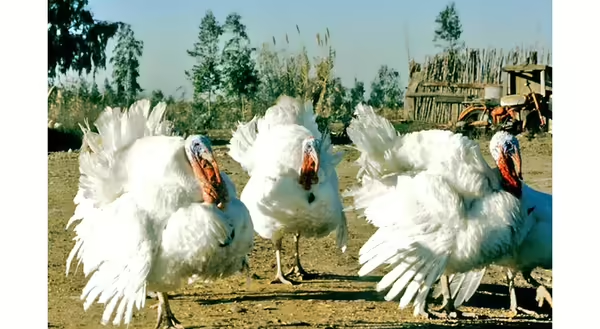
Photo credit: White turkeys by LBM1948, December 1986, Sanlúcar de Barrameda, Cádiz, Andalusia, Spain. Licensed under Creative Commons Attribution-ShareAlike 4.0 International (CC BY-SA 4.0).
ABOUT EXTENSION: Illinois Extension leads public outreach for University of Illinois by translating research into action plans that allow Illinois families, businesses, and community leaders to solve problems, make informed decisions, and adapt to changes and opportunities.
###
University of Illinois | U.S. Department of Agriculture | Local Extension Councils Cooperating
University of Illinois Extension provides equal opportunities in programs and employment.
If you need a reasonable accommodation to participate in this program, please contact us.
Early requests are strongly encouraged to allow sufficient time to meet your access needs.