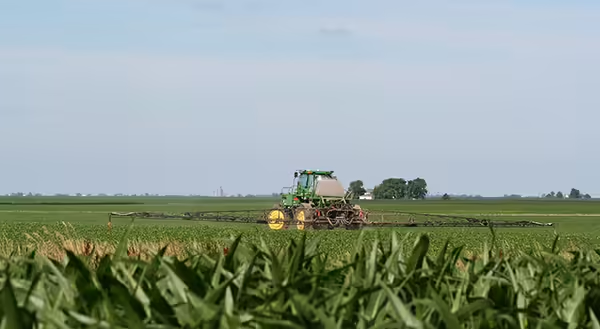
This summer I was invited to participate in creating a video about pesticide use in agriculture as part of the Illinois Farm Families Innovation Grows Here docuseries on pesticides. To prepare for this, I was provided with a host of good questions which I carefully thought about and wrote down my views and responses. To help educate those who perhaps aren’t familiar with pesticide use in agriculture, I share these with you now. The primary goal is to share why and how pesticides are used. While I have worked in Pesticide Safety Education for 27 years and I have personally applied pesticides both on my own property and as part of university research, I certainly do not claim to have all the answers. If you have questions about pesticides being used near you, I encourage you to have a friendly conversation with the grower or applicator. Many are happy to talk with you about their application needs and practices. All you have to do is ask.
Why use pesticides
How would you describe pesticides to a consumer?
They are chemicals that specialize in managing plant or crop pests such as insects, diseases, or weeds. They prevent, destroy, or repel pests. There are different types of pesticides depending on the specific pest. So, insecticides are used for insects. Fungicides are used for fungal problems like mold and rust. Herbicides are used for unwanted plants we call weeds. Antimicrobials and disinfectants are other types, and you might even use these in your home.
What role do pesticides play in today’s farming systems?
They are an important tool used for pest control. They protect crops and yield.
Why are pesticides important when it comes to protecting our food supply?
Without pesticides, the pests would be in charge and that would really limit what and how much we can grow to feed everyone. More land, more tillage, and more physical labor would be needed.
For someone who wonders why farmers can’t just “grow food naturally,” how would you respond?
They totally could, but they need to be realistic about things and expect yield loss due to competing weeds, and dead or injured plants due to insects and disease. So, they would have to plant more of the crop to overcome that. That means more resources are needed including land, time, labor, & fuel. While the repeated use of tillage can be very good at controlling weeds, it can also lead to soil erosion, which should be avoided.
How do pesticides affect food affordability?
All those extra inputs add to the costs it takes to produce a crop. Food demand and prices are increasing. The responsible use of pesticides helps make food affordable.
Can you share examples of everyday situations where pesticides help solve real problems (on farms or even in gardens and homes)?
I have used herbicides to control invading quackgrass in my vegetable garden. I have also used a fungicide on my rose bush to protect it from black spot disease. This year, I used a weed preventer in certain landscape areas. I prefer hand weeding, but my back and knees really don’t. Last year, I treated the stumps of some unwanted woody invasive plants I found growing on my property with a herbicide. For these, you must cut new growth repeatedly if you choose not to use a herbicide, but a herbicide will provide more efficient and effective control. Our local nature preserves and state parks use these tools as well to protect native plants.
How farmers use pesticides responsibly
Describe what responsible use of pesticides looks like.
Using a pesticide only when other pesticide control methods have been tried first. Using it only when needed so the pest must be present or will soon be present. Applying the pesticide at the proper time and rate – when the pest is susceptible and by following all label directions to protect the surrounding areas.
How do farmers decide when pesticides are needed?
Experience and scouting. Many rely on the previous year’s field records to anticipate what will be needed the following year. Pesticides are an added cost, so they don’t take the decision lightly.
Can you explain how precise or small the amounts are when pesticides are used?
Nowadays pesticides can be concentrated and applied in very small amounts. I’ve seen examples where the application rate was 32 oz per acre. That’s the equivalent of 3 cans of pop sprayed over the size of a football field. Spraying that alone would be very difficult to do, so it is mixed with water – maybe 750 gallons for example. So, most of what you see coming from the nozzles is water. Related to this, much of what you see surrounding an application to soil is actually dust that is kicked up from driving through the field. It can be confused for spray drift though.
What would surprise consumers to know about modern pesticides?
The amount of research and time that goes into the development of a single pesticide active ingredient, which is the part of the formulated pesticide that has activity against the pest. Only 1 in 10,000 active ingredients will advance to product registration by USEPA. And it takes 11 years to get there! It’s much like medicine; it takes a very long time once something is discovered to make it to the pharmacy shelves.
How do pesticides help reduce farmers’ environmental footprint?
Herbicides prevent weeds but also allow for the use of cover crops which can crowd out weeds. While tillage can be used for weed control, it can lead to both wind and water erosion. Cover crops, however, help to hold the soil in place. Herbicides are used to terminate the cover crop growth so that the crop can be planted. The remaining plant residue acts as a mulch to cover the soil, prevent new weeds, and conserve water. The organic matter is then returned to the soil.
How do pesticides fit into an integrated pest management (IPM) system?
Pesticides are only one type of pest control method used by those who must protect plants. There are other types of controls used such as tilling, mowing, hand pulling weeds, hand pruning out diseased sections or caterpillar tents from a tree, mulching, or using biological controls which are very specific and limited in use. Pesticides are typically used in combination with these other control methods to achieve the best results. Certainly, pesticides are an important tool in the whole IPM toolbox.
Regulation and oversight
How are pesticides approved to be used in Illinois and at the national level?
State and federal regulatory agencies work together to oversee the development and use of pesticides. They review hundreds of scientific studies for each product and determine which pesticides can be used on what crops. They determine the rates and how they are to be applied. They ensure that the smallest, effective amount is used. The data is available to the public for review. In fact, EPA receives and reviews thousands of public comments each year and incorporates them into their decision-making process.
What should IL consumers know about pesticide regulation?
Before any pesticide can be registered, the law requires USEPA to find that the product, used as labeled, does not pose unreasonable risks to human health or the environment.
What safeguards are in place to protect communities, wildlife, and the environment?
USEPA reviews active ingredients prior to registration and reviews them again every 15 years. There is a comprehensive consideration of toxicity across multiple species and life stages, specific evaluation of children's safety and developmental effects, assessment of any reproductive and chronic health impacts, environmental fate and exposure analysis, and where warranted, Endangered Species Act evaluations with any necessary mitigation.
Licensing (certification) and training
What’s the process for a farmer to get a license to apply pesticides?
To become licensed, a farmer would need at least a 70% passing score on a closed book Private Applicator exam administered by the Illinois Department of Agriculture. This demonstrates to the public that they are knowledgeable on the safe use of pesticides. They would also need proof of insurance and to pay the required license fee.
Does that cover all pesticides or does a farmer need to get licensed for different pesticide categories?
For farmers, this license is required for certain pesticides that are classified as restricted use by USEPA. They can apply these only to the land they own or manage. There are a couple of categories (grain fumigation and aerial) that would require additional safety knowledge and testing.
Are there different licenses for commercial applicators?
Yes, commercial applicators are applying pesticides to land they do not own personally. They all must first pass the General Standards exam to become licensed commercial operators. Then, typically the supervisors must pass additional exams focused on the pest or the areas they intend to apply pesticides in to become applicators. Some of these include: Field Crops, Seed Treatment, Turfgrass, Rights-of-Way, Ornamentals, and Mosquito. There are about 17 categories, however.
How often must the license be renewed?
Every 3 years.
What do applicators have to learn before they’re allowed to use certain products?
For the Private Applicator and the General Standards Exams and trainings, the main components are divided into several main topics including:
- Understanding Pesticides
- Equipment Calibration and Drift Reduction
- Human Pesticide Protection
- Integrated Pest Management
- Pesticides in the Environment
- Labels and Labeling
- Laws
But more specific items include:
- Differences in pesticide formulations
- Types of exposure
- Personal protective equipment and clothing
- Factors that affect off-target movement and how to prevent it
- The importance of reading and following the label
- What can be found on the label and where
These are only a few. I teach classes on this that span 3.5 hours, so a lot of information is covered.
What should Illinois consumers know about licensing?
The exams are challenging. Not everyone passes on their first attempt. But these safeguards are put into place to ensure that applicators know how to use these products as safely as possible to protect themselves, others, our land, our water, and the food we eat.
Food safety and consumer confidence
How do farmers make sure the food we eat is safe after pesticides are used?
Pesticide users are required by law to read and follow label directions. Before a farmer can harvest, they need to look up the pre-harvest interval on the label to see if enough time has passed. This PHI is the minimum time that must pass between application and harvest. All pesticides start to break down as soon as they are applied and exposed to sunlight and microbes in the soil. Pesticide residues need time to break down or degrade to a legal level called a tolerance that is set by the USEPA. All food crop pesticide labels will have these. For example, if you apply an insecticide to the zucchini in your garden, you need to wait a certain number of days before you can harvest that zucchini.
What would you say to consumers who are worried about pesticide residues on food?
We should all be concerned about a safe food supply. Farmers are feeding their families the same food that you and I are eating. By the time food reaches your grocery store, pesticide residues are generally well below the legal limit, or tolerance. However, you can further reduce your exposure to any pesticide residues that may remain on your food just by thoroughly washing produce.
Closing questions
As someone who works closely with pesticides, how do you personally feel about their safety in regard to food?
I think they need to be used wisely and with respect. As long as they are used according to label directions abiding by all restrictions on rates and timings, I’m not worried about my food.
What about their safety for applicators?
The term “safe” is relative. It’s better to reframe it as “risk”. What’s the real risk or chance of developing a health problem when using a pesticide? We like to use this visual: risk = toxicity x exposure.
Risk depends on which pesticide is used, how much is applied, how often it is applied, and who or what has contact with it. Risk can be lowered by reducing either toxicity or exposure. The toxicity of a pesticide product is indicated with a signal word ("Caution"=low, "Warning"=moderate, "Danger"=high) on the product label. Exposure occurs by breathing it in, getting it on the skin, or in the eyes. If you aren’t exposed, it can’t harm you at all. Wearing personal protective equipment reduces exposure.
Where can people learn more about pesticides?
The National Pesticide Information Center is an excellent resource. They have nice fact sheets on their website and toxicologists who respond to questions they receive on all things pesticide related. Learn more at npic.orst.edu.
Acknowledgements
Finally, a big shout out to the Illinois Farm Families Innovation Grows Here public awareness campaign. It was a wonderful experience working with them and without their organized and thought-provoking questions, this article likely wouldn’t have been possible. I’m thankful too for their desire to share truths about pesticide use. With many being far removed from where their food comes from and with the abundance of false information on social media, a more accurate story needs to be told by those who know.
Photo Credit: Michelle Wiesbrook, University of Illinois
ABOUT THE AUTHOR: Michelle Wiesbrook provides subject matter expertise and training in pesticide safety with an emphasis on horticultural weed science. She serves as the Illinois Pesticide Review newsletter editor, collecting and organizing material; and co-coordinates social media information for the PSEP program and ensures its timely publication. Her other interests include herbicide injury and invasive species.