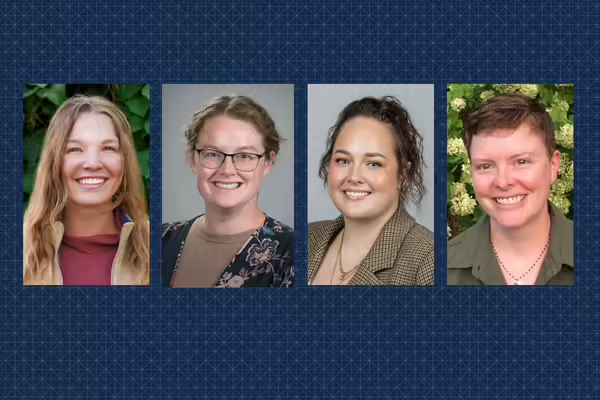
URBANA, Ill. — A handful of University of Illinois Extension staffing changes mean four more educators in the northern part of the state are sharing their energy, environment, and natural resources expertise with local communities. While the geographical areas Extension educators serve are different, their mission is the same: share research-based information to support action that benefits communities today for stronger tomorrows.
Chicago-focused Abbey Matre and Molly Johnson, who serves rural Carroll, Lee, and Whiteside counties, represent increasing statewide growth in Illinois Extension’s Natural Resources, Environment, and Energy program.
This October, the team also welcomed Emily Hansen, previously an Extension agriculture educator, who will provide natural resources programs in Bureau, LaSalle, Marshall, and Putnam counties. Plus, Jamie Viebach will continue to serve in DuPage, Kane, and Kendall counties, shifting from agriculture and agribusiness in November.
“We are adding skilled and collaborative Extension educators to meet growing needs in energy and the environment,” said Shibu Kar, Illinois Extension assistant dean of natural resources, environment, and energy. “They immerse themselves in the communities they serve to ensure their areas of expertise complement their local partners’ contributions so everyone can make positive change together.”
Urban, rural, or anywhere in between, Illinois Extension educators serve their communities through outreach that matters.
Urban environmental outreach
Matre leads the Cook County Master Naturalists training program, connecting participants with local experts, conservation groups, and volunteer opportunities. Her work focuses on fostering community engagement in restoration and sustainability in both urban and natural areas.
“I’m excited to help people discover that you don’t have to travel far to connect with nature,” Matre said. “Cook County is one of the most urbanized places in the country, yet it’s home to an incredible network of forest preserves, parks, rivers, wetlands, and Lake Michigan. These places support wildlife, improve our quality of life, and provide opportunities to explore the outdoors right in our own communities.”
Matre creates programs that help people explore the natural world around them while giving them practical, research-based information to use in their own homes, neighborhoods, and communities.
“One area I’m especially excited about is water conservation,” she said. “I’m creating educational programs that help Cook County residents save water at home while learning more about the Great Lakes and the role they play in supplying our drinking water.”
Watersheds, fossils, and agriculture
In contrast to Matre’s focus on the Windy City, the area Johnson serves is less densely populated. The University of Illinois Urbana-Champaign research that backs her work helps her stay current on local, regional, and state needs — and fuels how she shapes educational programming.
“The Lower Rock River Watershed has been identified as a priority by Extension’s Illinois Nutrient Loss Reduction Strategy,” Johnson said. “We can implement programming to protect the areas around our rivers that are so important for water quality and wildlife.”
Johnson’s work also helps foster the growth of the local Master Gardener and Master Naturalist programs. She connects with members of the community, supports Illinois Extension volunteers, and gets youth and adults outside in nature.
“I want to grow watershed stewardship and pollinator education in local schools in collaboration with our unit’s 4-H youth educators,” she said. “We offered Junior Master Naturalist Camps this summer, and the participants really enjoyed them. Next year I hope to host one camp in each county.”
From Cook County’s forest preserves to the Lower Rock River Watershed, the Illinois Extension mission means always assessing needs and finding ways to meet them through impactful outreach. That’s just fine with Johnson.
“I expect this programming will shift and evolve as time goes on and I learn more about local needs and interests,” she said.
Emily Hansen is eager to share her passion for nature and the environment with people of all ages.
“I enjoy helping people discover the wildlife, plants, and natural areas that make our region unique,” Hansen said. “I’m especially excited about a program that explores Mazon Creek fossils, which have generated a lot of interest. People are always amazed to learn that world-famous fossils can be found so close to home.”
Like so many in Extension, Hansen recognizes how areas’ varying priorities meld.
“In north-central Illinois, agriculture and natural resources are closely connected, so I enjoy helping people explore topics that sit at that intersection, including soil health, water quality, habitat conservation, and sustainable land management,” Hansen said. “By bringing together agricultural and ecological perspectives, I hope to help communities find solutions that support both productive landscapes and healthy natural systems.”
Focusing on local species
Each educator brings experience and passion to their community.
“From early in my career working as an environmental educator to my current obsession with native plants, local flora and fauna have always fascinated me,” Jamie Viebach said. “I’m also excited that I can expand into non-plant-related sustainability fields like recycling and water conservation.”
On her to-do list? Offering the new Climate Stewards program locally and educating homeowners about replacing invasive species in their yards with native plant options.
“I really want to lean into native plants, supporting both our local land and the people who work it,” Viebach said, adding greater collaboration with local Master Naturalists to her goals. “I want to strengthen our partnerships with other organizations with similar missions to find ways to support each other’s work.”
Extension’s natural resources, environment, and energy program provides research-based education for awareness and action to sustain healthy environments and ecosystems that support quality living and resilient communities. Extension staff empower people across Illinois to make a difference through the Master Naturalist, Climate Stewards, and Watershed Steward volunteer and training programs.
University of Illinois Extension develops educational programs, extends knowledge, and builds partnerships to support people, communities, and their environments as part of the state's land-grant institution. Extension serves as the leading public outreach effort for University of Illinois Urbana-Champaign and the College of Agricultural, Consumer and Environmental Sciences in all 102 Illinois counties through a network of 27 multi-county units and over 500 staff statewide. Extension’s mission is responsive to eight strategic priorities — community, economy, environment, food and agriculture, health, partnerships, technology and discovery, and workforce excellence — that are served through five program areas — 4-H youth development, agriculture and agribusiness, community and economic development, health and community wellness, and natural resources, environment, and energy.