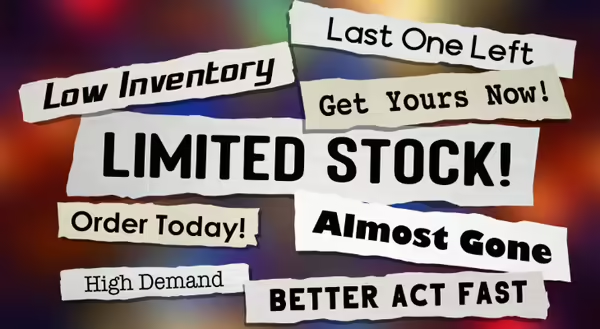
Lately, it can feel impossible to escape marketing messages that pressure consumers to make quick purchasing decisions. Everything seems to be "low in stock," "hard to find," or available for a "limited time only." Businesses often use scarcity tactics to increase a product's perceived value and encourage consumers to act quickly (Barton et al., 2022). Unfortunately, this sense of urgency can lead to impulse purchases that may later result in post-purchase regret (Ongyono et al., 2024).
Recognizing these marketing strategies can help you pause and realize that you often have more time to make a purchase decision than it may seem in the moment. Taking time to make thoughtful, intentional spending decisions can help you avoid purchases that fall outside your spending plan.
Creating a spending plan is an important financial habit, but sticking to it can be challenging, especially when high-pressure marketing makes you feel as though you might miss out on a great opportunity. By taking a moment to evaluate a potential purchase, you may discover that the urgency you feel is driven more by marketing than by an actual need. Before making a purchase, consider asking yourself the following questions:
- Is this purchase included in my spending plan?
- Am I buying because of a limited-time offer or because I truly need the item?
- What purpose will this purchase serve?
- Can I find a similar item for less money?
- Would I rather have this item or keep the money for something more important to me?
- Can I comfortably afford this purchase without taking on debt or sacrificing necessities?
- Does this purchase align with my values and long-term goals?
- Do I need this item right now, or can I revisit the decision later?
Children can be especially vulnerable to scarcity-based marketing. Many toys and collectibles are promoted as rare or difficult to find, encouraging consumers to purchase multiple versions in hopes of obtaining a specific item. While the excitement of opening a rare item may be enjoyable, that feeling can be short-lived and quickly replaced by the desire to buy more. What begins as an inexpensive purchase can soon become a costly habit.
Blind-box collectibles are one example of a marketing strategy that relies on uncertainty and anticipation to encourage repeated purchases. As adults, it may be easier to recognize how these tactics influence children. Modeling thoughtful spending habits and discussing advertising strategies can help young people understand that impulse purchases are not always worth the cost.
Understanding scarcity tactics can help you avoid unnecessary impulse purchases and stay focused on your financial goals. Create a spending plan and make a commitment to follow it, even when faced with high-pressure sales tactics. Don't let perceived urgency distract you from what matters most. Instead, take a step back, evaluate your options, and make purchasing decisions that support your long-term financial well-being.
References
Barton, B., Zlatevska, N., & Oppewal, H. (2022). Scarcity tactics in marketing: A meta-analysis of product scarcity effects on consumer purchase intentions. Journal of Retailing, 98(4), 741-758. https://doi.org/10.1016/j.jretai.2022.06.003
Ongyono, D. V., Sasongko, A. F., Widana, A. T., & Gunadi, W. (2024). The effect of flash sale on impulse buying of fashion goods which results in post-purchase regret. In Proceedings of the 6th International Conference on Informatics, Multimedia, Cyber and Information System (ICIMCIS 2024) (pp. 917-922). IEEE. https://doi.org/10.1109/ICIMCIS63449.2024.10956614
Title
Meet the Author
Jamie Mahlandt is a Financial Educator for Bond, Clinton, Jefferson, Marion, and Washington counties in Southern Illinois. She provides financial education to the local community with an emphasis on financial literacy and financial well-being.
Title
Subscribe
Subscribe to receive monthly blog updates.