
Empowering Better Communities
Find the keys to building healthy, prosperous communities.
Community and Economic Development programming helps community leaders, residents, and businesses build capacity for renewal and growth. The challenges facing communities are many. Illinois Extension works with you as you build effective teams to face the challenges and work more effectively and efficiently for your community.
Illinois State Census Data Center
University of Illinois Extension’s Community and Economic Development (CED) program plays a leading role in advancing data‑driven decision‑making across the state through its stewardship of the Illinois State Census Data Center (ISCDC). As part of the U.S. Census Bureau’s long‑standing State Data Center (SDC) Program, the ISCDC ensures that high‑quality federal data is translated into accessible, locally relevant information for Illinois communities. By connecting state and local partners with understandable, accurate, and timely demographic data, the CED program strengthens the two‑way communication channel between Illinois and the Census Bureau.
Under the leadership of CED Specialist Zach Kennedy, the ISCDC provides demographic analysis, technical assistance, and customized data tools that support business planning, community development, funding strategies, and policy decisions. The program transforms national Census data into practical resources—including county profiles, interactive maps, datasets, and tutorials — tailored specifically to the needs of Illinois residents, agencies, and organizations.
In addition to providing data, through the ISCDC, the CED program also uses its applied research expertise to solve complex data challenges. For instance, ISCDC staff identified populations within custom geographies located inside a 30‑mile radius of decommissioned coal plants in support of the Illinois Department of Commerce and Economic Opportunity’s (DCEO) Illinois Energy Transition Community Grant. Using GIS analysis, the team calculated eligible populations for 125 applicant jurisdictions, enabling DCEO to determine grant eligibility with precision. Similarly, when the USDA ERS food desert map became inaccessible during a federal government shutdown, the CED program and ISCDC partnered with DCEO and the Illinois Emergency Management Agency to recreate the map for Illinois. This ensured that programs such as the Illinois Grocery Initiative Grants could proceed without interruption.
Supporting the Delta Regional Authority’s Propel program
In 2025, University of Illinois Extension actively supported the Delta Regional Authority’s (DRA) Propel Program by providing structured programming and direct technical assistance for three communities within the DRA service area — Eldorado, Mounds, and Murphysboro. Among other efforts, Susan Odum, an Extension specialist serving Southern Illinois, supported leaders in participating communities by helping them pursue external grant funding. Extension's Community and Economic Development team also organized programming for regional stakeholders, in addition to the direct technical assistance.
Ferrell Hospital Infrastructure Support
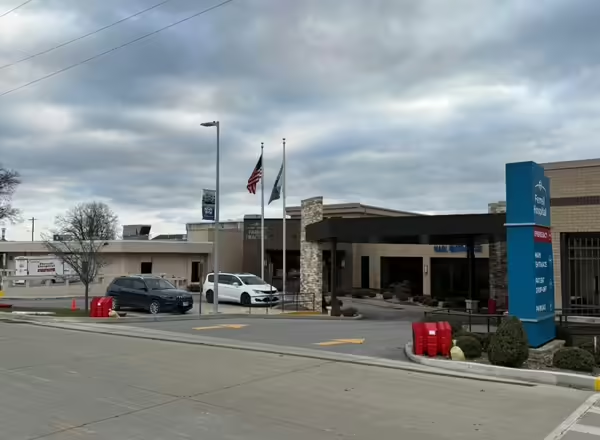
Susan Odum worked with the City of Eldorado to prepare grant applications that addressed critical infrastructure needs. As a result of this assistance, the City of Eldorado was awarded $795,290 in 2025 from the Delta Regional Authority for a flood control infrastructure project. Specifically, this funding allowed the city to repair and upgrade the flood infrastructure around Ferrell Hospital which is the city’s critical access hospital. In 2024, severe flooding forced the hospital to close for several months. Odum provided additional technical assistance that helped the City of Eldorado put together a successful Delta Catalyst Fund application, resulting in a $75,000 grant to purchase equipment for the sewer department.
Local Government Data Training
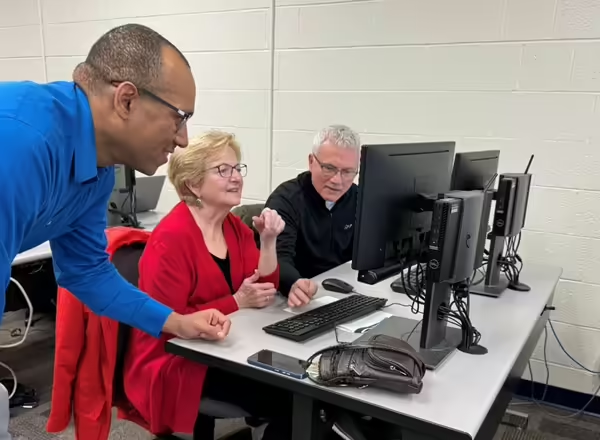
Illinois Extension's community and economic development team organized and delivered a Data Training for Local Government workshop at Southeastern Illinois College in Harrisburg, Illinois. Delivered by Mark White and Zach Kennedy, this day-long, hands-on workshop brought together leaders from the public, private, and nonprofit sectors to build practical skills in locating, interpreting, and applying public data. Participants worked with demographic, workforce, education, housing, and quality-of-life data to support data-driven decision-making, strengthen grant proposals, and respond to information requests. Additional programming related to grant writing, housing, and rural tourism is planned for 2026.
Illinois Grocers Summit
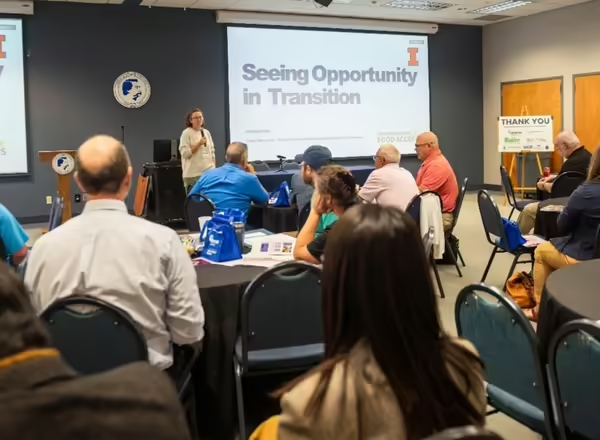
The Community and Economic Development (CED) team advanced its work in strengthening rural food access through the launch of the Southern Illinois Food Access Independent Grocer Summit, held at John A. Logan College. The inaugural gathering brought together independent grocery store owners, managers, and food system partners from across the lower 22 counties of Illinois. Thirty participants attended, including representatives from nine grocery stores and a range of sponsors, speakers, and exhibitors. The Summit was designed to connect rural grocers with practical resources and peer expertise to help them remain competitive in a challenging retail environment.
Throughout the half‑day program, presenters shared information on grant and loan opportunities, digital marketing and emerging AI tools, energy‑efficiency strategies, business transition planning, and new refrigerant regulations. Sessions also highlighted opportunities for collaboration with local farmers and featured a panel discussion on adaptability and resiliency led by three long‑standing store owners with more than a century of combined experience. Participant feedback reflected strong satisfaction with the event and interest in continued collaboration on topics such as energy efficiency, local food sourcing, and workforce development, including meat‑cutter recruitment and training.
The Summit was part of the broader Southern Illinois Food Access initiative, a program led by CED Educator John Shadowens, that addresses food insecurity and prevents the spread of rural food deserts. Based out of Unit 27, the Illinois Extension team works closely with more than 40 independent grocery stores and over a dozen food system partners to strengthen retail food access and ensure that healthy, nutrient‑dense foods remain available in areas at risk of losing their local grocers.
Interim Asistant Dean and Program Leader

Mark White
Community and Economic Development Team

Valerie Belusko

Michael Delany
Katherine Dudley

Rainah Folk

Dustin Fritsche

Zachary Kennedy

Michelle Kim


Russell Medley

Susan Odum
Nancy Ouedraogo

Laura Payne

Richard Proffer