Most cattlemen know that minerals are important and feed them in some way to their cattle herd. Minerals play critical roles in immune function, the reproductive system, and growth and development. While we talk a lot about mineral needs, the method of delivery is vital to a successful mineral supplementation program.
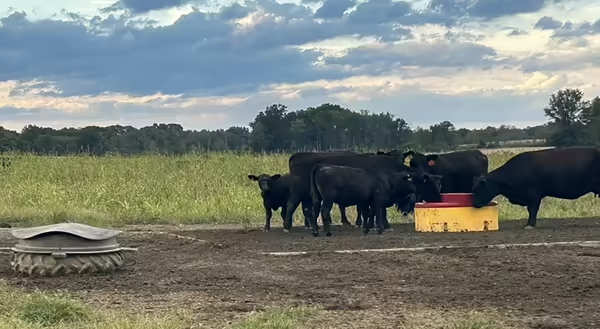
Free-choice mineral: With this method, minerals are offered free choice in a feeder where cattle consume minerals as needed. This is the most common method of mineral supplementation and is very familiar to producers. It provides continuous access to cattle, allowing it to work well in grazing systems. It is important to keep in mind that intake can vary among animals, with some consuming too much and some consuming too little. It’s always important to monitor consumption.
Mineral block is just that: minerals, or salt and minerals, compressed into a block. It’s convenient, weather-resistant, and easy to place in a pasture. Consumption will be slower than loose minerals and intake can be inconsistent even for the individual.
Mineral premix for a Total Mixed Ration (TMR). If you feed a TMR, it is likely that you are already mixing minerals directly into your ration. This allows you to more accurately control intake and deliver minerals to the bite. This method does require you to utilize a TMR feeding system. This is less common in small herds and less practical for grazing herds on summer pasture
Top-dress mineral supplements can also be included in or applied to the top of daily rations. With this incorporation, intake consistency better, and it fits well into diets that are being delivered daily. At the same time, this method is dependent on regular supplementation. If daily feeding is not occurring, this method is not effective.
Liquid minerals are another way to deliver minerals free choice. Feeder designs and handling liquid can pose challenges. Minerals are often paired with protein and energy supplementation in a free choice form that is very palatable. Again, it’s important to consider how much intake could fluctuate, and consumption should be closely monitored so you can best adjust to your cattle herd.
Injectable trace minerals can be delivered via needle and syringe. This delivers a known amount to each animal, making it useful before breeding, weaning, transportation, or other periods of high stress. Any variation from voluntary intake or concerns of bioavailability can be bypassed, because the trace minerals are injected directly into your cattle. However, this method does require more labor and cattle handling. An injectable trace mineral is not a complete mineral program and can add additional costs.
In summary, no mineral delivery method is universally the best option. The best method varies by the operation and should be determined by looking at a variety of factors including cost, labor, equipment, and needs to achieve a balanced ration.
Olivia Shike is a student who works in beef production, research, and producer outreach as a University of Illinois Extension intern in the I-BELIEF program through the Department of Animal Sciences in the College of Agricultural, Consumer and Environmental Sciences. This article has been reviewed by Extension Beef Cattle Specialist, Travis Meteer.