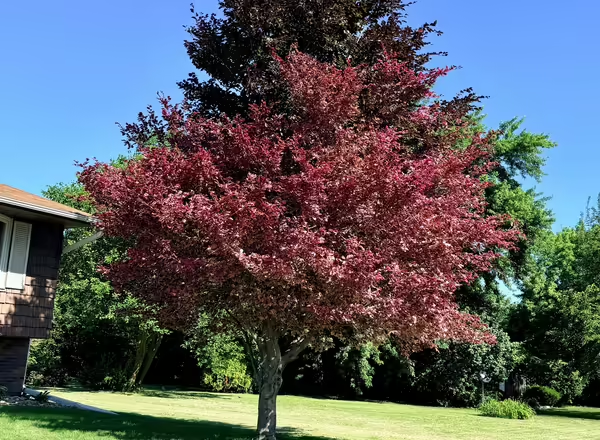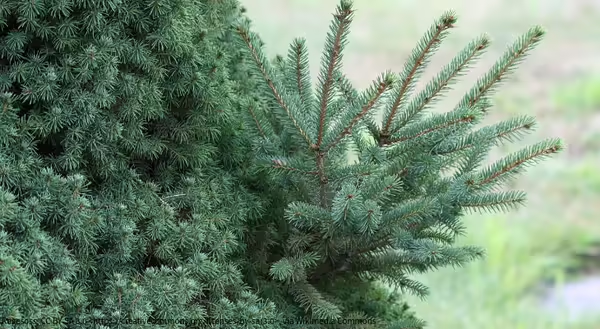
Plant breeding and selection programs have provided homeowners and landscape managers with a huge variety of plant options. Many familiar woody plant species are now available in unique sizes, unusual shapes, or produce leaves in nontraditional colors. Many of these selections are derived from a cutting, also known as a ‘sport’, taken from a natural mutation. While these variations can offer exciting options in the nursery, they are not risk-free. From time to time, these mutations are not maintained, resulting in a phenomenon called reversion.
Yeah, sports!
Before diving into the phenomenon of reversion, let’s consider the source of these cuttings…the sports. A sport is a genetic mutation localized on a plant part, often a branch or new shoot, that appears different than the parent plant. If the mutation is desirable, the mutation may be propagated by taking a cutting or using grafting methods to create a new cultivar.
Because the source of the modification was a genetic mutation rather than intentional breeding, the genetics may be unstable and eventually revert to exhibiting the original plant characteristics.
A reversion explainer
A plant is said to have ‘reverted’ when a cultivar known for a particular characteristic abandons that unique change and returns to a more traditional growth.
Examples of woody varieties reverting to more traditional form would be a dwarf Alberta spruce abandoning its slow growth and compact form for the faster-growing, larger form of white spruce (Picea glauca). Or a variegated European beech developing branches that produce solid-colored leaves.
Reversion can happen at any time—early in production or years after planting in the landscape—and it may affect just a branch or, in some cases, larger portions of the plant.
Causes of reversion in plants is most often related to the plant's genetic mutation that caused the unique qualities to return to the more stable, traditional form. Essentially, the cells that were causing the mutation do not replicate faster than the ‘normal’ cells and are replaced.
Plant stressors can inspire reversion. Environmental factors such as inadequate light, poor soil conditions, and inconsistent moisture availability can create a stressful environment that impacts plant growth. Incorrect planting or pruning methods are also plant stressors that affect growth. Improper care, such as over-fertilizing, can promote vigorous growth that overtakes mutations.
How to manage plants that show reversion
Although typically harmless to the plant, reversion can alter the aesthetic appeal and desirability of a plant. Additionally, the plant part that reverts is typically more vigorous than the rest of the plant. If left untreated, the plant part that is reverting may eventually take over the entire plant.
If a shoot emerges that demonstrates a reversion, prune the entire segment of the plant back to the plant part that displays the desired characteristics. If reversion is related to plant stress, take actions to alleviate those stressors.
Sports provide many of the distinctive woody plants we enjoy in our landscape. Understanding how they are obtained, the challenges that may accompany those desirable characteristics, and what to do if reversion occurs is one more example of how we prepare to better manage our ornamental landscapes.
Good Growing Fact of the Week: This article focused on woody plant mutations and reversions, but herbaceous perennials experience the same genetic phenomenon. Causes and management techniques are very similar to those outlined above.
Thank You for Reading!
Sign up for our emails! Want to get notified when new Good Growing posts are available? SIGN ME UP
Give us feedback! How helpful was this information (click one): Very helpful | Somewhat helpful | Not very helpful
Meet the Author
Emily Swihart is a horticulture educator with University of Illinois Extension, serving Henry, Mercer, Rock Island, and Stark counties since 2021. Emily provides horticulture programming with an emphasis on the home gardener, the urban forest, native plant ecosystems, and landscape design. Additional responsibilities include supporting local county Master Gardener and Master Naturalist volunteers - providing training, continuing education, advanced training, and their involvement in seasonal events and community outreach programs.