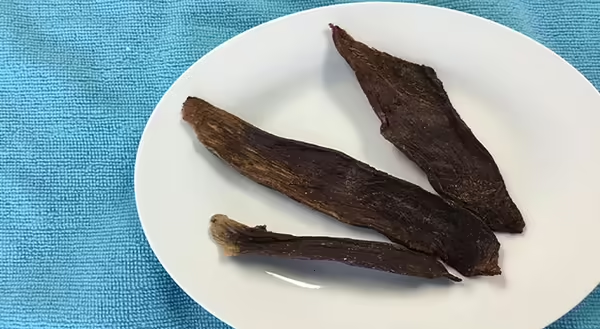
From hunters and campers trying to pack light to desk workers looking for a snack, jerky and other "shapes" of meat sticks and bar are tasty examples of using dehydration to preserve food for longer storage. By taking out water, it is harder for bacteria and other microbes that cause foodborne illness to grow and for the meat to spoil. Take a moment to consider these factors, whether you want to purchase jerky or make it at home.
Nutrition
The nutrition of jerky will vary based on the type of protein and added flavorings. For nutrition information on purchased jerky, read the food label.
In general, meat jerky contains nutrients found in meat, such as protein, fat (depending on the cut of meat used), and vitamins and minerals like vitamin B-12, folate, iron, and magnesium. While meat on its own does not contain carbohydrates, some brands may mix in sugar, fruits, or vegetables, which adds in carbohydrates and possibly fiber to the jerky.
Sodium. Salt (which contains sodium) is often added to jerky for flavor, and sodium-based preservatives like sodium nitrite are added to support food safety, since jerky is sold as a shelf-stable product without refrigeration. If you are limiting sodium to support heart health or other reasons, plan to eat lower sodium foods throughout the rest of your day to balance the higher sodium intake from jerky. Or look for reduced-sodium brands of jerky.
Shop
- Meat Jerky. Jerky comes in a variety of flavors and styles. Besides choosing one that sounds good, choose a package before the “best by” date. While dried foods like jerky are shelf stable, fats go rancid over time and create "off" flavors.
- Plant-Based Jerky. Often made from mushrooms or beans like soy, these dried meat-like strips are a fun way to eat more plants. Like meat jerky, review the food label for the amount of sodium, which may also be high.
- Shapes and Sizes. Choose the form that you prefer, from clastic meat strips and sticks to bites and bars. Strips will be chewy, most sticks and bites are wrapped in a casing, and bars are usually ground meat pressed into a rectangular shape.
Price
- Jerky prices vary between brands, but choose what fits in your budget. Compare unit price between brands to find the best deal.
Store
- Under Refrigeration. Although jerky is dried and preserved - and sold at room temperature - it is perishable once the package is open. For bags of loose strips of jerky, read the package to know how long the open bag can be at room temperature before needing to be refrigerated.
- On the Go. Single-serve sticks (full or mini sizes) and bars (ground meat formed into a rectangle) that are sold individually wrapped make an excellent on-the-go snack without refrigeration. If you don't finish the entire thing, move any extra you want to eat later to a refrigerator.
- Homemade. When properly dried, jerky will keep at room temperature for up to two weeks in a sealed container, according to the National Center for Home Food Preservation. The jerky can also be refrigerated or frozen for longer storage.
Prepare
Basic steps of making jerky include:
- Preparing the meat. This includes removing connective tissue and visible fat, cutting meat into strips, and adding flavorings.
- Drying the meat. Use an electric dehydrator at 140ºF and dry meat until it cracks but does not break.
- Store the jerky. Let jerky cool, pack into food-safe plastic bags or glass containers, and label.
- Add food safety steps, such as:
- Freeze pork or wild game for 1 month to kill trichinella parasite and eggs that may be found in the muscle.
- Kill E. coli, salmonella, or other microbes that cause foodborne illnesses by either: a) precooking meat strips to 160ºF before drying or b) bake dried strips in a single layer until they reach 160ºF. (For strips that were 1/4-inch thick or less before drying, bake for 10 minutes in a preheated oven set to 275ºF. Thicker strips will need to heat longer to reach 160ºF.)
For more specific steps and recipes for jerky, visit National Center for Home Food Preservation.
Eat
Pairing foods to make a mix of carbohydrates (and fiber), fat, and protein provides a snack that can feel both satisfying and provide hours-long energy until your next meal. Jerky serves as the protein in this example. Fruits, vegetables and grains provide carbs and fiber. Nuts and seeds, avocado, and cheese can provide fats. Which of these combos with jerky sound best to you?
- Snack board: jerky, walnuts, cheese cubes, apple slices, and whole-grain crackers
- On-the-go: meat stick and a fig bar
- Trail mix: jerky, pumpkin seeds, dried cranberries, and pretzels or dry cereal
- Veggie forward: mushroom jerky, carrot sticks, and hummus
- Soup snack: homemade or microwave soup topped with chopped jerky (like bacon bits)
Resources:
- National Center for Home Food Preservation, Drying - Jerky
- North Dakota State University, Jerky Making: Producing a Traditional Food With Modern Processes, 2022
- U.S. Department of Agriculture, FoodData Central
- U.S. Department of Agriculture, FSIS Compliance Guideline for Meat and Poultry Jerky Produced by Small and Very Small Establishments, 2014
- U.S. Department of Agriculture, Jerky and Food Safety | Food Safety and Inspection Service, 2016
- University of Alaska, Institute of Agriculture, Natural Resources and Extension, Making Jerky, 2021
Post originally published in 2019; content updated in 2026.
About the Author: Caitlin Mellendorf is an Illinois Extension Food and Nutrition Educator serving DeWitt, Macon and Piatt Counties in Central Illinois. She is a Registered Dietitian and her work focuses on helping community members gain the knowledge, skills and tools to live healthier, more nutritious lifestyles. This includes providing programs and answering questions about heart health, diabetes, food safety, food preservation, grocery shopping and cooking. You can reach Caitlin by email at chuth2@illinois.edu or call 217.877.6042.